318 Prompts for Children's Hidden Object Coloring Books: What 3 Years of Failure Taught Me About AI Publishing
I wasted 3 years failing at hidden object books. These 318 prompts finally worked. Generate publishable pages in 15 seconds. No art skills needed. $17.
For 3 years, I bought children’s activity books, studied the illustration credits, and told myself the same lie.
“I could probably figure out how to make these myself.”
I could not.
Every few months, I would open Canva. Watch a handful of YouTube tutorials about Amazon KDP. Spend 4 hours trying to draw 1 single hidden object scene. Get frustrated. Close my laptop. And quietly go back to buying other people’s books.
The cycle was predictable. The time I wasted added up to weeks of my life I will never get back.
Then I saw this product launch a few days ago. 318 Prompts for Children’s Hidden Object Coloring Books.
I hesitated. I am naturally skeptical of anything that promises to solve a problem I have personally failed at multiple times. But something about how this was framed made me pause.
It did not promise I would become an artist. It did not promise passive income while I slept. It simply offered a system for generating something that publishers have been selling successfully for nearly 80 years.
That is a completely different conversation.
So I bought it. I tested it. And here is exactly what I learned.
Why Most People Never Buy Tools Like This
Let me address what you are thinking right now.
“Another prompt pack? I can just ask ChatGPT to draw a hidden object coloring page myself for free.”
You are not wrong. You can. I did. Many times.
Here is what happens when you do that for free.
The AI gives you something that looks vaguely like a hidden object page. The objects are floating in empty space. The title is missing or unreadable. The checklist is nowhere to be found. The line art has weird shading that makes it unusable for coloring books. And the hidden objects are so obvious a 3-year-old finds them in 5 seconds.
You spend 45 minutes giving feedback. Regenerating. Tweaking prompts. Fixing one problem while creating 3 new ones.
By the end, you have something that is still not publishable. And you have lost the will to continue.
That is the hidden cost of “free.” It is not the money. It is the time. The frustration. The slow erosion of confidence that maybe this whole publishing thing is not for you.
The reason I decided to try this product was simple. The creator clearly understood the specific mechanical problems with AI-generated hidden object pages. The prompts were not generic. They were engineered around something called the Camouflage Code.
That level of specificity told me someone had actually tested this. Repeatedly.
So I bought it.
See what the prompts actually generate here.
What You Actually Get
Let me break this down in practical terms, not marketing language.
The product contains 318 prompts across 53 categories. Each category is a specific scene type that parents and teachers actually search for.
Pirate islands. Dinosaur parks. Christmas morning. The first day of school. The zoo. The aquarium. A fire station. A snow day. Halloween night. A construction site. A medieval castle. An Arctic expedition. A wizard school classroom. A busy amusement park. Treasure island. An underwater world. A family farm. A jungle safari.
These are not random. These are the scenes that have been selling consistently for 8 decades because children never stop being interested in them.
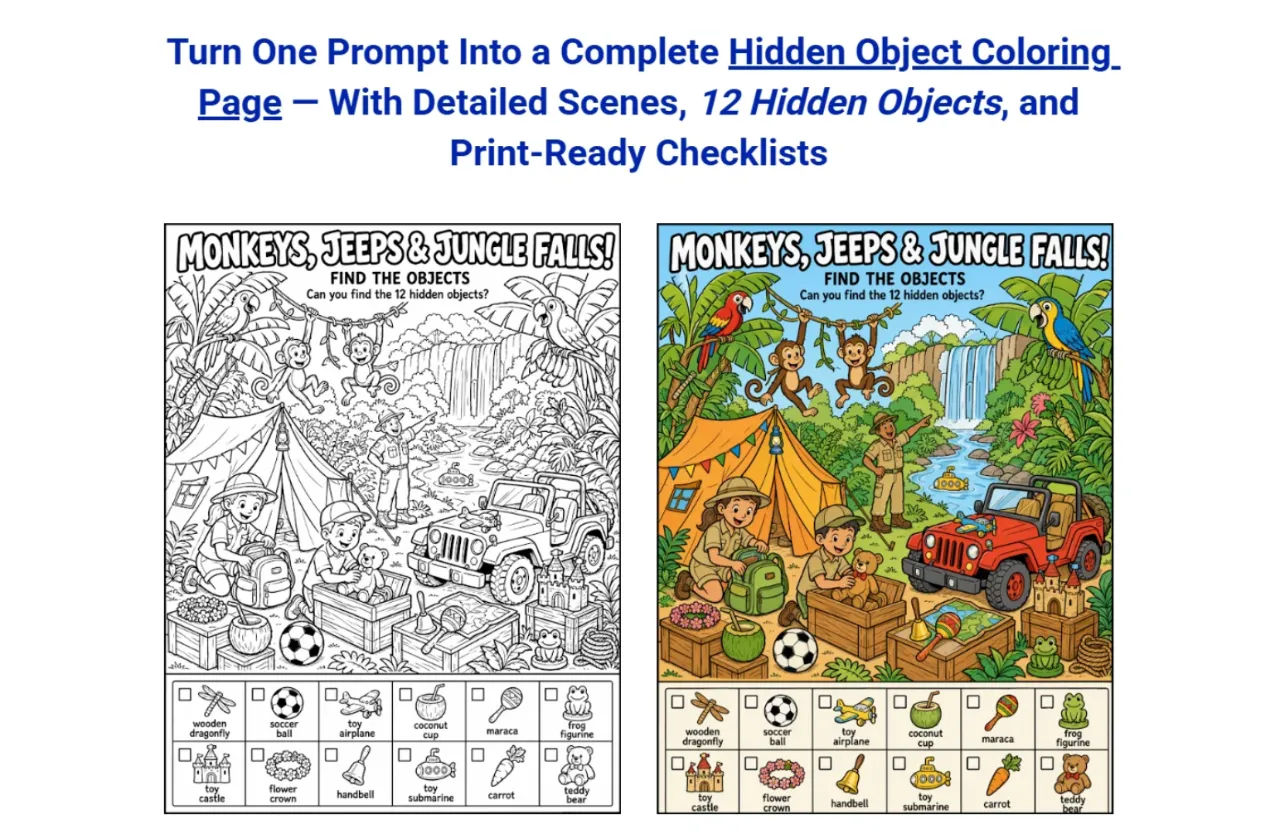
Each prompt is a complete package. You paste it into ChatGPT with GPT Image 2.0. It generates:
A decorative title in playful hand-lettered style
A detailed scene with multiple characters and layered background
Exactly 12 hidden objects camouflaged into the illustration
A numbered checklist from 1 to 12 with tiny line-art thumbnails and check-boxes
Pure black-and-white line art with solid outlines and zero shading
The typography comes out crisp. The checklist is readable. The hidden objects are genuinely hidden in ways that make sense within the scene.
I tested the first prompt on a Saturday morning. The Amusement Park prompt. It generated a complete page in about 15 seconds.
The title read “A Day at the Fair” in a bouncy hand-drawn style. The checklist ran down the right side with small thumbnail drawings. The hidden objects were woven into the scene naturally.
A pair of glasses resting on a carousel horse. A key tucked under a bench. A seashell sitting inside a popcorn bag.
It looked like something you would buy in a bookstore.
That was when I stopped being skeptical and started being curious about what else these prompts could do.
The Multiplier Effect That Changed My Mind
Here is where this product surprised me.
Every copy comes with 3 bonus prompts. At first I thought these were just extra prompts for different scenes. They are not.
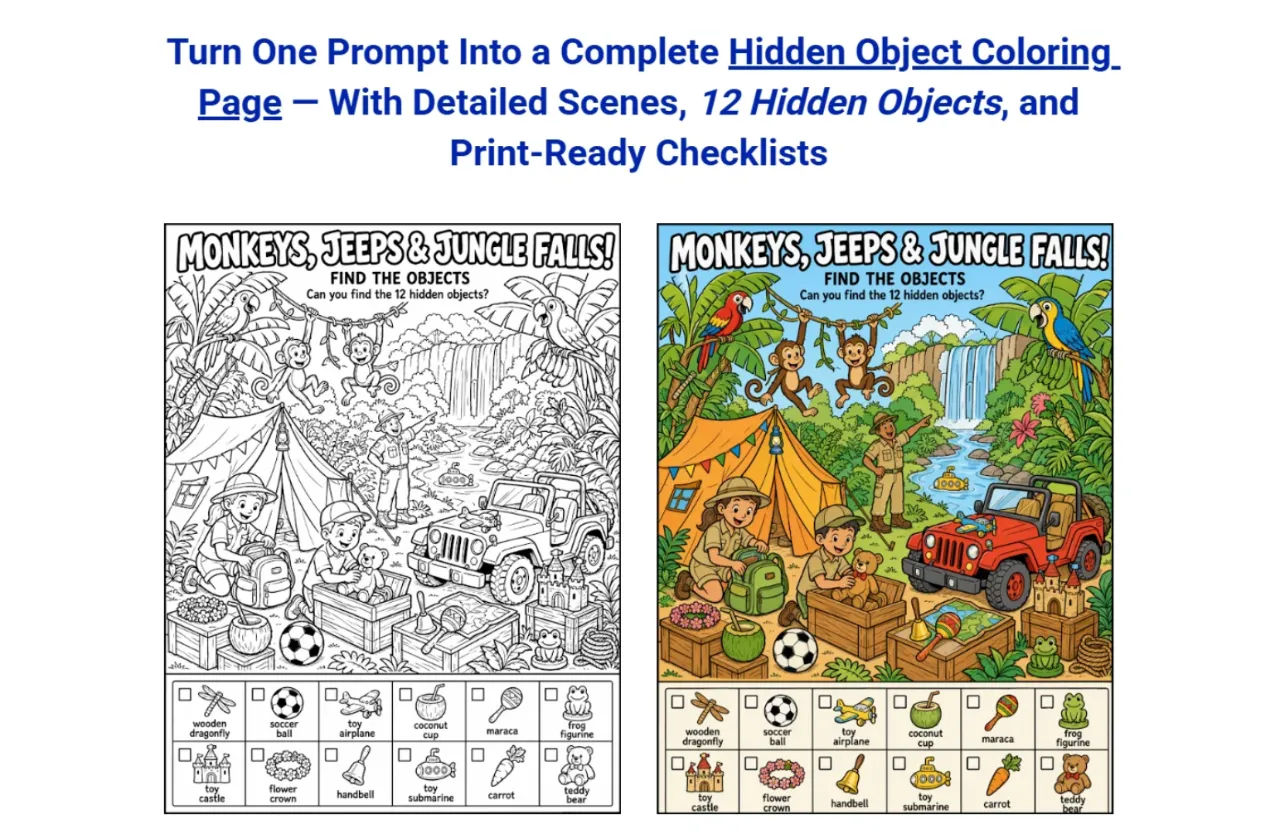
Bonus Prompt 1 creates a full-color edition of the exact same page. Same composition. Same hidden objects. Same checklist. But rendered in warm, flat colors while preserving the black line-art outlines. This becomes a completely different product for a different market.
Bonus Prompt 2 creates an early learner edition for ages 3 to 6. Fewer characters. Larger objects. Thicker outlines. Only 6 hidden objects instead of 12. A simplified checklist with oversized thumbnails. This opens the preschool activity book category.
Bonus Prompt 3 creates a classroom-ready worksheet. Same scene reformatted with Name, Date, and Class headers. An instruction line. A teacher’s tip box. This opens Teachers Pay Teachers and the homeschool market.
One prompt gives you 5 finished pages. 5 distinct products. 5 different buyer profiles.
This changed the math for me completely.
I was not buying 318 prompts. I was buying the ability to generate over 1,500 publishable pages from a single prompt library.
If you want to see the output quality before deciding, check the samples here.
The Daily Experience
Let me describe what it actually feels like to use this product.


Onboarding took about 10 minutes. The prompts come in a simple document. You copy one. You paste it into ChatGPT. You wait 15 seconds. You have a page.
Learning curve is almost none. If you have ever used ChatGPT, you already know how to use this.
What surprised me (good): The consistency. Every prompt I tested produced usable output on the first try. No weird artifacts. No distorted hands. No broken typography. The style lock works.
What surprised me (good): The density of the scenes. These are not simple drawings. Each page has multiple characters, layered backgrounds, and enough visual complexity to keep a child engaged for 20 minutes. That is not easy to generate.
What surprised me (bad): Nothing major. But a few limitations became apparent quickly.
Limitation 1: The prompts only work with ChatGPT using GPT Image 2.0. If you try to use them with other image generators like Midjourney or DALL-E, the results will not be the same. The typography rendering specifically depends on that model.
Limitation 2: While the prompts produce complete pages, you still need to assemble them into a book. That means using Canva, Affinity Publisher, InDesign, or even Word to compile pages and design a cover. The prompts do not do that part for you.
For someone who has never made a book before, that assembly step might feel like work. It is not hard work. But it is work.
Compared to alternatives: This product removes the 2 biggest bottlenecks I have experienced. The skill bottleneck and the time bottleneck. I no longer need to know how to draw. I no longer need to spend hours on 1 single page.
What I need to do is select prompts, generate pages, and arrange them. That is a radically different workload.
Pros and Cons
PROS
Prompts produce genuinely publishable pages on the first try. No editing required.
The Camouflage Code works. Objects are integrated into scenes naturally, not floating on empty backgrounds.
Typography renders cleanly and consistently. The checklists are readable and properly formatted.
53 categories cover the highest-demand scenes parents and teachers search for daily.
3 bonus prompts effectively multiply your output by 5 times.
No art skills required. No illustration software required. No outsourcing required.
The output style matches what has been selling commercially for 80 years.
Each prompt generates title, scene, 12 hidden objects, and numbered checklist in 1 go.
CONS
Only works with ChatGPT using GPT Image 2.0. Other generators produce inconsistent results.
You still need basic book assembly skills or a willingness to learn them.
The prompts produce individual pages. A full book requires multiple prompts and some layout work.
The product is brand new. Launched only a few days ago. Limited long-term user data.
If you expect 1 prompt to generate an entire book, that is not how this works.
You cannot resell the prompts themselves. Only the pages you generate.
Pricing and Value Analysis
The product is priced at $17.
Let me translate that into practical terms.
A single freelance illustration for 1 hidden object page typically costs between $30 and $100, depending on complexity. A 20-page book would cost you $600 to $2,000 outsourced.
Spending $17 to generate hundreds of pages means the product pays for itself on the very first page you would have otherwise paid an illustrator to create.
Time saved: Each prompt saves you roughly 4 to 6 hours of drawing time. Multiply that by 318 prompts. You are looking at over 1,500 hours of illustration work avoided.
Mental load reduced: The prompts remove the paralysis of starting from a blank page. You do not need to figure out scenes, object placement, typography, or style consistency. It is all baked in.
Skill replacement: You do not need to learn illustration. You just need to copy and paste.
Risk perception: At $17, the downside is minimal. If it does not work for you, the loss is smaller than a pizza delivery. If it does work, it changes what you are capable of producing.
Who this is perfect for:
You want to publish children’s activity books but cannot draw
You have tried generating pages with free prompts and been frustrated
You understand that assembly still requires effort but want the creative part solved
You are willing to spend a few hours generating and arranging pages
You recognize that hidden object books have been selling for 80 years and will continue to sell
You want to sell on Amazon KDP, Etsy, or Teachers Pay Teachers
Who should skip this:
You expect 1 click to produce a finished book ready for upload
You are not willing to learn basic book assembly software like Canva
You have no interest in publishing or selling the pages you generate
You are looking for a get-rich-quick scheme disguised as a prompt pack
You do not have access to ChatGPT with GPT Image 2.0
The Market Reality
Let me share something important.
In 1946, a husband-and-wife team named Garry and Caroline invented this hidden object puzzle format in a farmhouse in rural Pennsylvania. They placed their magazines in pediatrician waiting rooms. Kids could not put them down.
That was nearly 80 years ago.
Today, inside the Amazon Kindle store, a single compilation from their publishing house quietly moves an estimated 104 copies every single day. That is 1 book. 1 format. 1 idea that has not stopped selling for 8 decades.
Parents, grandparents, teachers, and homeschool families are still buying this format faster than almost any other children’s activity book.
Until now, making pages like these required either:
An art degree and 4 to 6 hours per page
Or $30 to $100 per page paid to an illustrator
This product removes both requirements.
You do not need to learn to draw. You do not need to hire anyone. You do not even need to know how to sketch a stick figure.
What used to take a top illustrator a full day of hand-drawing now sits inside 1 copy-paste prompt.
Final Verdict
I have bought a lot of digital products over the years. Most of them sit in a folder on my hard drive. Opened once. Never used again.
This one is different.
It solves a specific mechanical problem that has no other easy solution. You cannot learn to draw like this in a week. You cannot hire an illustrator for $17. You cannot prompt your way to consistent publishable pages without a system.
The person who built these prompts clearly tested them extensively. The Camouflage Code is not marketing fluff. It is a real set of constraints that produce better output.
For someone who has spent years wanting to publish children’s activity books but feeling blocked by the art requirement: This product removes that block entirely.
For someone who has never thought about publishing before: This product gives you a low-risk entry point into a category with 8 decades of proven demand.
For someone who is skeptical (like I was): The $17 price makes the decision easy. If it does not work, you lost lunch money. If it works, you gain a system for producing assets that people are actively searching for and buying.
The window for this specific tool is open because the technology just got good enough to render typography cleanly. 1 year ago, this would not have worked. Right now, it does.
If you have been stuck in the same cycle I was stuck in, staring at blank Canva pages and closing your laptop in frustration, this is worth trying.
Here is exactly what you get for $17:
318 prompts across 53 high-demand categories
The Camouflage Code framework hard-coded into every prompt
3 bonus prompts (Color Edition, Early Learner, Classroom-Ready)
The ability to generate 5 different products from 1 single prompt
Over 1,500 potential publishable pages
No hype. No income guarantees. Just a system that works if you use it.
Click here to get your copy of 318 Prompts for Children’s Hidden Object Coloring Books.
ThanhDaisy9x is a digital marketer and product reviewer with 7+ years of experience testing AI tools and SaaS platforms. He writes from actual usage, not theory. This article contains affiliate links that help support independent reviews.