I Tested "322 Prompts for Complete Printable Planner Products" - Here's My Honest Take After Building 3 Planners in One Afternoon
Can a $17 prompt pack really help you build a sellable planner without design skills? I tested 322 prompts across 46 niches. Here's my honest take on what works, what doesn't, and whether it's worth your money.
I’ve been creating and selling digital products long enough to know that the gap between “I have a good idea” and “I have a product that actually sells” is usually a lot wider than people expect.
A few months ago, I was sitting on what I thought was a solid concept for a printable planner. I had the niche, I knew the audience, and I could picture exactly what the finished product should look like. Then I opened a blank document and tried to actually build it.
That’s when the real work started.
I spent days designing individual pages, fighting with layout tools, rewriting the same description over and over, and second-guessing whether the page order even made sense. By the time I had a rough draft, I was too exhausted to market it properly. I published it anyway. It sold a few copies, but I knew it could have been better. More importantly, I knew I wouldn’t be doing that again anytime soon.

That experience stuck with me. So when I came across 322 Prompts for Complete Printable Planner Products a few days after it launched, I didn’t get excited right away. I got skeptical.
Another prompt pack? Another “just paste this into ChatGPT and watch the money roll in” product? I’ve seen plenty of those. Most of them are just generic templates that produce generic results. They save you a little time, but they don’t actually solve the hard problems.
What made me look twice was the specificity.
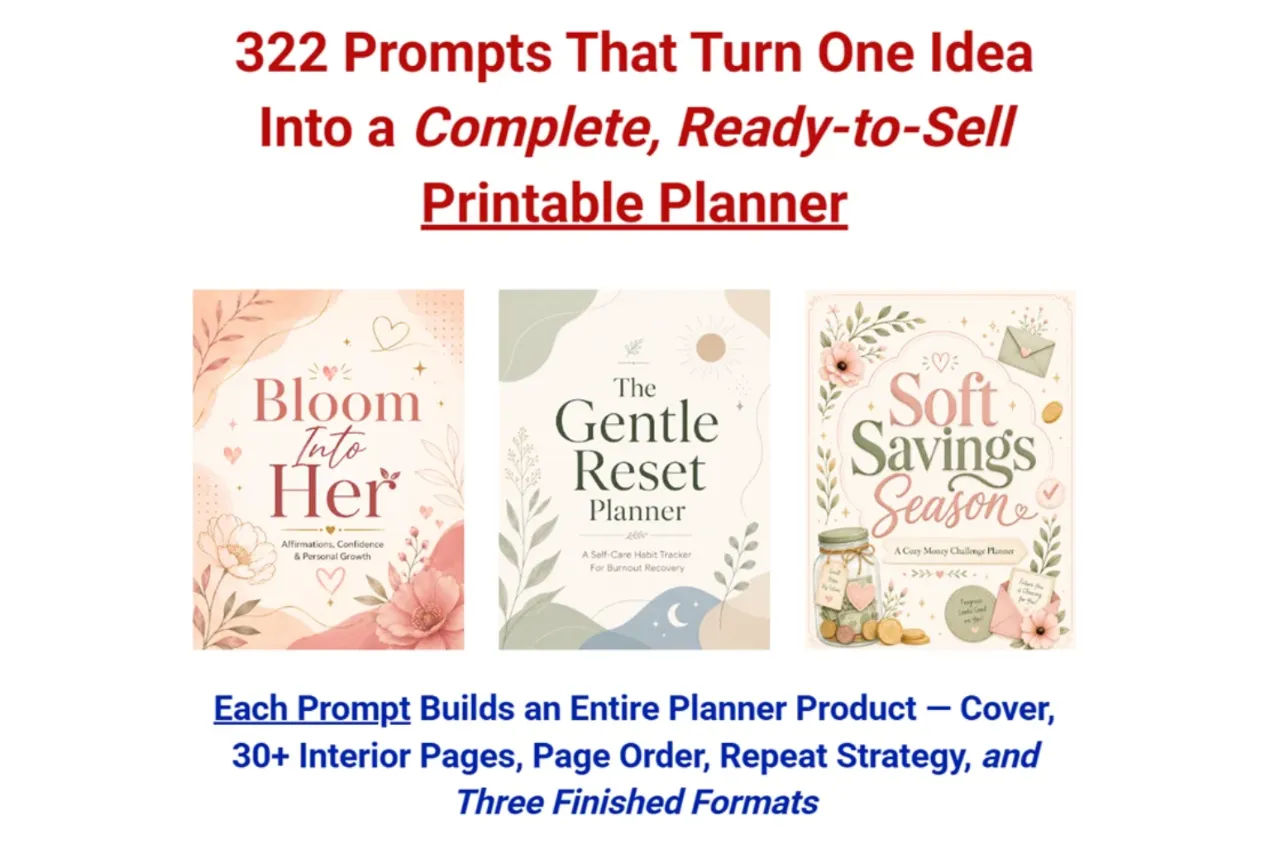
This wasn’t a collection of vague brainstorming prompts. It was a structured system that claimed to turn one idea into a complete, ready-to-sell planner – cover, interior pages, page order, repeat strategy, and 3 finished formats. That’s not a prompt. That’s a production line.
I decided to test it. Not because I believed the hype, but because I wanted to see if it actually solved the 6 walls I had personally hit when I built my first planner.
What This Product Actually Does (And What It Doesn’t)
Let me be honest about what this product actually does, because the name doesn’t tell the full story.
You get 322 prompts organized across 46 planner niches. That sounds like a lot, but what matters isn’t the number. What matters is that each prompt is a complete blueprint for a specific planner type. You don’t get a vague suggestion. You get a title, a subtitle, a product description, 7 SEO keywords, a cover image prompt, a full set of interior page prompts, a recommended page order, and a repeat strategy that tells you exactly how many times to repeat each page.
That last part is the kind of detail most people overlook until they’re knee-deep in a project and realize they have no idea how to structure a 90-day planner without making it feel repetitive or incomplete.
The prompts are designed to work inside plain ChatGPT. No design software, no special tools, nothing to install. You paste the prompt, and ChatGPT returns the entire blueprint. Then you generate the cover and interior pages using ChatGPT’s image generation capabilities, assemble them in Canva or any free PDF tool, and you have a finished product.
If you want to skip the manual assembly entirely, there’s a bonus Codex Auto-Build Guide that includes a mega-prompt for the Codex desktop agent. You paste the prompt, approve the plan, and Codex generates every page, applies the repeats, and assembles the print-ready PDFs in the sizes Amazon KDP and Etsy require. It builds all 3 product versions – the 30-page starter, the 60-page Etsy planner, and the full 90-day premium planner – in a single run.
That’s not a small convenience. That’s the difference between spending an afternoon on one product and spending that same afternoon on 3 products across multiple formats.
What impressed me most was the baked-in quality control. The prompts include rules that prevent the AI from generating garbled text, broken boxes, or placeholder words on the final pages. Every interior page is designed in vertical portrait format with clean boxes, checklists, and writing lines. The styling is consistent across all pages, so the finished product looks like a professional design studio created it, not a series of experiments.
If you want to see how it works in practice, you can check it out here.
My Real-World Experience Using This System

Using this system felt different from the usual prompt packs I’ve tested.
The onboarding was straightforward. I picked a niche – Self-Love Planner for Women – and pasted the prompt into ChatGPT. Within seconds, I had the full blueprint: a commercial title, a metadata subtitle, a buyer-ready description, 7 targeted SEO keywords, a cover prompt, 27 interior page prompts, a recommended page order, and a repeat strategy.
The cover prompt generated a soft, feminine design with a peach and blush palette, delicate floral accents, and clean typography. It was exactly the kind of cover that stops a shopper mid-scroll on Etsy.
The interior pages were where the system really proved itself. Each page prompt generated a clean, professional layout with consistent styling. The Welcome page, the How To Use page, the Self-Love Vision page, the Confidence Goals page – every page felt intentional and cohesive. The blank fill-in areas were left empty, with no bracketed placeholder text printed on the page. That’s a small detail, but it’s the kind of detail that separates a professional product from something that looks like it was generated by an AI that doesn’t understand print design.
The learning curve was minimal. If you’ve ever used ChatGPT, you already know how to use this system. The only thing you need to learn is the assembly process, and the guide walks you through it clearly. I tested the manual method first, then tried the Codex Auto-Build method. Both worked. The manual method gave me more control over the final look. The Codex method saved me hours of repetitive work.
What surprised me most was the repeat strategy. I had never thought about planning the repeat counts for a planner in such a structured way. The system tells you exactly how many times to repeat each page based on the product size. For a 30-day planner, you repeat the daily page 30 times, the weekly page 4 times, and the monthly page once. For a 90-day planner, you scale it up accordingly. That kind of precision eliminates the guesswork that usually derails planner projects.
I compared this mentally with other approaches I’ve tried. I’ve used generic prompt packs that gave me vague ideas but left me to figure out the execution. I’ve used design templates that looked great but required hours of customization. I’ve even tried hiring freelancers to build planners for me, which was expensive and inconsistent. This system sits in a sweet spot between those extremes. It gives you a complete blueprint and lets you execute it at your own pace, with or without automation.
What I Liked and What Could Be Better
Let me be straightforward about what works and what doesn’t.
What works well:
The prompts are highly specific and produce consistent, professional results across all 46 niches.
The repeat strategy and page order are built in, so you never have to guess how to structure a planner.
The Codex Auto-Build Guide is a genuine time-saver if you want to produce multiple products quickly.
The baked-in quality rules prevent common AI issues like garbled text, broken boxes, and placeholder text.
The 3 product formats (30-page, 60-page, 90-page) give you flexibility to sell at different price points.
The 46 niches cover the highest-demand categories, so you’re not wasting time on products nobody wants.
What could be better:
You still need basic familiarity with ChatGPT and image generation tools. If you’ve never used AI before, there’s a small learning curve.
The manual assembly method requires some effort. You’re generating pages one at a time and assembling them in a PDF tool. It’s not difficult, but it’s not completely hands-off unless you use the Codex method.
The product was only launched a few days ago, so there aren’t many user reviews or case studies available yet. That’s normal for a new product, but it’s worth noting if you prefer to wait for social proof.
The Codex Auto-Build method requires the Codex desktop agent, which is a separate tool. The guide tells you how to use it, but you need to have it installed.
No product is perfect, and this one isn’t trying to be. It’s a tool that solves a specific set of problems. If those problems match yours, it’s worth every penny. If you’re already an experienced planner designer with your own systems in place, you might not need it.
The Price Question: Is $17 Actually Worth It?

The price is $17.
That’s the kind of number that makes people pause. It’s low enough to feel like an impulse buy, but high enough to make you wonder if it’s actually worth it.
Here’s how I think about the value.
Time saved: Building a single planner from scratch, including the cover, interior pages, page order, and marketing copy, can easily take 10 to 20 hours. That’s assuming you already know what you’re doing. If you’re learning as you go, it takes even longer. This system reduces that time to a few hours, or even less if you use the Codex Auto-Build method. At minimum wage, 10 hours is already more than $17. The math works even if you only build one planner.
Mental load reduced: The hardest part of creating a product isn’t the execution. It’s the decision-making. What should the title be? What pages should I include? How should I order them? How many times should I repeat each page? What keywords should I target? This system answers all those questions for you. That’s not just a time saver. It’s a cognitive relief that lets you focus on the parts of the business you actually enjoy.
Skill replacement vs skill enhancement: This product doesn’t replace the need for design skills entirely. You still need to assemble the final PDF and make minor adjustments if you want to customize the look. But it replaces the need to be a professional designer, copywriter, and SEO specialist all at once. It enhances your existing skills by handling the parts that are tedious or outside your expertise.
Who this is perfect for:
Beginners who want to publish their first printable planner but don’t know where to start.
Experienced sellers who want to scale their catalog without spending weeks on each new product.
Anyone who has tried to build a planner before and got stuck on the details.
Faceless creators who want to build a planner shop without showing their face or building an audience first.
Who should skip it:
People who already have a proven system for designing planners and don’t need a structured blueprint.
Anyone who isn’t willing to spend a few hours learning how to use the prompts and assemble the final product.
People who expect a completely automated, one-click solution that requires zero effort.
The bonuses are worth mentioning. The Codex Auto-Build Guide alone would be worth the price for anyone who wants to produce multiple planners quickly. And the 46 niches give you enough material to build a catalog that could keep you busy for months.
Final Verdict: Should You Buy This?
Here’s the calm, honest summary.
322 Prompts for Complete Printable Planner Products is not a magic button. It won’t make you a millionaire overnight. It won’t build your business for you. What it will do is remove the friction that stops most people from ever publishing their first planner.
The system is well-designed, the prompts are specific and consistent, and the bonus Codex Auto-Build Guide is a genuine time-saver. The 46 niches cover the highest-demand categories, and the 3 product formats give you flexibility to sell at different price points on different platforms.
What stands out to me, in practice, is the attention to detail. The repeat strategy, the page order, the quality rules that prevent AI errors – these aren’t afterthoughts. They’re the result of someone who has actually built and sold planners before and knows exactly where people get stuck.
If you’ve been sitting on a planner idea and telling yourself you’ll start “someday,” this is the tool that turns someday into today. The market is there. The buyers are searching. The only question is whether your planners are the ones they find.
I’m glad I tested it. I’m already using it to build my next few planners, and I’m confident the time and mental energy I’m saving will pay for itself many times over. If you’re ready to stop overthinking and start publishing, this is a solid place to begin.