336 Agentic Prompts for Memory Lane Coloring Book Series Review
I tested 336 Agentic Prompts for Memory Lane Coloring Book Series to see if one paste really builds a sellable book. The good, the slow parts, and who should skip it.
I have been trying to crack the Amazon KDP coloring book market for about a year now, and every single time I hit the same wall. I would get excited about a niche, sketch out a few pages, and then realize I still needed twenty-five more drawings. Then came the line quality problem. Every AI image generator I tried spat out these beautiful, intricate designs that looked great on screen and were absolutely miserable to color. Fine lines, overlapping shapes, gray shadows baked in. My mom tried one and gave up after ten minutes, and she is the exact audience for this stuff.
So when I saw the 336 Agentic Prompts for Memory Lane Coloring Book Series, I was skeptical in a specific way. The sales page promised that each prompt hands your AI agent a full book: a color cover, thirty bold-line interior pages, listing copy, and three print-ready folders for Amazon and Etsy. All from one paste. I have bought plenty of prompt packs that turned out to be three pages of vague instructions and a prayer. This one claimed to be a complete production run for ChatGPT Codex or ChatGPT Work, with the agent planning, rendering, checking, and packaging everything on its own.
I bought it for $17 and spent an afternoon testing one prompt from start to finish. What follows is what actually happened, including the parts that made me want to throw my laptop out the window.
Our Verdict
336 Agentic Prompts for Memory Lane Coloring Book Series
A solid prompt pack that really does produce complete, senior-friendly coloring books for Amazon and Etsy, provided you have ChatGPT Codex or Work and some patience.
Instant digital download, one-time payment
What You Actually Get
Let me be precise about the deliverable here, because the name is doing a lot of work. You are not getting 336 coloring books. You are not getting 336 images. You are getting 336 individual text prompts, each designed to make your AI agent build one complete coloring book from scratch. So the collection holds 336 potential books, or one book with 335 sequels if you wanted to go insane and publish them all.
Each prompt supposedly contains a full production brief. Inside there is an original title and subtitle, a product description ready for any listing, a back-cover blurb, seven SEO keyword phrases, a period accuracy lock, a thirty-page scene plan, a full-color front and back cover prompt, thirty individual interior page prompts, and instructions for three typeset front-matter pages. That sounds like a lot, and it is, but the real question is whether the agent can execute all of it in one session without drifting off the rails.
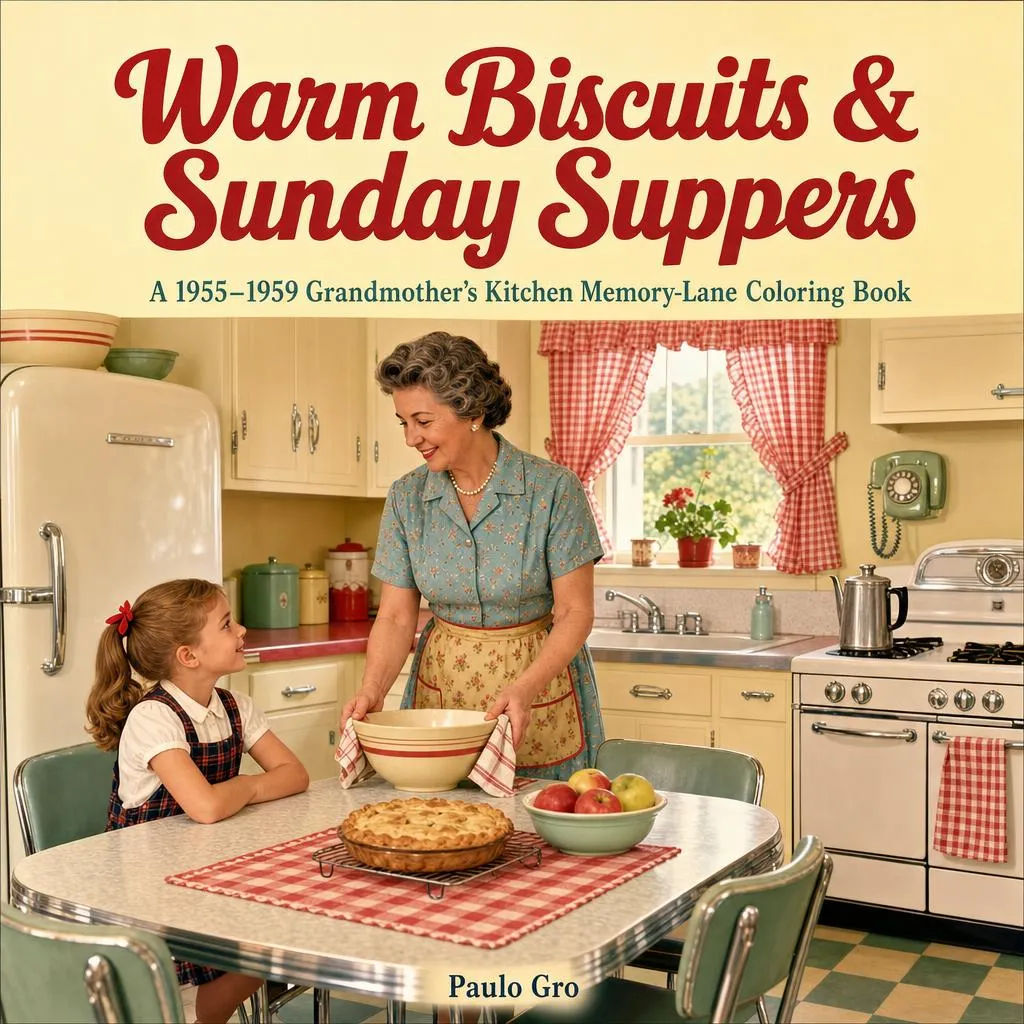
The themes themselves are where the pack earns its keep. This is not generic retro stuff. I am talking about specific, memory-trigger scenes like a 1950s Grandmother's Kitchen Before Sunday Dinner, the Neighborhood Soda Fountain After School in the late 1950s, and Wash Day at the Backyard Clothesline in the 1950s. There are 48 distinct themes listed on the page, each holding multiple prompt variations so you can build an entire series inside one niche without repeating a single page. The specificity matters. If you have ever tried to prompt an AI for a 1940s kitchen and watched it add a microwave, you understand why the period accuracy lock is a genuinely thoughtful feature.
Key Features That Matter for Selling
The first feature worth talking about is the senior-friendly line specification. The prompt tells the agent to render pure black outlines on pure white, with bold-to-medium lines, open spaces, and clearly separated objects. This is the exact opposite of what most AI art generators produce by default, and it is the single biggest reason I have failed at this niche before. A coloring book for older adults cannot have dense, tiny tangles. It needs room for an unsteady hand. The prompt pack builds that constraint into every single page request, which saves you the battle of fighting the AI every time.
The second feature is the quality gate. The agent is instructed to check its own work and discard anything that comes out non-square, gray-toned, or off-plan, then re-render it before moving on. In practice, this means the agent does not just generate thirty images and call it done. It verifies each one against the spec. I watched this happen when one of my interior pages rendered with a faint beige background. The agent flagged it, deleted it, and redid it without me asking. That alone saved me maybe an hour of manual checking.
The third feature is the packaging into folders. When the run finishes, you get an Amazon_KDP folder with a print-ready interior PDF and cover files, an Etsy_Printable folder with one complete downloadable PDF of the whole book, and a High_Res_Pages folder with all thirty-two images numbered in order. You still need to upload these to KDP or Etsy yourself, but the formatting work is done. No resizing, no converting, no figuring out the 8.5 x 8.5 square at 300 DPI spec on your own.
Actually Using It
I decided to test the theme that felt most likely to fail: A 1950s Grandmother's Kitchen Before Sunday Dinner. My reasoning was that kitchen scenes have the most period details to get wrong. Stoves, refrigerators, canisters, tablecloths, curtains. Any one of those could drift into the wrong decade and ruin the whole book. I opened ChatGPT Codex, pasted the prompt in, and hit enter.
The first response took about ninety seconds and laid out a complete plan. It proposed the title "Sunday Dinner at Grandma's Kitchen: A 1950s Memory Lane Coloring Book for Seniors with Large Print, Bold Lines, and Easy Relaxing Scenes." It included a product description with the nostalgic hook, the audience, the period, and the page count. It wrote a back-cover blurb. It listed seven keyword phrases like "1950s coloring book for seniors" and "large print nostalgia coloring book." Then it presented a thirty-page scene plan, mixing the stove, the sink, the pantry, the kitchen table set for dinner, pies cooling on the counter, and a few quiet pages like a window with morning light and a cat on a chair.
Then it asked me for two things: the author name and approval. That was the entire amount of thinking I had to do at that stage. I typed a pen name, said go, and walked away to make coffee.
When I came back about twelve minutes later, the agent reported a completed book. It had rendered a full-color front and back cover with the title, subtitle, and my author name placed and readable at thumbnail size. It had generated thirty interior pages, each one a true 8.5 by 8.5 inch square at 300 DPI, pure black outlines on white. It had typeset a title page, a copyright page, and a warm welcome note, then dropped them into the right positions. And it had created those three folders I mentioned earlier.
I opened the interior pages first, because that was my real test. I printed six pages and coloured one of them myself for about forty minutes with a set of cheap felt pens. The lines were bold and open, the objects were clearly separated, and there was no gray shading anywhere. I could see exactly where one shape ended and another began. That is the standard that matters for this audience, and the pack hit it.
Then I looked for the failures, because there are always failures. The cover image came out slightly busy. The agent had placed the title over a scene of the kitchen table, and at thumbnail size the text was legible but competing with the illustration behind it. I needed about ten minutes of follow-up prompting to get a cleaner version where the title sat on a solid color block. Also, one of the interior pages, the one with the pantry, rendered the shelving slightly crooked. Not enough to matter after coloring, but noticeable if you looked closely. The agent did not catch that one on its own, because the geometry was technically square even if the perspective was off.
The biggest limitation is not the prompts themselves. It is the platform they run on. The sales page says this requires ChatGPT Codex or ChatGPT Work. If you only have the free tier or a standard ChatGPT Plus subscription without the agentic file-saving capability, this pack will not work as advertised. You need the version that can plan, render images, check its own work, and save real files. That is a separate subscription cost on top of the $17, and it is worth factoring into your decision before you buy.
I also tested the "Volume 2" command. After the first book finished, I typed "Volume 2" and the agent re-read its plan, generated a new thirty-page scene list of different rooms and moments in the same kitchen world, and built a second book. Nothing repeated, and the era stayed locked. That is where the series math gets interesting, because one prompt becomes an entire shelf if you want it to.
Ready to see if one paste builds your first coloring book?
Digital download, try one prompt tonight
Pricing and Value Analysis
The price is straightforward. The sales page mentions $350 in the context of projected market growth and $150 in relation to something else, but the actual purchase price is $17. That is a one-time payment for 336 prompts, which works out to about five cents per potential book. Even if you only ever successfully publish ten of those, you are at $1.70 per book for the prompt cost, which is trivial next to the effort of writing the briefs yourself.
Where the value gets complicated is the subscription cost. You need ChatGPT Codex or ChatGPT Work to run these prompts. That is a recurring monthly fee that is not included in the $17. If you already have one of those, the pack is a no-brainer price. If you do not, you need to add that subscription cost to your real total, and the math changes depending on how many books you actually ship.
Here is a rough cost comparison for getting one coloring book to the upload stage:
| Method | Upfront Cost | Time Per Book | Line Quality Risk |
|---|---|---|---|
| Hire illustrator | $200 to $500 | 2 to 4 weeks | Low, but slow and expensive |
| Manual AI prompting | $0 | 6 to 10 hours | High, constant fights over style |
| This prompt pack | $17 | 1 to 2 hours | Low, quality gate built in |
The pack sits in a sweet spot. It is not free like manual prompting, but it removes most of the trial and error that makes manual prompting take all day. And it is vastly cheaper than paying an illustrator, with the tradeoff that you still need to verify the output yourself before publishing.
Pros and Cons
Pros
- One paste genuinely builds a complete, printable book with covers and front matter
- Senior-friendly bold line spec is baked into every prompt, no more fighting the AI
- Period accuracy lock prevents embarrassing decade drift
- Three organized folders ready for Amazon KDP, Etsy, and bundles
- Volume 2 command lets you build a whole series from a single theme
Cons
- Requires ChatGPT Codex or ChatGPT Work, an extra subscription cost
- Cover image sometimes needs manual cleanup before it looks clean at thumbnail size
- Occasional geometry issues on interior pages slip past the quality gate
- You still have to upload everything to Amazon and Etsy yourself
Who This Is For
This is for anyone who has been circling the adult coloring niche and keeps stalling at the production step. If you have a ChatGPT Codex or ChatGPT Work subscription already, this pack removes the single biggest blocker between idea and upload. It is also for sellers who want to build a recognizable series rather than publishing one-off books, because the Volume 2 workflow makes sequels feel almost too easy. And it is for people who want to target the senior and memory care market specifically, because the line width and scene selection are calibrated for that reader in a way generic prompt packs are not.
Who Should Skip It
Skip this if you are not willing to spend money on a ChatGPT Codex or ChatGPT Work subscription. The $17 pack is useless without that platform, and if you refuse to pay for it, you are better off with a free prompt writing guide. Skip it if you expect to make zero effort on quality control. The agent catches most problems, but I still found one page with slightly crooked shelving and a cover that needed a cleanup pass. If you are not comfortable reviewing thirty pages of art and asking for corrections when something looks off, this workflow will frustrate you. And skip it if you are looking for a fully automated print-on-demand business where you never look at the output. This gets you 90 percent of the way there, but that last 10 percent is still on you.
Frequently Asked Questions
What exactly are the 336 Agentic Prompts for Memory Lane Coloring Book Series?
Each prompt is a complete production brief for ChatGPT Codex or ChatGPT Work. When you paste one in, the agent plans a full coloring book, renders thirty interior pages plus a color cover, typesets front matter, and packages everything into folders ready for Amazon KDP and Etsy. It is 336 potential books, one paste each.
Does this work without ChatGPT Codex or ChatGPT Work?
No. The prompts are built specifically for agentic AI platforms that can plan, render images, check their own work, and save files. A regular chat prompt will give you a plan and then stop. You need the subscription tier that supports the full agentic workflow.
Are the coloring pages actually senior-friendly?
The prompts explicitly instruct the agent to render pure black outlines on pure white, with bold-to-medium lines, open spaces, and clearly separated objects. In my test, the output matched that spec. No gray fills, no dense line tangles, no cramped details.
Can I really sell the books these prompts create?
The output folders are formatted for Amazon KDP and Etsy uploads. You still need to create accounts on those platforms and upload the files yourself. There is nothing stopping you from selling the finished books, but you are responsible for the final upload and any platform requirements.
How long does one prompt take to produce a book?
In my test, the planning phase took about ninety seconds and the full render took roughly twelve minutes. Your time will vary depending on the platform's current load and your subscription tier. You do not need to watch it work, so plan to walk away during the render phase.
What if the agent makes a mistake on a page?
The prompt includes a quality gate that instructs the agent to discard and re-render any page that comes out non-square, gray-toned, or off-plan. I saw this happen once for a background color issue. For smaller problems like slightly crooked geometry, you can ask for a re-render of that specific page in a follow-up message.
Final Verdict
I went into this expecting another thin prompt pack, and I came out with two complete coloring books that I am genuinely planning to upload to Amazon. The $17 price is almost absurdly low for the amount of production work each prompt offloads, provided you already have the right ChatGPT subscription. The senior-friendly line spec and the period accuracy lock solve the two problems that made me quit this niche before. I still had to clean up a cover and check every page myself, so this is not a hands-off money printer. It is a tool that removes the hardest 80 percent of the work and leaves you with a manageable review pass. For that, it is worth every cent.