344 Prompts for Gut-Wrenching True Crime Books Review: Can This AI Prompt System Help You Write Better True Crime Books?
Read this 344 Prompts for Gut-Wrenching True Crime Books review to see how 344 AI prompts help writers create true crime books with 43 categories, cover prompts, metadata, chapter frameworks, and victim-centered storytelling.
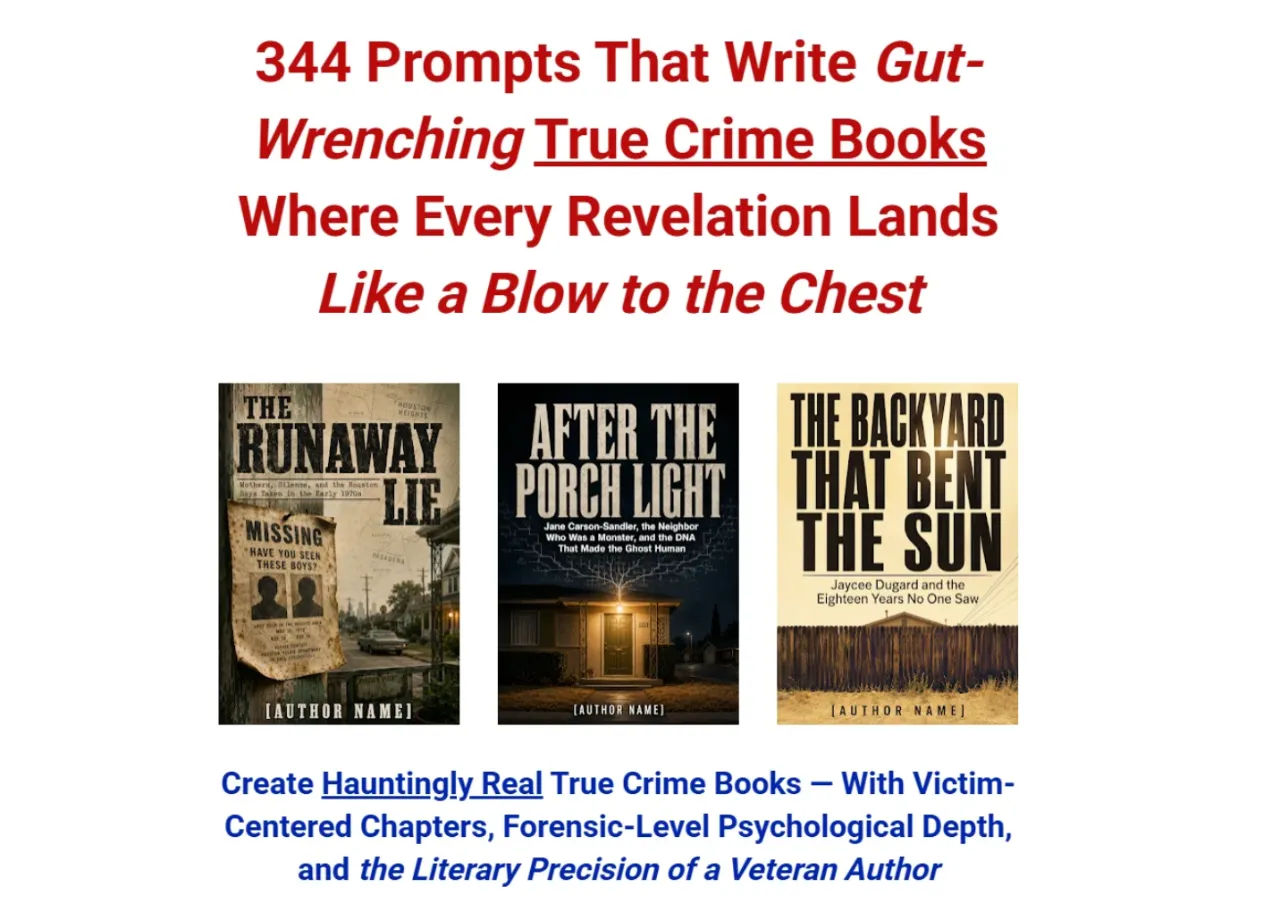
True crime is one of the most powerful nonfiction genres, but it is also one of the easiest to mishandle.
That is the tension every serious creator faces.
The audience is clearly there. Readers buy true crime books. Viewers watch documentaries. Podcast listeners follow multi-part investigations. Kindle audiences continue to search for cold cases, wrongful convictions, forensic breakthroughs, missing-person stories, institutional failures, and survivor-centered narratives.
But strong demand does not make the genre easy.
A weak true crime book can feel careless almost immediately. It may summarize events without emotional depth. It may center the perpetrator too much. It may repeat public facts without building a real narrative. It may use dramatic language without restraint. It may feel more like a long case recap than a serious book.
That is why many AI-generated true crime projects fall short.
AI can generate words quickly, but speed is not enough. In a sensitive genre like true crime, a creator needs structure, research discipline, ethical judgment, pacing, atmosphere, and a clear emotional center.
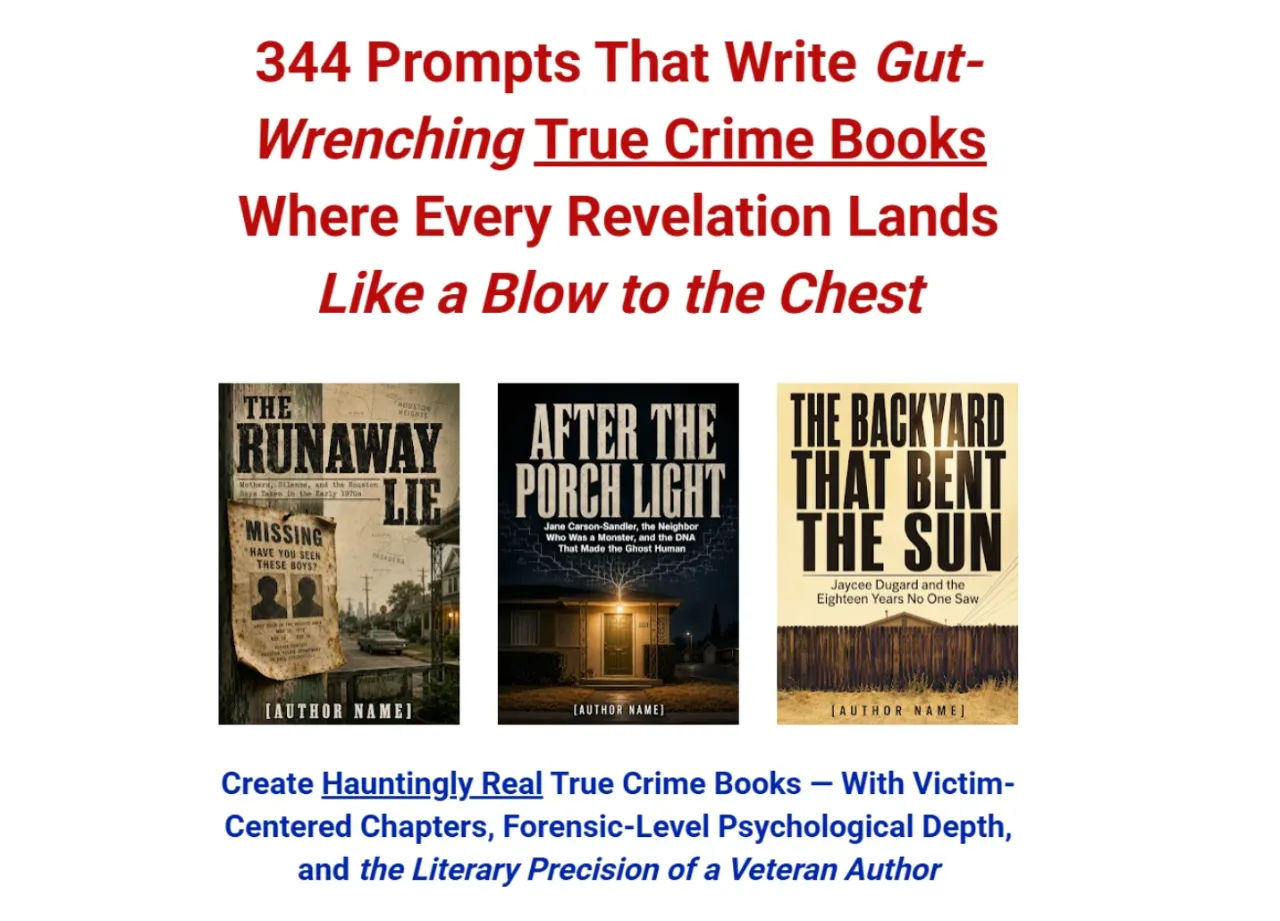
This is why 344 Prompts for Gut-Wrenching True Crime Books caught my attention.
This newly launched prompt collection is built for creators who want to generate deeper true crime books and scripts using AI, but without relying on generic “write me a true crime book” prompts. It includes 344 prompts across 43 true crime categories, with a focus on victim-centered narrative structure, psychological depth, book metadata, cover prompts, chapter prompts, and even a desktop agent guide for using tools such as Claude Cowork or ChatGPT Codex.
At first, I was skeptical.
Prompt products are everywhere now. Some are useful. Many are not. A lot of prompt packs are just basic commands repackaged as premium assets. They may help beginners start, but they do not usually produce serious long-form work.
So the real question is not whether this product has many prompts.
The better question is whether these prompts help creators build stronger true crime books with better structure, better emotional discipline, and less blank-page confusion.
After reviewing the product structure, I think the answer is yes — for the right type of user.
Check 344 Prompts for Gut-Wrenching True Crime Books here.
Why True Crime Needs More Than Basic AI Writing
The biggest mistake creators make with AI writing is assuming that more output equals more value.
That may work for simple content tasks, but it does not work well for true crime.
True crime requires narrative responsibility.
A good book in this genre does not simply explain what happened. It shows how lives were changed, how warning signs were missed, how institutions responded, how families carried uncertainty, and how the aftermath continued long after the case became public.
The best true crime writing usually has a strong human center.
It does not turn the perpetrator into the main attraction. It does not use tragedy as decoration. It does not rush past victims and survivors to focus only on the mechanics of the case.
That is why the victim-centered angle of this product matters.
The prompts are designed to push the AI toward narratives that keep victims, survivors, families, and systemic context at the emotional center. That is a better approach for both quality and ethics.
A basic prompt might ask AI to write about a case.
A stronger prompt tells AI how to frame the case, how to avoid sensationalism, how to pace revelations, how to handle uncertainty, how to prevent repetition, and how to maintain the dignity of the people involved.
That is where 344 Prompts for Gut-Wrenching True Crime Books becomes more interesting than a typical prompt list.
It is not just asking AI to write.
It is trying to give AI a narrative architecture.
The Main Benefit: Better Structure Before You Start Writing
In my experience, one of the hardest parts of writing a nonfiction book is not the sentence-level writing.
It is the structure.
Where should the story begin?
What should the reader understand first?
When should the investigation enter the narrative?
How much background is necessary?
Which character or family carries the emotional center?
How do you avoid repeating the same information across chapters?
How do you end the book without making the resolution feel rushed?
These are the questions that separate a real book from a long article.
The strongest part of this product is that it appears to address those structural questions directly.
According to the product information, each Super Prompt can generate a complete publishing asset. That includes a magnetic title and subtitle, a back-cover description, a custom narrative framework, a cover prompt, and 8 to 14 detailed chapter prompts. The system is also built around adaptive narrative architecture, meaning the AI is guided to create a custom structure based on the case, era, evidence, and emotional arc.
That is important.
Most AI book workflows fail because the creator jumps straight into chapter generation. The result may have words, but it does not always have direction.
This prompt system encourages the creator to build the book blueprint first.
That changes the workflow.
Instead of asking AI for a finished book immediately, you first build the architecture. Then you review the structure. Then you generate chapters based on a stronger plan.
For KDP publishers, that can reduce production confusion. For YouTube documentary creators, it can help turn a case into a more compelling long-form script. For ghostwriters, it can provide a deeper outline before drafting. For AI-assisted authors, it can remove a lot of early-stage uncertainty.
That is the real practical value.
The 43 True Crime Categories Give The Product Commercial Range
A prompt product becomes more useful when it gives creators multiple directions to test.
This product includes 43 true crime categories. These cover high-demand angles such as cold cases, wrongful convictions, forensic breakthroughs, kidnapping and captivity stories, serial offender cases, family-related cases, cult-related cases, healthcare-related cases, unsolved murders, digital forensics, and other true crime sub-niches.
That range matters because true crime is not one single market.
Some readers are drawn to cold case investigations. Some prefer wrongful conviction stories. Some are interested in forensic science. Some follow survivor-centered narratives. Some watch documentary-style content about institutional failure or cases solved by new technology.
For creators, this gives flexibility.
A KDP publisher could build a focused series around wrongful convictions or cold cases. A YouTube creator could use the prompts to develop documentary scripts. A podcast planner could use them to structure long-form episodes. A ghostwriter could use the categories to build client projects.
However, this is also where creators need to be careful.
A category is not a finished project. It is a direction.
True crime still requires research. You need credible sources, public records, court documents where available, reliable reporting, and careful fact-checking. A prompt can help shape the story, but it cannot replace the responsibility of verifying what you publish.
That distinction matters.
See the full prompt system here.
Why The Cover Prompts And Metadata Matter
A true crime book does not only need chapters.
It needs positioning.
This is another area where the product has practical value. The prompts are designed to generate book titles, subtitles, back-cover descriptions, SEO-style keyword direction, and cover prompts.
For self-publishers, this matters because the buying decision often starts before anyone reads a chapter.
Readers see the title.
They see the cover.
They read the subtitle.
They scan the description.
They decide whether the book feels credible and compelling.
A weak title or generic cover can make a serious project look cheap. A strong cover prompt can help create a visual direction that fits the mood of the story without becoming sensationalized.
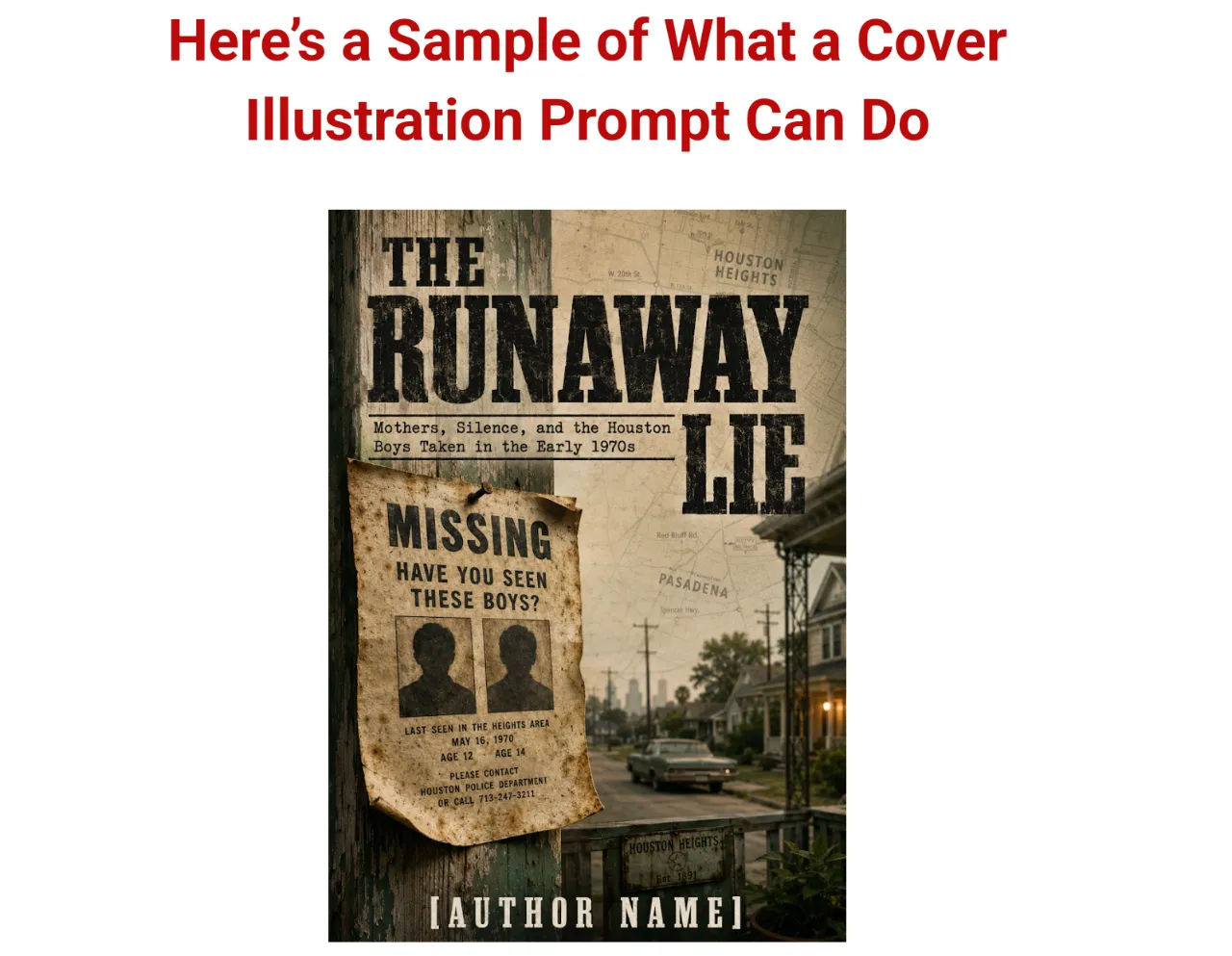
The product information describes cover prompts that include atmosphere, typography guidance, aspect ratio, color palette, and genre-specific visual direction. That is useful because true crime covers need restraint. They need to feel serious, readable, and emotionally aligned with the story.
This is especially helpful for KDP creators who are not designers.
You still need to review and refine the final cover. But having a strong prompt gives you a better starting point than asking an AI image tool for a vague “true crime book cover.”
My Real-World View On How I Would Use It
If I were using 344 Prompts for Gut-Wrenching True Crime Books, I would not treat it as a one-click publishing machine.
That would be the wrong mindset.
I would use it as a serious production framework.
First, I would choose a specific true crime category and identify a case with enough public documentation to support a responsible book or script. Then I would gather reliable source material. I would look for timelines, court records, official statements, credible journalism, interviews, and documented facts.
After that, I would use the prompt to create the book blueprint.
This blueprint would include the title, subtitle, description, narrative framework, cover prompt, and chapter prompts. I would then review that blueprint carefully before generating any full chapters.
This review step is important.
Does the framework respect the facts?
Does it avoid unsupported speculation?
Does it keep the victims and survivors at the center?
Does it avoid making the perpetrator the emotional focus?
Does it create a strong reading experience without exaggerating the case?
Only after that would I generate the chapters.
Then I would edit and fact-check.
This is where some buyers may misunderstand the product. The prompts can help you write faster and structure better, but they do not remove the need for editorial judgment. They do not guarantee factual accuracy. They do not replace research.
The best use case is not “copy, paste, publish.”
The best use case is “research, structure, generate, review, edit, publish responsibly.”
Used that way, the product can save a meaningful amount of time while still keeping quality control in the creator’s hands.
The Desktop Agent Guide Is A Strong Bonus, But Not For Everyone
One of the more advanced parts of the product is the included desktop agent guide.
The product information mentions an alternative method using Claude Cowork or ChatGPT Codex. Instead of generating a book chapter by chapter, the creator can use a mega-prompt to generate a full blueprint, write chapters, and compile formatted Word documents.
That is interesting.
For experienced AI users, this could be a major time-saver. If you understand how to manage AI output, review manuscripts, organize files, and correct errors, the agent workflow can make production smoother.
But I would not recommend that beginners rush straight into full automation.
If you are new to AI-assisted publishing, start manually. Generate the blueprint first. Review it. Generate one chapter. Review again. Understand the quality level before trying to automate the whole process.
Automation is only useful when you know what good output looks like.
Otherwise, it can produce mistakes faster.
So I see the desktop agent method as a strong option for advanced users, not necessarily the first step for everyone.
Review 344 Prompts for Gut-Wrenching True Crime Books here.
What I Like About This Product
The biggest strength is that the prompts focus on narrative structure, not just word generation.
That is rare.
Many prompt packs try to impress buyers with quantity. This product is more interesting because it focuses on how a true crime book should be built. The prompts guide the AI through emotional framing, chapter pacing, victim-centered storytelling, psychological insight, metadata, and cover direction.
I also like that the product is broad enough to support multiple formats. It is not only for KDP publishers. It can also help YouTube documentary creators, podcast planners, ghostwriters, audiobook creators, and long-form content builders.
The 43 categories add commercial flexibility. Creators can explore different parts of the true crime market instead of being locked into one narrow theme.
The cover prompt component is also useful because visual positioning matters in publishing.
Most importantly, I like the emphasis on restraint. A true crime product that pushes AI to avoid generic or careless output is much more useful than one that simply encourages fast publishing.
What I Would Be Careful About
There are several limitations buyers should understand.
First, prompts do not replace research. You still need to verify every factual claim. This matters especially in nonfiction and true crime.
Second, AI can still make mistakes. Even strong prompts can produce inaccurate details, unsupported assumptions, or awkward phrasing. You must review the output.
Third, true crime has ethical weight. You should not use this product to create sensationalized content that exploits real tragedies. The best use of the system is victim-centered, evidence-aware storytelling.
Fourth, some creators may underestimate the editing stage. A prompt can produce a strong draft, but a serious book still needs revision.
Fifth, legal sensitivity matters. Avoid unsupported accusations, invented dialogue, and claims that cannot be verified.
These are not reasons to avoid the product. They are reasons to use it properly.
Pricing And Value Analysis
The value of 344 Prompts for Gut-Wrenching True Crime Books should be judged by structure gained, time saved, and production clarity.
If you tried to build a comparable system yourself, you would need to study true crime narrative structure, prompt engineering, KDP metadata, cover prompt creation, chapter pacing, ethical framing, and AI workflow design.
That takes time.
This product gives you a ready-made framework.
For KDP publishers, the value is repeatable book architecture. For YouTube creators, it is deeper documentary script planning. For ghostwriters, it is faster project outlining. For AI-assisted authors, it is a way to move from idea to structured manuscript more efficiently.
The product is not worth buying if you expect it to guarantee sales.
No prompt pack can do that honestly.
The better question is whether it helps you create a stronger true crime manuscript structure faster than you could build on your own.
For the right user, I think it does.
This product is best for KDP publishers, true crime writers, AI-assisted authors, YouTube documentary creators, ghostwriters, podcast planners, and content entrepreneurs who understand the importance of research and editing.
It is not ideal for people who want instant publishing with no fact-checking, people who are uncomfortable with sensitive nonfiction topics, or creators looking for a low-effort way to exploit tragic cases.
Final Verdict
344 Prompts for Gut-Wrenching True Crime Books is a serious prompt collection for creators who want to build deeper, more structured true crime books and scripts with AI assistance.
Its strength is not just the number of prompts.
The real strength is the architecture behind them.
The prompts are designed to generate metadata, adaptive narrative frameworks, cover prompts, chapter prompts, pacing rules, psychological insight, and victim-centered direction. That makes the system more useful than a basic prompt pack.
It will not replace research.
It will not replace editing.
It will not replace ethical judgment.
It will not guarantee book sales.
But it can give creators a stronger foundation.
If you are serious about creating true crime books, KDP titles, YouTube documentaries, podcast scripts, or long-form content in this genre, this product is worth considering.
Use it responsibly. Research carefully. Edit thoroughly. Treat it as a professional framework, not a shortcut around quality.
That is where it makes the most sense.