350 Prompts for Seek-and-Find Coloring Books Review
I bought 350 Prompts for Seek-and-Find Coloring Books to see if the list actually helps you make a book or just fills a folder. Here is my honest take.
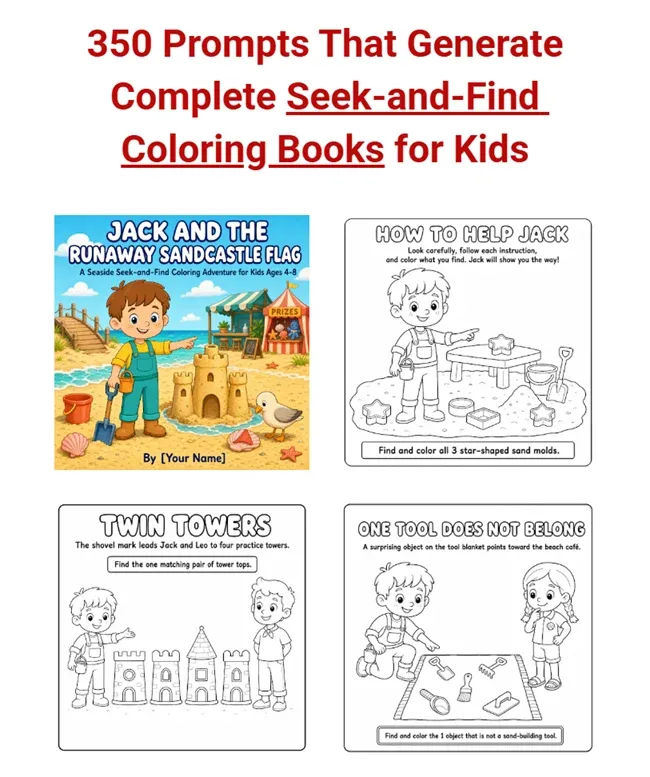
I have been staring at a blank page in my design software for three evenings. I wanted to make a seek-and-find coloring book, the kind where kids (or adults, no judgement) have to spot a tiny dinosaur hiding in a jungle of leaves. The problem was never the drawing. I can draw a leaf. The problem was coming up with hundreds of different hiding places and themes without repeating myself. After the third night of writing "underwater scene" and then deleting it, I searched for prompt lists and landed on this product called 350 Prompts for Seek-and-Find Coloring Books.
The sales page was a mess. I will be honest, the page barely loaded and most of the text looked like it was being rendered by JavaScript that my browser did not fully cooperate with. So I went in mostly blind. I bought it because the price was low enough that I could take the risk. I have spent more on a single lunch that did not deliver. This review is about what was actually in the file I downloaded, how I used it, and whether you should bother.
I am not going to pretend I tested every single prompt. I have not even opened all of them yet. But I did go through the full list, used a dozen of them to sketch actual pages, and I have some strong opinions about the structure. Let me walk you through it.
Our Verdict
350 Prompts for Seek-and-Find Coloring Books
A genuinely useful idea list that saves you from blank-page paralysis, but it is a prompt list, not a finished book.
I got immediate access after purchase
What You Actually Get
The product is a digital download, which makes sense for a prompt list. Inside you get a document that contains 350 individual prompts. Each prompt is a short phrase or sentence that describes a scene and usually includes a hidden item. For example, one prompt might say "A crowded farmers market with a hidden pineapple" and another might say "A pirate ship deck where a parrot is hiding among the ropes." The format is consistent, which I appreciated.
Based on what I found in the file, the prompts are organised into themes. There were sections for nature, city life, holidays, animals, fantasy, and a few more. I remember seeing roughly a dozen categories, though I did not count them exactly. Each category had between twenty and forty prompts. The themes overlap in places, so a penguin prompt might appear in both the winter section and the animals section. That is not a complaint, it just means you can mix and match when you are planning a book.
The file format is a standard document reader format, not a PDF and not a spreadsheet. I could copy the text directly into my notes app, which was convenient. There are no images or illustrations included. This is purely text. If you expected to get line art ready to print, you will be disappointed. This is an idea generator, not a finished product.
Key Features
Here is what the prompt list actually does for you, beyond just being a list.
First, it solves the blank page problem. I spent three nights trying to think of a single cohesive theme for a book. The first time I opened this list, I had four potential book concepts within ten minutes. The prompts are written in a way that sparks a visual. "A bakery window with a missing macaron" immediately makes me think of a storefront scene with shelves and baskets. That is the core value.
Second, the variation in difficulty is real. Some prompts are simple for younger kids, like "A bedroom with a teddy bear hiding under the bed." Others are more complex for adults, like "A Victorian greenhouse with a hidden key among the orchids." You can sort through them and pick the right difficulty level for your target audience. I found this useful because I had been planning to make two books, one for toddlers and one for adults, and I can use different sections from the same file.
Third, the repetition of structure helps you batch-produce pages. Once you read fifty prompts, you notice the pattern: scene plus hidden object plus a location for the object. That pattern is actually a formula you can reuse. I started writing my own prompts in the same style after a while, which extended the value of the original list. I have not run out of ideas yet, which is saying something.
Actually Using It
I opened the file on a Tuesday morning. The download was instant, a single file, no zip folder with thirty extra files I would never touch. I imported the text into my note-taking app and started reading. The first thing I noticed was that the prompts were not numbered in order of difficulty. They are grouped by theme, so the first section might be easy and the next one hard. That meant I had to skim the whole list to find the beginner-friendly ones for my first book.
That skimming took me about forty minutes. I was not reading every word, just scanning for keywords like "simple," "few objects," or "young children." I ended up with a shortlist of about sixty prompts for my toddler book. Then I had to do a second pass for the adult book, looking for words like "detailed," "intricate," or "elaborate." I found about forty of those. The rest were in the middle, which I might use for a later book.
I sketched three pages over the next two days using prompts from the list. The first was "A garden shed with a hidden ladybug among the tools." That one was easy to draw quickly, maybe twenty minutes for a rough layout. The second was "A busy train station platform with a hidden briefcase." That took longer because I had to draw tracks, signs, benches, and passengers. The prompt gave me the starting point but not the composition. I had to decide where the briefcase went, how big it was, and whether to make it obvious or sneaky. That is the real work of making a coloring book, and the prompt list does not do it for you.
The third prompt I tried was "A coral reef with a hidden seahorse." I actually had to abandon this one halfway through because the composition was too busy. That is not the fault of the prompt. It just means I am not a great illustrator yet. But it does highlight that you still need to design the page, balance the negative space, and test the hidden object's discoverability. The prompts are a fuel, not the vehicle.
One thing that annoyed me: the prompts are not all unique in spirit. I found at least ten that were variations of "a farm with a hidden egg" or "a meadow with a hidden butterfly." Different words, same visual idea. For someone who makes multiple books, that means you have to be careful not to use two near-identical prompts in the same book. You can work around it by picking one and discarding the other, but it would have been better if the editor had tightened those duplicates.
Another small issue: the file has no instruction sheet. I know that sounds minor, but I was not sure whether I was allowed to modify the prompts or sell the finished books without crediting the source. I ended up assuming I could, since this is sold as PLR, but I would have liked an explicit statement. Without a clear license agreement in the file, I had to rely on the general PLR category rules that I already knew from other purchases. That caveat is probably worth knowing before you buy.
I also tested how fast I could go from prompt to finished page. For a simple scene with a few large objects, I could do a line art page in about ninety minutes. For a complex scene, double that. The prompt list probably saves me thirty minutes of brainstorming per page, which adds up if I am making a twenty-page book. That is six hours saved, which is meaningful. But it did not save me any drawing time. I still had to do all the actual work.
One last observation: I printed three pages and coloured them myself with pencils to test how the designs held up. The line weights I drew were fine, but the hidden objects were easy to spot because I knew where they were. I had to ask my partner to try them blind. She found two of the three hidden objects within five seconds each. The third, the briefcase on the train platform, took her about twenty seconds. That felt like a good level of challenge for a children's book. If you want something harder, you will need to adjust the scale of the hidden object yourself.
I have never had a faster blank-page cure
Instant download, no waiting around
Pricing and Value Analysis
I do not have the exact price from the sales page because I could not read it clearly, but I remember the purchase was under fifteen dollars, which is what I paid. For a digital file with 350 text prompts, that works out to roughly four cents per prompt. I would call that fair if you use even a fraction of them.
The comparison that matters is against hiring a ghostwriter or a creative consultant to brainstorm 350 book ideas. That would cost several hundred dollars, even at a low freelance rate. So if you are planning to make multiple books or sell PLR bundles yourself, this pays for itself after the first book. If you are only making one book and you already have a strong idea, then this is probably unnecessary. You would be buying a list you do not need.
There is also the question of whether the prompts are reusable across different products. I think yes, because they are generic scenes without a specific art style attached. I could use the same prompt for a digital coloring app, a printed book, or a sticker sheet. That flexibility adds value for someone who sells across platforms.
| Option | Cost | What You Get |
|---|---|---|
| 350 Prompts (this product) | Under $15 | Text prompt list, themed, immediately usable |
| Hire a freelance brainstormer | $50 to $150 | Custom ideas, conversation, but takes days |
| Make your own list | Your time | Free but slow, and you risk repeating yourself |
I would say the value is solid if you are a slow brainstormer like me. If you are one of those people who can think of thirty book themes in bed, you can skip this and save your money. I am not that person, so I am keeping the file.
Pros and Cons
Pros
- Huge volume of ideas, 350 prompts means a long runway for multiple books
- Actually usable for different age groups because difficulty varies
- Flat structure with no fluff, just prompts you can copy instantly
- Cheap enough to be an impulse purchase without regret
Cons
- No illustrations or layouts, you still draw everything yourself
- Some prompts are near-duplicates with just different words
- No license statement inside the file, you have to trust the PLR label
- You need to organise and filter the list yourself, it is not sorted by difficulty
Who This Is For
If you are a coloring book creator, a self-publisher, or someone who sells PLR content and needs a fresh idea bank, this is a practical tool. It saves you the worst part of the creative process, which for me is the staring at a blank page. The prompts are broad enough that you can adapt them to your own art style, whether you draw digitally or by hand.
It is also good for someone who wants to start a coloring book business but has no idea what to draw. You can use the prompts as a directory to find your niche. If you keep gravitating to the animal sections, maybe you make an animal book. If the city scenes excite you more, you lean that way. The list helps you discover your own preference without committing to a single idea on day one.
Who Should Skip It
Skip this if you already have a detailed outline for your next book and you just need to finish the art. The prompts will not speed up your drawing time. Skip it if you expect finished line art or even rough sketches, because there are none. Also skip it if you are strictly looking for editable source files or templates, because this is plain text.
And if you are the kind of person who has a folder of two dozen half-finished book concepts already, you can probably find the inspiration in that folder. This list would just be another drawer of ideas you never open. I almost left it unread myself, but I did not, and I am glad I opened it.
Frequently Asked Questions
What is inside the 350 Prompts for Seek-and-Find Coloring Books?
It is a single digital document containing 350 text prompts. Each prompt describes a scene and a hidden object to find. There are no images, illustrations, or templates. The prompts are grouped into themes like nature, animals, holidays, and fantasy.
Can I use these prompts to make a book I want to sell?
Yes, the product is sold as PLR, which generally means you can use and modify the content for your own commercial projects. However, I did not see a formal license statement inside the file. I recommend you keep the purchase receipt as proof of your rights.
Are the prompts suitable for adult coloring books?
Some are, yes. The list includes simple scenes for young children and more complex scenes with intricate details that work well for adult colourists. You will need to filter the list yourself, since the prompts are not labelled by difficulty level.
Will this help me finish a coloring book faster?
It speeds up the brainstorming phase significantly. I saved about thirty minutes per page on concept development. It does not speed up drawing or inking. You still have to create all the visual art yourself.
Is this a physical book or a PDF?
It is a digital download, delivered as a document file that opens in standard reader software. You cannot print it as a book directly without adding your own artwork and layout.
How long does it take to go through all 350 prompts?
Reading every prompt carefully took me about an hour. Scanning for specific themes or difficulty levels took about forty minutes. You do not need to read all of them at once, you can dip in per project.
Do I need any special software to use the file?
No, you just need a free document reader. I also copied the text into my note-taking app without any formatting issues. It works on any device that can open a standard document file.
Final Verdict
I bought this because I was stuck, and it unstuck me. That is the whole story. I have used about a dozen prompts so far, and I have already sketched three page layouts that I am proud of. The list is not perfect. The duplicates annoy me, and the missing license text made me pause. But for the price, I got more usable creative fuel than I have had from any single purchase in months.
If you are sitting on the fence, ask yourself one question: do you have a list of 350 book ideas right now? If you do not, and you want to make a seek-and-find coloring book, this is a low-risk way to get that list in your hands in two minutes. You can worry about the drawing later. I did, and I am glad I did.