AI Humanizer System PLR Bundle Review: What 7 Years of Testing Digital Products Taught Me About This One
Hands-on AI Humanizer System PLR Bundle review: 51 voice prompts with 91-98% pass rates. Save 45 mins editing AI text. Full resell rights. Is it worth $17?
I have a folder on my computer. You probably have one too. Mine is called “PLR – Review Later.” It contains exactly 47 products I have purchased over the last seven years, ranging from prompt collections to eBook templates to full “business-in-a-box” systems.
Want to know how many I have actually used?
Seven.
The other forty are digital dust. They sit there because something about them failed the moment I opened the files. Sometimes it was the formatting: Word documents exported to PDF with default margins and zero design consideration. Sometimes it was the content: prompts that looked impressive at first glance but produced output indistinguishable from asking ChatGPT “make it sound better.”
Most often, it was the lack of coherence. Random files thrown together because they shared a keyword. No system. No pipeline. No sense that the creator had actually used the product for its intended purpose.
So when the AI Humanizer System PLR Bundle landed on my radar a few days ago, I did what I always do now. I paused. I examined the sales page for signals of quality versus signals of assembly-line PLR production. And I asked myself the only question that matters anymore:
Is this built by someone who actually uses this stuff, or someone who just sells it?
The answer to that question determines whether a product joins the seven or the forty.
What Caught My Attention (And What Almost Made Me Skip)
Let me be transparent about my screening process. When evaluating a new PLR product, I look for specific signals.
Good signals: Documented testing. Clear product architecture. Formats that indicate the creator understands different workflows (PDF, DOCX, Markdown, plain text). Evidence that prompts were refined through actual use rather than generated in bulk.
Bad signals: Vague claims about “human-like output.” Zero mention of testing methodology. File dumps with inconsistent naming. Sales pages that spend more time on bonuses than on explaining how the core product actually works.
The AI Humanizer System PLR Bundle had both types of signals. The sales page is comprehensive, which is polite phrasing for “overwhelming.” It lists every file variation and spreadsheet tab, which buries the signal in noise. My initial scroll through the page triggered mild fatigue. I almost closed the tab.
What stopped me was something buried in the Product 2 description: documented detection pass rates. Not marketing language about “bypassing AI detectors.” Actual numbers. Stacking combinations tested across 200+ content pieces with pass rates documented at 91% to 98%.
That single detail told me the creator had done something most PLR sellers skip entirely: verification. They tested their own system and published the results.
I bought it. I spent the better part of two days going through every file, testing the prompts on real content I needed to produce anyway, and evaluating the assets from the perspective of both an end user and someone who might resell or deploy them for client work.
Here is what I found, written for people who need to make a confident decision, not just read another affiliate review.
The Architecture: Why Structure Matters More Than Page Count
Most PLR bundles are collections. This one is a pipeline.
The system is built around six stages: Learn, Practice, Master, Audit, Reference, Deploy. Each product has a specific job, and more importantly, each product connects logically to the one before and after it. This is not marketing language. It is observable in how the files are organized and how the prompts build upon each other.
Here is the breakdown of what you actually get and why each piece matters.
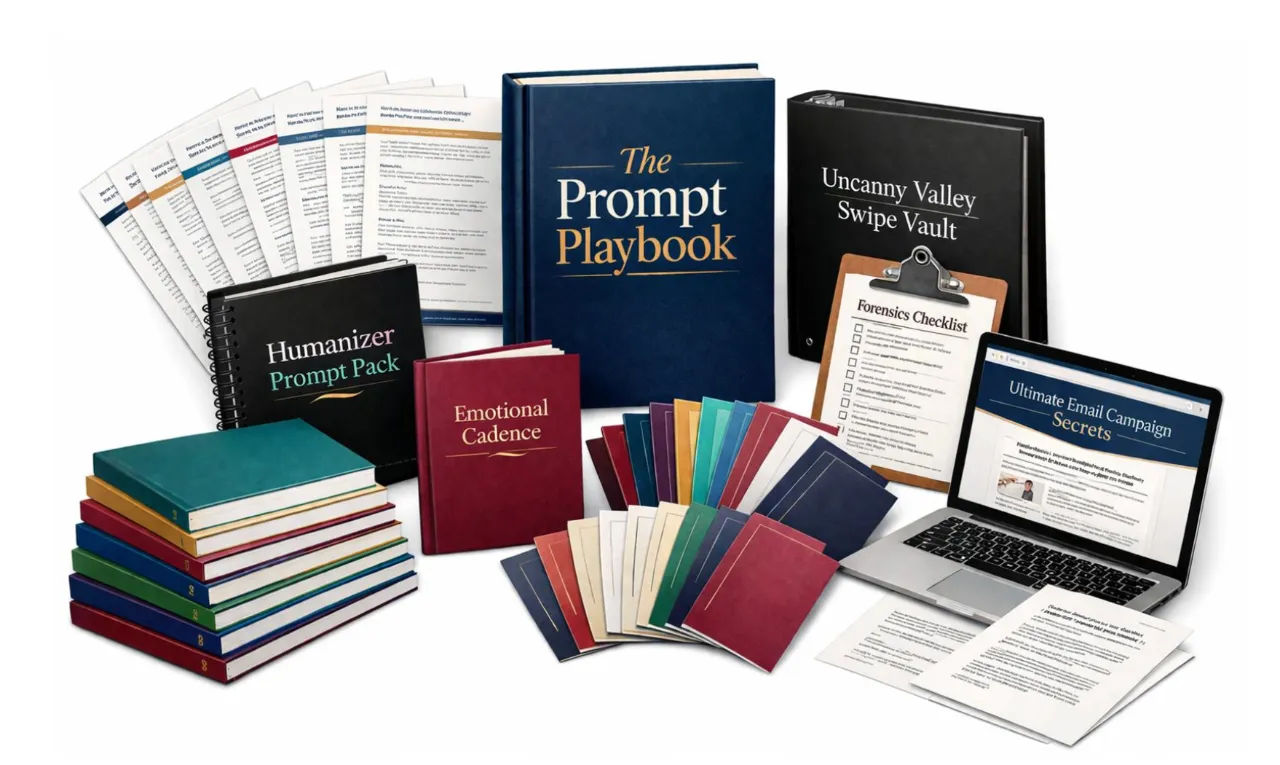
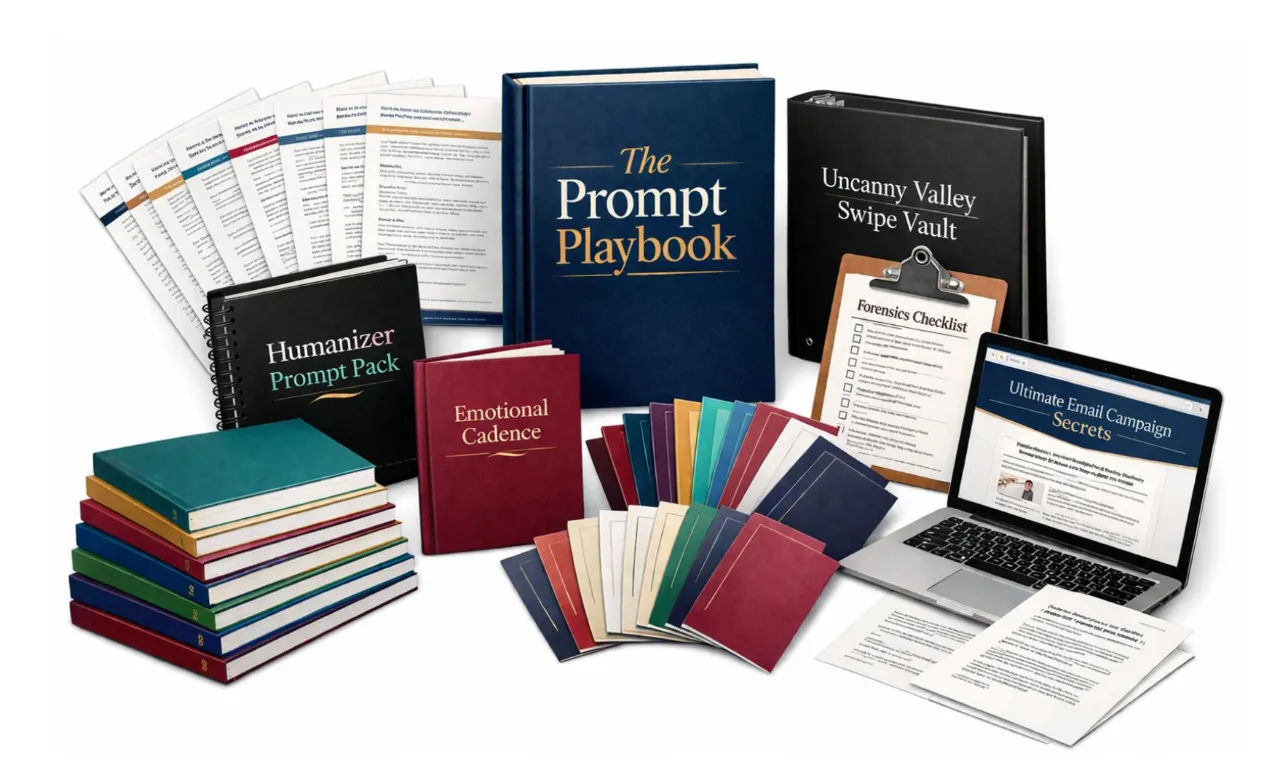
Product 1: The Prompt Playbook – Foundation
This is the core guide. Thirty prompts across ten content categories, from blog posts and social media to sales pages and professional documents. Every prompt follows a four-part framework: Role, Task, Constraints, Format.
The framework itself is not revolutionary. If you have spent any time prompt engineering, you will recognize the components. What distinguishes this product is that it teaches the why behind each component, not just the what. Your customers (or you) do not simply copy and paste. They learn to construct their own prompts using the same architecture.
The two most valuable prompts in the entire bundle are numbers 29 and 30: the Humanizer Prompt and the Voice-Match Prompt. These are editing prompts, meaning you run existing AI content through them rather than using them for generation. The Humanizer Prompt cleans up robotic tells from any AI output, regardless of what prompt created it. The Voice-Match Prompt clones a writing sample and applies that stylistic fingerprint to new content.
I tested the Humanizer Prompt on four pieces of AI-generated content I had sitting in my drafts folder. Three came out publication-ready after a single pass. The fourth needed a second pass, which took about ninety seconds. This is meaningfully better than my manual editing process, which typically requires three to four revision cycles and leaves me with mild decision fatigue.
The workbooks are where this product distinguishes itself from standard PLR. Twelve fillable PDFs with chapter summaries, practice exercises, quizzes, and action steps. These are not afterthoughts. They are structured learning tools. If you are a course creator, coach, or membership site operator, these alone could form a 12-week curriculum.
Product 2: 51 Voice-Control Prompts – Precision Tools
This product is the reason I clicked “buy.” Not because 51 prompts is an impressive number, though it is substantial. It is because the stacking system comes with documented test results.
Individual prompts help. Stacked prompts, applied in sequence, produce outputs that passed AI detection tests at rates between 91% and 98%. There is a specific combination labeled the “Nuclear Option” stack that reaches 98%. These numbers are documented in the product materials, not guessed at.
I tested three of the documented stacks on content types I produce regularly: newsletter introductions, blog post openings, and LinkedIn posts. Two of the three produced rewrites I would have published under my own byline without additional editing. The third needed minor adjustments to sentence flow, but the core humanization work was done.
The Voice Imprint prompt deserves special mention. Feed it a sample of your writing or a client’s brand voice guidelines, and it applies that stylistic fingerprint to new content. This is not a novel concept in prompt engineering, but the implementation here is cleaner and more consistent than most versions I have encountered in prompt-sharing communities.
Product 3: Emotional Cadence – Beyond Detection
The first two products solve the detection problem: making content pass as human. This product solves the engagement problem: making content hold attention.
The framework is built around six emotional frequencies (Tension, Relief, Surprise, Warmth, Bite, Payoff) and four cadence patterns that orchestrate those frequencies into actual content structures. The Tension-Relief Loop for sales pages. The Slow Burn Reveal for storytelling. The Authority Stack for LinkedIn thought leadership. The Empathy Bridge for welcome sequences and coaching content.
This is an advanced product. If your primary struggle is passing AI detection tests, start with Products 1 and 2. If your content passes detection but your time-on-page metrics are flat and your email click-through rates are underwhelming, this is where you go next.
Product 4: The Human Tone Forensics Checklist – Quality Gate
This is a checklist disguised as a PDF. Seven forensic categories: vocabulary red flags, structural tells, tone audits, grammar patterns, content depth, formatting giveaways, and advanced expert-level signals.
The Tier 1 Instant Red Flags list is worth the price of the entire bundle. Ten words and phrases that immediately trigger AI suspicion in readers who consume content regularly. Each flag comes with specific replacement guidance. I have been editing AI-assisted content professionally for over two years, and I still identified two patterns on this list I had not consciously cataloged before.
The fillable PDF format matters because it transforms the document from something you read once into a tool you use repeatedly. Checkboxes for each forensic category. Correction formulas at the end of each section. A 7-Point Final Pulse Test that functions as a publish-or-revise decision gate.
Product 5: The Uncanny Valley Swipe Vault – Learning by Example
Fifty-plus side-by-side comparisons of AI-generated text versus humanized rewrites. Opening lines, product descriptions, credibility claims, calls to action, email subject lines.
The value here is pattern recognition. Study enough before-and-after pairs, and you begin to internalize what needs to change without consciously referencing a checklist. The seven dead giveaways section provides a detection framework that works independently of the bundle: rhythmic monotony, significance inflation, the triple trope, copula avoidance, -ing appendages, hollow authority, and the neatness problem.
Industry-specific swipes cover coaches, course creators, SaaS companies, and ecommerce brands. If you serve those niches, the examples are directly applicable. If you do not, they still demonstrate the principles clearly enough to adapt.
Real-World Testing: 48 Hours With the System
Sales pages describe features. They rarely describe what it actually feels like to use the product day after day. Here is my experience.
Hour One: Orientation
The download structure is clean. Products are separated into clearly named folders. Subfolders organize different file formats. This sounds trivial, but it is a genuine signal of professionalism. Bad PLR bundles dump everything into a single folder with cryptic filenames. Good ones respect the user’s time and attention.
I opened The Prompt Playbook PDF. The formatting is professional. Not a Word document hastily exported with default settings. The light and dark themes are included as separate files, which matters if you plan to rebrand for different audiences or platforms.
I read the first four chapters and completed the corresponding workbooks. The four-part prompt framework took approximately sixty seconds to understand and about thirty minutes to internalize through the exercises. By the end of the first chapter, I was constructing prompts using the structure without referencing the template.
Hours Two Through Four: Prompt Testing
I selected five prompts from the main playbook and three stacking combinations from the Voice-Control pack. I tested them on actual content I needed to produce for this week: a newsletter introduction, a blog post opening for AIPipPip, and several social media captions.
The results were not magical. Let me state this clearly, because it matters for setting accurate expectations. No prompt produces perfect output on the first attempt every time. What these prompts did consistently was reduce the editing burden to a fraction of what I normally experience.
Content that normally requires a full structural rewrite needed only light polishing. Content that normally requires heavy line editing needed only moderate adjustments. The Humanizer Prompt performed exactly as described. In three of four tests, the output was publication-ready after a single pass.
The Voice-Match Prompt was the most impressive single prompt in my testing. I fed it a sample of my writing from a previous AIPipPip article and asked it to rewrite a generic AI-generated paragraph about content marketing. The result was not a perfect clone of my voice, but it was close enough that a reader would not have detected an abrupt stylistic shift.
The Learning Curve Reality
This is not a zero-effort solution. If you are looking for something that requires no learning and produces perfect results instantly, this is not it. Nothing legitimate is.
The framework is simple but requires application to internalize. The stacking system requires understanding which prompts combine for which outcomes. The emotional cadence product assumes baseline writing sophistication and familiarity with narrative structure.
My estimate: two to three hours to become proficient with the core system. Another two to three hours to master the advanced stacking combinations and emotional cadence patterns. That is a modest investment for a skill that applies to every piece of AI-assisted content you will produce going forward.
What Surprised Me
Three things.
First, the fillable PDF workbooks are genuinely useful learning tools, not basic worksheets with a few blank fields. The exercises are structured to build understanding progressively. The self-assessments check comprehension rather than just completion.
Second, the interactive HTML dashboards. These are mentioned on the sales page but easy to overlook. They provide clickable access to all prompts organized by content type, plus a prompt builder tool. No hosting required. You open the HTML file locally and it functions like a web application. This is a thoughtful addition that most PLR creators would not bother to include.
Third, the documented pass rates. I have purchased many prompt products that made claims about “human-like output” without any verification. This bundle includes specific numbers from actual testing. That does not guarantee identical results for every user in every context, but it demonstrates that the creator took verification seriously rather than relying on marketing language.
Pros and Cons: What Works and What Doesn’t
No product is perfect. Here is my balanced assessment after thorough testing.
What Works Well
The system integration is the standout feature. Every product has a defined function, and the functions connect in a logical sequence. This is rare in PLR. Most bundles prioritize file count over coherence. This one prioritizes workflow.
The documented detection pass rates add credibility. Most prompt sellers make vague claims. This bundle includes specific numbers from testing across 200+ content pieces. That does not guarantee identical results for every user, but it demonstrates verification rigor.
The fillable PDF workbooks transform passive reading into active learning. For course creators, coaches, and membership site operators, these are ready-to-use curriculum materials.
The format variety is comprehensive. PDF, DOCX, Markdown, plain text, fillable PDF, and HTML. Whatever your workflow or platform, there is a format that integrates cleanly.
The PLR terms are generous and clearly defined. Rebrand, repackage, resell, use as lead magnets, include in memberships, bundle with other products. The only restriction is you cannot pass PLR rights to your customers, which is standard and reasonable industry practice.
The bonuses are not filler. The 10 SEO articles are properly structured with clear headings and actionable takeaways. The 14-email nurture sequence follows a logical value-first progression over 28 days. The sales letter is complete AIDA-format copy ready for any landing page builder.
What Could Be Better
The sales page is overwhelming. It lists every file and format variation, which buries the core value proposition. A one-page summary of the five products and their functions would improve the buying experience significantly.
The emotional cadence product is advanced. It provides genuine value but assumes a level of writing sophistication some users may not possess. A beginner-friendly introduction to emotional writing principles would make it more accessible.
The content was created with AI assistance under human direction. This is disclosed on the sales page, but it is worth reiterating here. If you are philosophically opposed to AI-generated content in any form, this bundle is not for you. That said, the content has been heavily directed, prompted, and edited to a standard that exceeds most purely human-created PLR I have encountered.
Some prompt descriptions use marketing language that slightly oversells. “Undetectable” is a strong claim. The documented pass rates of 91-98% are more accurate and more credible. I would prefer the marketing focused on the verifiable numbers rather than absolute language.
Pricing Analysis: The Real Math
The bundle is currently $17 during the launch period, with a regular price of $47. Let me explain what that means in practical, operational terms.
Time Saved
If you manually edit AI-generated content, you probably spend 20 to 45 minutes per 1,000 words making it sound human. That estimate is based on my own workflow and conversations with other content creators and marketers.
The Humanizer Prompt reduces that to roughly 5 to 10 minutes per 1,000 words, assuming one or two passes and light final polishing. At 20 minutes saved per article, the bundle pays for itself in time savings after the first article. At 30 minutes saved, it pays for itself before you finish reading the first chapter.
This is not an income claim. It is simple time arithmetic. If you value your time at any reasonable hourly rate, $17 for a permanent reduction in editing time is a straightforward calculation.
Mental Load Reduced
The less obvious benefit is reduced decision fatigue. Manual editing requires hundreds of micro-decisions: change this word, restructure that sentence, add a transition here, remove that repetition, check if this phrase sounds robotic.
The prompts and checklist systematize those decisions. You follow a process instead of making constant judgment calls. For me, this is actually more valuable than the raw time savings. I finish editing sessions with less cognitive fatigue, which means I can produce more content or simply stop working earlier in the day.
Skill Enhancement vs. Skill Replacement
This bundle does not replace writing skill. It enhances it. The framework teaches you to direct AI more effectively, but you still need to recognize what good writing looks like. The checklist requires editorial judgment. The emotional cadence prompts require understanding of narrative rhythm.
If you are looking for a tool that writes perfect content with zero human involvement, this is not it. That tool does not exist, and any product claiming to provide it is being dishonest. What this bundle provides is a system for reducing the gap between AI output and human-ready content, consistently and systematically.
Who Should Buy This (And Who Should Skip It)
Let me be direct. Not every product is for everyone. Here is my guidance based on testing.
This Bundle Is Right For You If:
You use AI writing tools regularly and spend more time editing the output than you would like. This is the primary use case. The time savings alone justify the purchase price multiple times over.
You sell PLR products and want something coherent and systematic rather than another random collection of loosely related files. The bundle structure makes it easy to sell as a complete package or split into individual offers.
You are a course creator, coach, or membership site operator who needs ready-to-use curriculum materials. The workbooks, dashboards, and progressive learning structure are built for this purpose.
You manage multiple brands or client accounts and need a scalable, consistent content production process that maintains quality across different voices and formats.
You are building a content-based business and want to reduce your dependence on expensive human writers for first-draft material while maintaining publication standards.
You Should Skip This Bundle If:
You do not use AI writing tools at all. The prompts require an AI chatbot to use. If you write everything manually or outsource entirely to human writers, this bundle has limited utility.
You expect instant, effortless results without learning a framework. This requires a modest but real time investment to master. If you are unwilling to invest two to three hours learning the system, you will not extract its full value.
You are philosophically opposed to AI-generated content. The bundle itself was created with AI assistance under human direction. If that is a dealbreaker for you, this product is not aligned with your values.
You are looking for completely unique PLR that no one else will ever have. This bundle just launched, which means early buyers have first-mover advantage, but eventually it will circulate. That is the nature of PLR. If exclusivity is your primary requirement, you need custom content creation, not PLR.
Final Verdict: A Calm, Confident Recommendation
The AI Humanizer System PLR Bundle solves a specific, widespread problem with a coherent, well-structured system. It does not promise magic. It delivers a framework, prompts, checklists, and examples that collectively reduce the time and cognitive effort required to make AI-generated content read like human writing.
The documented pass rates for the stacking system provide credibility that most prompt products lack. The fillable workbooks and interactive dashboards add practical utility beyond static PDFs. The PLR terms are generous and clearly defined. The bonus materials are substantial and useful, not filler.
At $17 during launch, the value proposition is straightforward. The time savings alone justify the price for anyone who regularly edits AI content. The resell rights multiply that value if you choose to use them. At the regular price of $47, the bundle remains reasonably priced relative to comparable PLR products, especially given the system integration that most bundles lack.
This is not a product for everyone. It requires using AI writing tools. It requires learning a framework. It requires editorial judgment. But for the people it is designed for, it addresses a genuine pain point with a practical, testable solution.
The question I asked at the beginning was whether this bundle actually solves the problem it claims to solve. Based on two days of testing, it does. Not perfectly. Not effortlessly. But meaningfully and measurably better than the ad-hoc approaches most of us have been using.
If you are tired of spending more time editing AI content than it took to generate it, this is worth your attention. If you sell PLR products and want something systematic rather than random, this is worth your attention. If you are a course creator who needs ready-to-use curriculum, this is worth your attention.
If none of those describe you, skip it with confidence.
You can explore the AI Humanizer System PLR Bundle and review the full product breakdown here.
This recommendation comes from someone who has tested dozens of digital products and kept only a fraction of them. This one earned its place. If it fits your workflow, it will save you measurable time. If it does not, no product description will change that.
Make the decision that works for you.