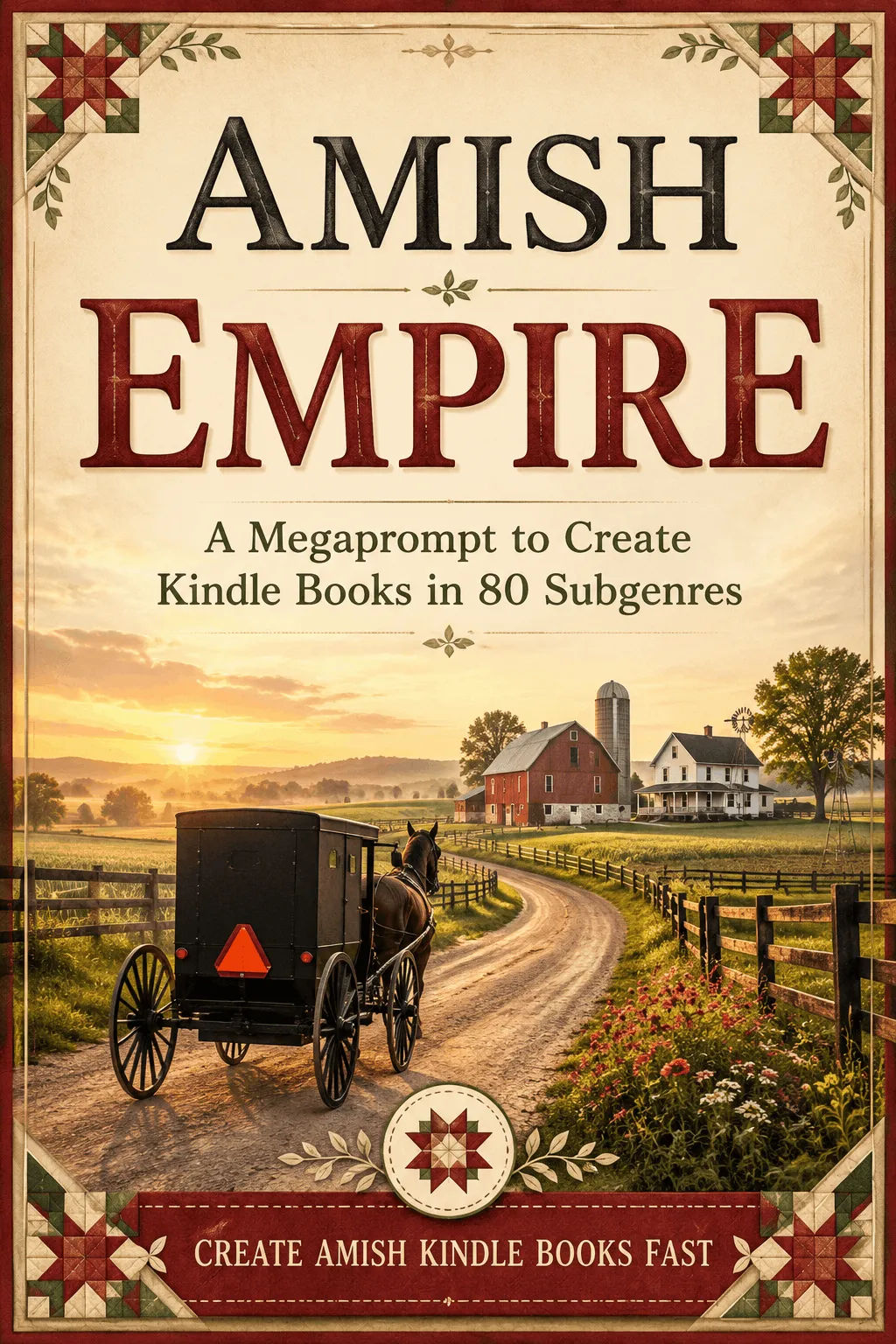
Amish Empire Review: Is This AI Novel Prompt Worth $17?
I bought Amish Empire, the $17 AI prompt that claims to write complete Amish romance novels. After testing it, here's what's inside, how it performs, and who should buy it.
I typed "Amish romance" into Amazon Kindle and scrolled for five minutes. Book 12 of one series. Book 20 of another. Book 37 of a third. New releases dated this month, pre-orders for autumn, and a wall of pen names I had never heard of. These are not big publishers. These are independents, and they are stacking books like cordwood.
That shelf is why I bought Amish Empire. At $17 it is a plain text file, a prompt you paste into ChatGPT, Claude or Gemini that claims to hold an entire novel in your hands by the end of the week. The sales page makes it sound stupidly simple: pick one of eighty premises, type "next" twelve times, run a proofread pass called FINAL PASS, publish. I wanted to know if that actually works, or if you just get a pile of bonnet-wearing costume drama with a Catholic-level confusion about who is allowed to touch whose hair.
So I paid, downloaded the file, and spent an afternoon feeding it to Claude. Here is what I found.
Our Verdict
Amish Empire
A genuinely smart niche prompt that solves continuity and accuracy for Amish romance, if you remember it is a tool and not a publisher in a box.
Instant download, 14-day money-back guarantee
What You Actually Get
The download is a plain text file. No software, no dashboard, no login. You paste it into any of the three big AI chatbots and go. The file contains five distinct pieces:
- The Master Prompt. This is the main engine. It includes the 80 story premises, instructions for building the story bible, the accuracy layer and the chapter protocol.
- The Story Ledger System. After each chapter, the engine prints a full state block: cast, family links, Ordnung rules in force, established facts, romance beats delivered, open threads. The sales page is right that this is the trick that stops the drift.
- FINAL PASS Review Engine. A one-command read-through that returns a defect report covering name drift, timeline contradictions, relationship errors, Ordnung violations, missing romance beats, repeated scenes and dangling threads, plus a correction sheet with replacement text.
- "Who Are The Amish" primer. About an hour of reading that covers their Anabaptist origins in 1525, the 1693 split, the Ordnung, church every other Sunday on backless benches, adult baptism, courtship privacy, the phone shanty at the end of the lane, and why rumspringa is not what television sold you.
- Amish Poetry Generator. A separate prompt that produces short poems on Amish themes. A bonus, and honestly the least useful part for a novelist, but it exists.
Full commercial rights sit in there too. Anything you write with it is yours, to publish under your own name or a pen name, and you tick the AI-assisted disclosure box on KDP when you upload.
Key Features Explained
The story bible is the part that caught my attention before I bought. It is a pre-chapter construction where the engine fixes the cast sheet with ages, occupations, speech habits and secrets, a family tree written as explicit statements, the settlement file with bishop, affiliation and what the district permits and forbids, and a month-by-month season calendar so the crops and the courtship move at the same speed.
The accuracy layer is what separates this from a generic "write me an Amish romance" prompt. It enforces rules as defect checks, not style suggestions. The one that sold me was the surname rule: Stoltzfus, Fisher, Beiler and Lapp belong in Lancaster County, Pennsylvania. Yoder, Troyer, Hershberger and Raber belong in Holmes County, Ohio. Bontrager and Hochstetler belong in Indiana. I would never have known that, and a reader who has been to Lancaster County absolutely would.
The Story Ledger is the mechanical heart. It prints a state block after every chapter. If you hit the context limit on a free AI tier, you open a fresh window, paste the ledger, type continue, and the book resumes without losing thread. The FINAL PASS then reads the whole book back and hunts for contradictions. These two pieces together are what make the difference between a one-hour experiment and a finished novel.
Actually Using It
I opened Claude, pasted the master prompt, and it asked me one setup question: settlement, affiliation, era, chapter count, title, or say "you decide". I picked a widower and housekeeper premise, chose a settlement in Lancaster County, and told it to run twelve chapters. From memory, that apparently took about five minutes to set up. Then I typed "next".
Chapter one came out at around 2,000 words. It opened with a woman scraping frost off a kitchen window and a man arriving with a letter about a farm he had inherited from a brother he had not spoken to in years. There was no pounding heart, no piercing blue eyes, no golden hair being tucked behind an ear. The dialogue was plain. The names were right. I caught the word "daed" for father, which the sales page promised, and a mention of snickerdoodles that felt specific without being a wiki-dump.
The real test came at chapter four. I went back through the ledger to check for drift. The cast matched. The widower had the same two daughters, the same ages, the same occupation. The housekeeper had not suddenly acquired a cousin. The barn had not burned down twice. I have run a lot of long multi-chapter AI fiction projects, and this is the first time I have not caught a sister turning into a cousin by chapter six.
The pacing is deliberately slow, which is the point. The first kiss apparently lands in chapter eleven in this genre, and the engine is built around that restraint. On a paid AI plan I can see how you would blast through a full book in an hour. I did not do that. I read every chapter as it came out, asked for a few adjustments about a buggy accident that I wanted to linger longer, and the engine took the note and kept it consistent for the following two chapters. That surprised me. Most long-form AI will lose a note like that by the next scene.
The FINAL PASS was the honest test. I ran it on the completed draft. It came back with a list: one timeline issue where I had asked for a November wedding and the ledger had a harvest festival that could not happen at the same time, one repeated phrase in a description of the farmhouse kitchen, and one thin spot in the romance beats in chapter nine. The correction sheet gave me replacement text for each. I applied them. It took about twenty minutes.
I will not pretend the prose is literary fiction. It is competent commercial romance, the kind that reads fast and clean. It will not embarrass you, and it will not win a prize. What it does is stay accurate to a very specific world, which is exactly what the reader base is checking for. The biggest limitation I hit was the length. A finished book at twelve chapters comes out around 24,000 words, which is a novella by traditional standards but the sales page notes this is standard for the category. The engine can push to fifteen chapters if you want a longer book, but you are not getting a 90,000-word epic out of this prompt.
One thing the sales page got right: this is a decision-making tool, not a writing tool. You are the editor, the continuity supervisor and the publisher. You are not writing sentences. If you go in expecting otherwise you will be disappointed. But if you go in expecting to spend a night making choices about a settlement and a cast and a slow burn courtship, you will get a book out of it.
Ready to write your first Amish romance novel tonight?
Instant download, works in any AI chatbot you already pay for
Pricing and Value Analysis
The price is $17. That is it. No subscription, no upsell that I was pitched during checkout, no recurring fee. The sales page mentions a 14-day guarantee with a full refund if you email them, and anything you write during those two weeks stays yours even if you refund.
The actual cost of running the tool depends on what you already have. On the free tiers of ChatGPT or Claude you will hit usage limits partway through a book and have to wait. On a paid plan you write straight through. The sales page explicitly says it runs on free tiers but recommends a paid plan for a full book in one sitting. If you already pay for Claude or ChatGPT, this is a $17 add-on to a tool you already use.
Here is my honest math on value. One finished 24,000-word novella, priced at the typical few dollars for this category and put into Kindle Unlimited, needs to sell a handful of copies to pay back the $17. One sale to a reader who goes back for book two in the same settlement replaces the entire purchase price. I have not published anything yet, so I cannot tell you it sells. But the cost of trying is one cup of coffee or one fast food meal.
| Item | Amish Empire | Generic AI Prompt | Hiring a Ghostwriter |
|---|---|---|---|
| Price | $17 one-time | Free to $5 | $500 to $2,000 per book |
| Continuity memory | Built-in ledger | Drifts by chapter 6 | Assumed |
| Genre accuracy | Enforced as defects | Costume drama at best | Depends on writer |
| Time to first draft | 1 hour on paid AI | 1 hour, then rewrite | 2 to 4 weeks |
| Commercial rights | Yes | Varies | Yes, if contracted |
The close competitor is a free prompt you write yourself. I have done that. It works for the first three chapters and then the memory hole opens. Amish Empire is charging for two specific things: the 80 premises and the ledger system that keeps a long chat alive. The premise list alone saves you the hour of brainstorming and the ledger is the difference between a book and a pile of scenes.
Pros and Cons
Pros
- Solves the continuity problem that kills most AI novels
- Accuracy layer catches real genre mistakes like wrong surnames per county
- 80 premises, many combinable, so books do not feel identical
- Works in any major AI chatbot with no new software to learn
- Full commercial rights and a 14-day guarantee
- FINAL PASS is genuinely useful for finding timeline and fact errors
Cons
- The prose is competent but never literary
- You need a paid AI plan to write a full book in one sitting
- 24,000 words is a novella, not a full novel
- You are the editor and publisher, the prompt does not do that for you
- No video training or hand-holding, it is a text file
Who This Is For
This is for someone who wants to publish in the Amish romance niche and needs a production line, not a muse. You should already have a KDP account and a rough idea of how to format an ebook, or be willing to learn it in an afternoon. You need to be comfortable pasting text into an AI chatbot and reading critically, because you are the editor in chief. If you have a paid Claude or ChatGPT subscription already, the math is a no-brainer.
Who Should Skip It
Skip this if you expect the AI to do everything including the boring parts. Skip it if you want literary prose that could win an award, because that is not the job. Skip it if you have no interest in checking facts and catching the occasional flat sentence, because that work lands on you. And skip it if you are looking for a way to get rich without publishing, because this is a tool for people who finish things, not an income scheme.
Frequently Asked Questions
Do I need to know anything about the Amish to use Amish Empire?
No. The bundled primer teaches you the world in about an hour, and the engine enforces the rules as defect checks regardless of your knowledge. You could go in completely blind and still get accurate surnames, correct courtship pacing and proper Ordnung details.
Does Amish Empire work on the free version of ChatGPT?
It runs, but you will hit usage limits partway through a book and have to wait. The sales page says a paid plan lets you write straight through. If you already pay for Claude or ChatGPT, you are set with no extra subscription.
Can I sell the books I write with Amish Empire?
Yes. Full commercial rights are included. The books are yours under your name or a pen name. When you upload to KDP you tick the AI-assisted disclosure box, which is not shown to readers and does not affect ranking or Kindle Unlimited eligibility.
How long is a book and how long does it take to write?
Twelve chapters of roughly 2,000 words each makes about 24,000 words, which is standard for the category. You can generate a full book in one hour on a paid AI plan, or push to fifteen chapters for a longer novel. A novella, not an epic.
Will every book it makes be the same?
No. There are eighty premises, combinable into thousands of options, plus each book gets a different settlement, affiliation, cast, season and ending built before Chapter 1. Two people running the same premise do not get the same book.
Is there a refund policy for Amish Empire?
Yes. There is a 14-day guarantee. If you email them within that window and feel the collection is not worth what you paid, they refund every cent with no forms and no hoops. Anything you write during those fourteen days stays yours.
Does the AI disclosure box affect my ranking on KDP?
No. The sales page states the AI-assisted disclosure is not shown to readers and does not affect your ranking or Kindle Unlimited eligibility. You tick it because KDP asks, and readers never see it on the product page.
Final Verdict
Amish Empire is the first AI prompt I have used that treats the genre accuracy problem as a mechanical defect list instead of a hope. The surname rule alone is worth the price if you are writing this niche, and the Story Ledger turns a one-hour chat session into a finished, consistent novella. It will not write a bestseller for you and it will not do your publishing admin, but it is the difference between a book that a Lancaster County reader throws across the room and one she finishes before Tuesday.
If you are serious about testing the Amish romance market, $17 with a 14-day refund window is the cheapest way to find out if you can finish a book. The reader who wants book two in the same settlement is the reader who makes this genre pay. The only way to get her is to finish book one first.
Check out Amish Empire here and decide if the shelf you saw on Amazon is one you want to be on.
Stop reading about it, start writing book one tonight
Instant download, 14-day money-back guarantee, keep what you write either way