Are We There Yet PLR Review: 512 Prompts for $17
I pasted the first Are We There Yet PLR prompt into a free ChatGPT account to see if one paste really produces a book plan. Here is what came back, and what it costs.
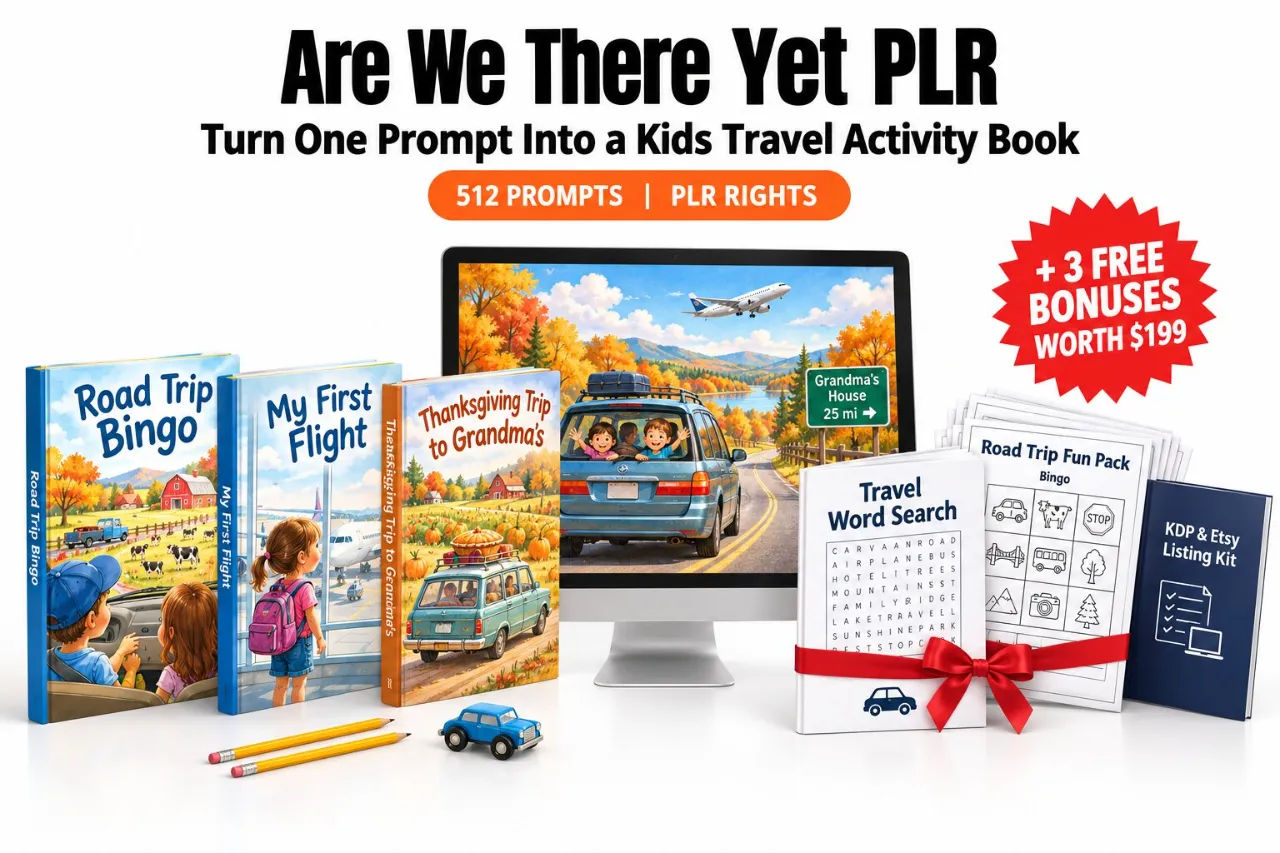
I opened a blank Google Doc on a Sunday night meaning to plan one road trip activity book for the Thanksgiving drive, and by 11pm I had a document full of half-pages and no book. That was three weeks before I started testing Are We There Yet PLR, a $17 prompt library of 512 book ideas aimed at people who want to make travel activity books for kids ages 5 to 10 and sell them on Amazon KDP or Etsy.
My problem was not ideas. I had too many of those. The problem was the middle of the project, where you stop asking "what book should I make" and start asking "what goes on page seventeen, and does the word search grid actually contain the word 'windshield' or did I just type it into the key and hope?"
So I bought it. Full price, $17, one-time payment, downloaded the moment my card cleared. This is what happened over the next week.
Our Verdict
Are We There Yet PLR
A genuinely useful prompt library for anyone making kids' travel activity books, as long as you understand it hands you plans and prompts, not finished pages.
One-time payment, 3 bonuses included
What You Actually Get
The download is small, which surprised me. No software installer, no login screen. You unzip a folder, double-click one file, and a toolkit opens inside your web browser. It runs offline, which I tested by switching my wi-fi off and clicking around for ten minutes.
Inside the folder:
- 512 prompts for complete travel activity books, grouped into 7 collections of 6 themes each, 42 themes total
- A Book Idea Finder that asks three questions (who the book is for, car or plane, which holiday) and shows matching ideas
- 42 browsable theme collections, with every idea card showing age range, trip type and holiday
- One-click copy on every prompt, which copies the whole thing and opens ChatGPT in a new tab
- A Rebrand page where you type your product name, brand and support email, pick colors, and download your own copy
- Three guides: a beginner PDF, a KDP and Etsy selling guide, and an AI autopilot guide
- An Excel spreadsheet of all 512 prompts, one per row, for Sheets or Numbers
Then the three bonuses. A travel word search pack of 60 puzzles with answer keys plus a Word Search Maker tool, a 20-page Road Trip and Airplane Fun Pack of printable pages, and a KDP and Etsy Listing Kit with 30 ready-written listings. The page values them at $199 combined. I have opinions about that number, which I get to below.
Key Features, and What They Do For You
The core thing, the 512 prompts, all follow one structure. Paste one into ChatGPT and you get back 11 parts: title and subtitle, age range and skill level, a product description ready for a listing, 7 SEO keywords, the trip and activity focus, a visual style guide, a book structure, a cover prompt, a page-by-page plan with a copyable picture prompt for each page, a print and puzzle check, and starter, standard and expanded version ideas.
That page-by-page part is the whole reason I wanted this. I can write a title. What I cannot do comfortably is sit down and decide that page 14 should be a look-and-find and page 15 should be a count-the-buses page and page 16 should be a packing checklist, for a 6-year-old, on a drive to Chicago. The prompt does that part.
The puzzle integrity rule matters more than it sounds. Every prompt tells ChatGPT to build each puzzle first and write the finished grid into the picture prompt, and it bans page types that image tools draw badly: mazes, crosswords, sudoku, dot-to-dot. That is a real edit to how these prompts behave, and it is the difference between pages you can publish and pages you delete.
The style guide feature is the other one I actually noticed in use. Each picture prompt repeats one style sentence about palette, mascot and page frame, so the pages belong to the same book. I have tried making an activity book without this and ended up with a cover in bold flat cartoon and interior pages in soft watercolor, which looks like someone stapled two different products together.
Actually Using It
I started with the Book Idea Finder. Three clicks: age 5 to 7, car, Thanksgiving. It showed me a shortlist, I picked one, and the full prompt landed on my clipboard with ChatGPT opening in a fresh tab.
I was on the free ChatGPT plan. That matters because the sales page claims every prompt works there, and I wanted to check rather than assume. I have not tested a paid plan, so I can only tell you the free one worked.
I pasted. It thought. It produced a plan.
Title, a subtitle that did not feel stuffed with keywords, an age range with adapt-for-a-sibling notes, a listing description I could have used near-verbatim, and seven keyword phrases that read like things a person would type. Then the style guide, the book structure at around 26 to 32 pages, the cover prompt, and the page list.
The page list came back with a front cover, a This Book Belongs To page, a packing checklist, a "what will we see?" page, a trip route tracker, big-city picture bingo, a city look-and-find, count the city buses, and a street sign spotter. Around ten pages were named in the sample they show on the sales page, and mine came out similar in kind but not identical in content. Total time from paste to full blueprint: about a minute, maybe ninety seconds. I timed it loosely, not with a stopwatch.
Then I started pasting the individual picture prompts into ChatGPT.
This is where the work actually is, and where I want to be honest with you. One paste gives you a plan. Each page then needs its own paste, and each image needs checking. I did nine pages across two sittings, roughly forty minutes each, and I threw away two. One had a bus with six wheels, which for a counting page is fatal. The other had text that was almost legible but not quite, which is worse than obviously wrong text because it looks fine in a thumbnail.
Fixing a page meant tweaking the prompt wording and regenerating, which took a few minutes each. Not hard. Not automatic either.
The tool that surprised me most was the one I expected to ignore: the Word Search Maker in Bonus 1. I picked a theme from the 20 on offer, picked Medium, told it to build five puzzles, and it produced five grids with answer keys and saved them as a PDF. It works in the browser with no connection. The pitch says each puzzle is checked so every word appears exactly once, and the grids I generated held up when I spot-checked three of them by hand. I did not check all five grids word for word because that would have taken longer than making them did.
Bonus 2, the Fun Pack, is 20 printable pages in black ink: picture bingo cards, a 50-state license plate hunt, trackers, scavenger hunts, Would You Rather cards, journal pages, a window drawing page. Paper-and-pencil stuff, nothing to cut in the car. My nephew did the license plate hunt in about twenty minutes in a restaurant booth, which is not the intended setting but tells you the difficulty lands where it says it does.
Bonus 3 is the boring bonus and the one that saved me the most time. Thirty listings, each with title, subtitle and description, 7 Amazon keywords and 13 Etsy tags, character limits already checked. I copied two of them into Etsy drafts and adjusted the wording for my own pages. I am not going to pretend I verified that all 30 fit every platform's limits today. I checked two.
See the prompt library for yourself
Instant download, works offline, 3 bonuses included
Pricing and Value Analysis
$17, one-time. That is the price I paid and there is no subscription attached to it. The $199 figure on the page is the stated value of the three bonuses, not a price anyone pays. I want to be clear about that because the page leans on it heavily, and it is easy to skim past and think you are getting $199 off something.
Do I think the bonuses are worth $199? No. I think that number is a sales-page number. Do I think they are worth more than $0 to me? Yes, comfortably. The Word Search Maker alone replaced an afternoon I would have spent making grids by hand or paying for a generator, and the listing kit is the kind of dull work I will pay to avoid. If I had to put a cash figure on the three bonuses for my own use, I would say somewhere in the $25 to $40 range. That is a gut estimate, not a claim about market value.
Here is the comparison I actually ran in my head before buying, laid out plainly.
| Option | Cost | What you get | Where it falls short |
|---|---|---|---|
| Are We There Yet PLR | $17 one-time | 512 prompts, offline toolkit, spreadsheet, 3 bonuses | Plans and prompts, not finished pages |
| Writing prompts yourself | Free, but hours | Whatever you already know | Slow, and easy to miss page types and puzzle rules |
| Hiring a freelance illustrator | Usually far more than $17 | Finished art, if the brief is good | You still need the book plan first |
| Generic ChatGPT requests | Free | Vague lists that need heavy editing | No page-by-page prompts, no consistency rule, no puzzle check |
If you make one book from this and it sells a handful of copies, the $17 is covered. If you make nothing, you have lost $17, which is one lunch. That is the honest shape of the risk.
On refunds: I have no information about a refund policy for this product, so I am not going to invent one. Check the terms on the product page before you buy if that matters to you. It should.
Pros and Cons
One thing on the PLR terms before the list, because it is the most misunderstood part. Full Private Label Rights here means you can sell the books you make and keep 100%, rebrand the toolkit with your name and colors and sell that, edit or combine or translate it, and add it to paid bundles. You cannot give it away free or as a lead magnet, you cannot pass PLR or resell rights to your own customers, and you cannot drop it in a free membership or PLR store. Worth reading twice.
Pros
- 512 prompts with a fixed 11-part structure, so you always know what you are getting
- Puzzle integrity rule that bans page types image tools draw badly
- Book Idea Finder cuts 512 ideas down to a shortlist in three clicks
- Works offline in the browser, no login or install
- Word Search Maker in Bonus 1 is genuinely quick
- Listing kit in Bonus 3 kills a boring afternoon of writing tags
Cons
- One prompt gives a plan, not finished pages, and each page needs its own paste and check
- Image generation still produces errors you have to spot and regenerate
- The $199 bonus value is a sales-page number, not a real one
- No information on refunds at the time of writing
- Rebranding means supporting your own customers, which is a job in itself
Who This Is For
You are already selling, or trying to sell, on KDP or Etsy and you want to move faster through the planning stage. Or you are a parent, grandparent or teacher who wants a custom book for one specific trip and does not care about selling it. Or you sell PLR and digital products and want something you can rebrand and put your name on. In all three cases the value is in the front of the project, where the blank page usually stops people.
Who Should Skip It
Skip it if you want finished pages you can upload today. This is a prompt library, and the prompts need ChatGPT and a page-by-page review to become a book. Skip it if you are not willing to check every page for spelling, counts and puzzles before publishing, because the page says that plainly and it is not a disclaimer, it is the actual work. And skip it if you want to resell the PLR rights onward to your own buyers, because the terms say no.
Frequently Asked Questions
What is Are We There Yet PLR?
It is a library of 512 ChatGPT prompts for creating kids' travel activity books for ages 5 to 10, covering road trips and flights. It comes with an offline browser toolkit, a Book Idea Finder, 42 themed collections, a spreadsheet of every prompt, full Private Label Rights, and three bonuses.
Is Are We There Yet PLR worth it?
If you make travel activity books for KDP or Etsy and the planning stage slows you down, yes. At $17 one-time, one prompt that saves you an afternoon of page planning covers the cost. If you expect finished pages you can publish without checking them, it is not.
How much does Are We There Yet PLR cost?
It costs $17 as a one-time payment. That includes the main collection of 512 prompts, the offline toolkit, the spreadsheet, and three bonuses the page values at $199 combined. There is no subscription. Payment goes through WarriorPlus, and you get an instant download.
Can I really sell the books I make with it?
Yes. Full PLR lets you sell the books and printables you make and keep 100%, rebrand the toolkit and sell that, edit or combine or translate it, and add it to paid bundles. You cannot give it away free, pass resell rights to your customers, or put it in a free membership or PLR store.
Do the prompts work with free ChatGPT?
Yes, every prompt works on the free plan. I tested it on a free account and got a full book blueprint in about a minute. The page notes that a paid plan is faster and produces sharper image pages, but I have not tested that myself, so I cannot confirm how much difference it makes.
What are the alternatives to Are We There Yet PLR?
You can write prompts yourself for free, but you will spend hours on it and probably miss things like the puzzle-integrity rule. You can ask ChatGPT generic questions, which tends to produce vague lists. Or you can hire an illustrator, which usually costs far more and still leaves you planning the book.
Is there a refund policy?
I do not have information about a refund policy for this product at the time of writing, so I am not going to guess. Check the terms on the official page before you buy, and read whatever the checkout page says about it.
Final Verdict
I have made two books from this and thrown away three pages along the way, which feels about right for the price. The prompts are the product and they are specific enough to be useful and structured enough to be predictable, which is more than I can say for my own Sunday night attempts. The bonuses punch above their real-world value, especially the Word Search Maker. The $199 headline is marketing, and the work of checking every page is still yours.
For $17, one-time, with the PLR terms actually allowing you to sell what you make, it earned its place in my toolbox. If you have been circling a travel activity book for weeks and getting nowhere, this is the shortcut that got me off the loop.
Ready to plan your first book?
One-time $17, full PLR, 3 bonuses worth $199