Dead Signal Book Builder Review: My Honest Test
I fed an abandoned radio station idea into Dead Signal Book Builder and it produced a chapter plan that did not fall apart. Here is the honest version, limits included.
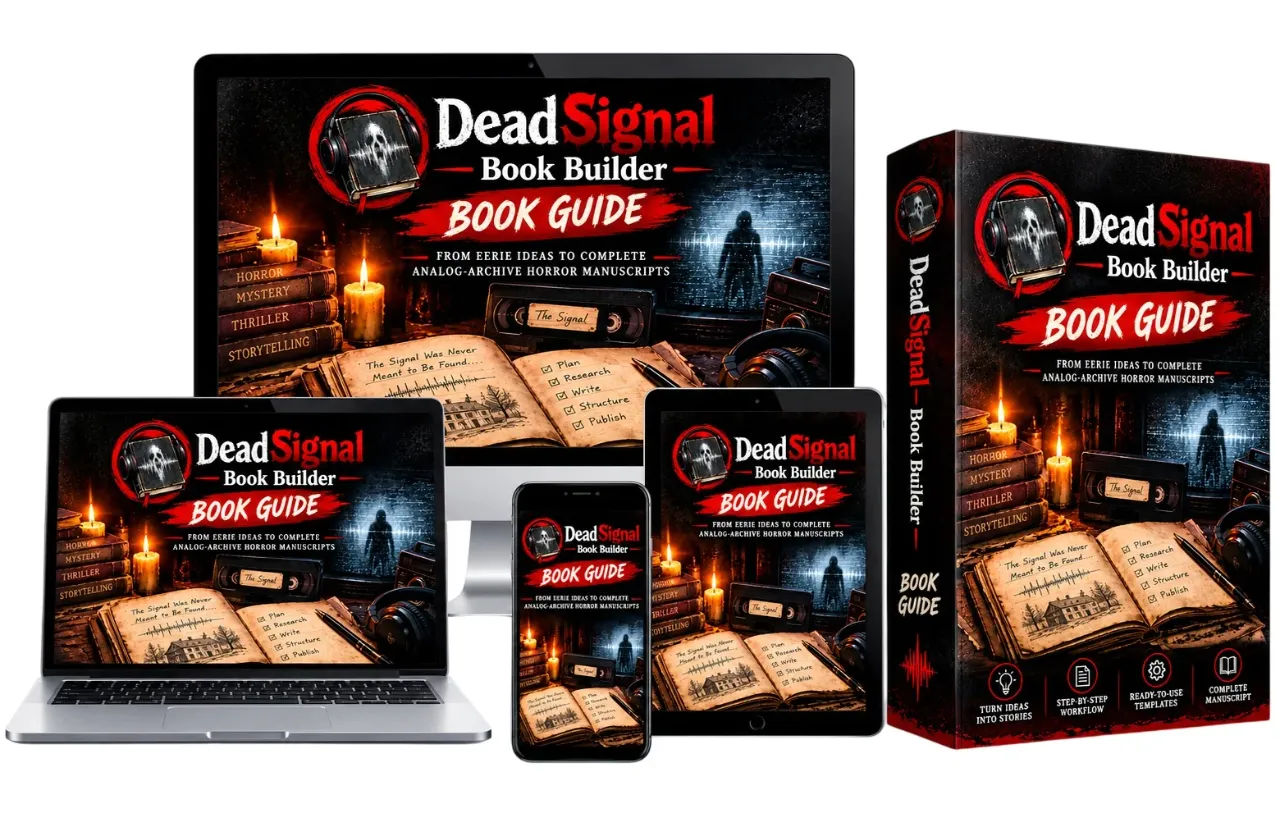
Dead Signal Book Builder is a $17 guided workflow that runs as a Claude Skill, and I bought it because I had a half-finished analog horror manuscript sitting in a folder called draft-v3-FINAL-actual that had not been touched since March. The idea was fine. A community radio station in rural Wales that keeps broadcasting a shipping forecast for a coastline that does not exist. I knew the mood. I could hear the static. What I did not have was chapter twelve, or chapter nine, or any confidence that the thing held together past the first three scenes.
So the pitch on the sales page landed on me the way it is supposed to. It says the problem is not ideas, it is execution, and that nobody handed you a system. That is a fair description of my last four years of writing attempts. I handed over the money and expected, honestly, a prompt pack with better branding. What turned up is more structured than that, and it also has a few gaps the page does not dwell on. Both of those things are true and you should know about both before you spend anything.
I ran one complete idea through it end to end over about five evenings, and I have notes.
Our Verdict
Dead Signal Book Builder
A genuinely useful chapter-by-chapter workflow for analog horror, if you already have an idea and can tolerate a Claude Skill's setup quirks.
One-time payment, 14-day support and refund process
What You Actually Get
Dead Signal Book Builder arrives as a package of Skill files, not as a web app and not as a member's area full of videos. The sales page lists what is bundled: the Skill files themselves, reference documents, templates, examples, tests, validators, installation assets, a customer guide, rebrand instructions, licence documents, and a folder of PLR marketing assets. There are also dead signal book builder setup notes in the included guides, which mattered more than I expected because this is a Claude Skill rather than a normal piece of software.
The practical shape of it is this. You install the Skill, you open it, and you walk your own premise through a fixed sequence. The sequence printed on the sales page runs: Concept Brief, Characters, Threat Rules, Archive Format, Story Bible, Plot, Chapters, Draft, Canon, Review, Revision. Eleven stages. It is not a menu you pick from, it is a rail you move along, and the page is explicit that the order is the point.
You also get a Basic KDP Preparation Checklist at the end, which is smaller than it sounds. It is a checklist, not a formatting service, and it will not design your cover or write your blurb. And there is Series Blueprint Mode, which I have only partly poked at because I am not close to needing it yet.
Key Features and What They Do For You
The feature list is long, so let me say what each one actually changes about your week rather than repeat it.
Beginner Idea Intake and the Horror Hook Builder. These two take a single line, the page uses "I want a story about VHS tapes found in an abandoned TV station" as the example, and turn it into a premise with a shape. For me this was the difference between a vibe and a promise to the reader. It forced me to write down what the hook actually is in one sentence, and that sentence has since stopped me from wandering off into two subplots that did not serve it.
Threat and Entity Architecture. This is the one I did not know I needed. The page promises your monster or mystery ends up with real, consistent rules, and in practice it produces a written set of constraints, what the entity can do, what it costs, what it cannot cross. If you have ever written a haunting that can apparently do anything it likes until the plot requires otherwise, you will recognise why this matters.
Lead Character Builder and Supporting Cast Gate. Two separate stages, which is more than most tools bother with. The word "gate" is doing real work here, you do not move on with a cast that is still a list of names.
Analog Media System. This handles tapes, broadcasts and recovered documents, which is the specific furniture of this subgenre. If you are writing an archive horror book, this is the stage that decides how your documents behave in the story rather than just how they look on the page.
Story Bible. The sales page calls it your single source of truth, and that is accurate. It is a reference document that the later stages check against.
Master Plot and Reveal Ladder. The Reveal Ladder is the interesting one: the page describes it as making your mystery unfold instead of dumping everything at once. That is a real failure mode in first books, and having the reveals listed in order, with what the reader knows at each point, is the kind of thing I would never have built by hand.
Chapter Architecture. Every chapter card is meant to include POV, goal, obstacle and turn, a hook and sensory anchor, a voice line and memorable image, a horror beat and a relationship beat, plus a continuity dependency so nothing contradicts itself later. That is a lot per chapter and it is the reason this product exists. More on this below, because it is where the real value sits.
Canon Tracker, Batch Drafting and Adversarial Story Review. The Canon Tracker is a running record so you stop contradicting yourself three chapters back. Batch Drafting lets you produce scenes in groups rather than one at a time. The Adversarial Story Review stage is framed as finding weak spots before your readers do, and it is genuinely uncomfortable in a useful way.
Targeted Revision and Ending Resolution. Revision scoped to whatever the review flagged, then a dedicated stage for landing the ending, which is where my last attempt died.
Actually Using It
Setup took longer than a normal download. Because it runs as a Claude Skill you are dealing with files and a couple of install steps before anything happens, and the customer guide assumes a certain comfort with moving things around. If you have never installed a Skill before, budget twenty minutes and read the guide properly rather than skimming it like I did. My first attempt failed because I had put a folder in the wrong place. That was my fault, but it is worth saying out loud that this is not a browser tab you open.
Once it was running, I fed it the radio station premise. What came back in the Concept Brief stage was unexpectedly tight. It asked me for the hook and then reflected it back with the sharp edges on, and I found myself deleting two ideas I had been carrying for months because they muddied the premise. That hurt a bit. It was correct.
The Threat Rules stage is where I stopped being cynical. My entity had been vague in my head, a voice on the frequency that says unsettling things. The workflow forced me to define what it wants, what it costs the people who hear it, and what it cannot do. I ended up with a rule that the broadcast can only be heard by someone who is alone, which instantly gave me a reason for every character in the book to be isolated at the worst possible moment. That single constraint generated more plot than six months of notes.
Chapter Architecture is the headline feature and it earns the billing. I ended up with fifteen chapters, each with a POV, a goal, an obstacle and a turn, plus the continuity dependency linking it to what came before. Fifteen is a lot of cards, but they were consistent with each other. In my old draft I had two separate scenes where the protagonist learns about the station's history for the first time. Two. Nobody caught that because nobody was checking.
Drafting scenes was the part I liked least, and not because it is bad. The workflow drafts with you one scene at a time, and the output is serviceable rather than beautiful. It moves the story, it hits the beats on the card, it does the job. If you are expecting prose you can paste into KDP untouched, you will be disappointed and you will also be asking the wrong thing of it. I rewrote most sentences. The bones underneath were sound, and rewriting good bones is a much easier evening than staring at a blank page wondering what happens next.
The Adversarial Story Review was the highlight of the whole process. It went through the manuscript, flagged the chapter where my reveal came too early, pointed out a supporting character who existed only to deliver information, and named two separate places where the threat broke its own established rules. I did not agree with all of it. I agreed with about eighty percent, and that eighty percent was stuff I would have paid a developmental editor to notice.
Total time: roughly five evenings of two to three hours each, plus a chunk of a Saturday. What I have now is a fifteen-chapter architecture, a story bible I actually trust, a written ruleset for the entity, and chapter one drafted and rewritten to a standard I am happy with. That is further than the manuscript has ever been.
Ready to stop letting the idea sit in your notes app?
One-time $17, no subscription
Pricing and Value Analysis
Dead Signal Book Builder costs $17, one time. The sales page states this twice and is clear there is no subscription and no recurring fee.
The page makes a comparison I think is fair to repeat, because it is the right frame. A structural edit from a professional book coach runs into the hundreds, and that is for feedback on a finished book. Ghostwriters cost considerably more. Against either of those, $17 is not really a comparison. The honest question is not whether it is cheap, it obviously is, but whether it does the job you are buying it for.
It is worth being precise about what else you might spend that $17 on, because there are real alternatives and I have tried some of them.
| Option | Typical cost | What you get |
|---|---|---|
| Dead Signal Book Builder | $17 one time | Guided 11-stage workflow, story bible, chapter architecture, canon tracking, review stage |
| Generic AI prompt pack | Varies, often similar | Loose prompts and idea starters, no fixed sequence, no continuity checking |
| Developmental editor | Hundreds and up | Feedback on a manuscript you have already finished, no drafting help |
| Writing craft books | Varies | Teaching, structure theory, no applied output for your specific premise |
The odd thing about the PLR licence, and it is worth flagging early, is that the package comes with Private Label Rights. That means you are allowed to edit the files, rebrand them, and sell your rebranded edition to your own customers. The licence document is explicit that you cannot pass the PLR rights themselves onward, cannot claim Master Resell Rights, and cannot dump the unmodified package into freebie vaults or public drives. Your end customers get a personal use licence only.
For a fiction writer that licence is mostly irrelevant. For someone who already sells digital products, it is a strange and actually significant part of what the $17 buys, and it does not get much attention on the sales page. I do not have a use for it personally. If I did, the economics of this purchase would look completely different.
One more thing on value. The page states that the optional upgrades, the prose-polishing engine, the anti-cliché rewrite system, the multi-book production dashboard and the genre-expansion library, are all separate. It also states plainly that you do not need any of them to finish your book with the front-end product. Based on my run through it, that claim holds. I never once hit a wall that required an upgrade. The gaps I ran into were about setup and about my own writing quality, not about locked doors.
Pros and Cons
Pros
- Chapter architecture with continuity dependencies stops the contradiction problem cold
- Threat rules stage forces a consistent entity instead of a monster that does whatever the plot needs
- Adversarial review genuinely caught a too-early reveal and two broken rules
- One-time $17 with no subscription, and no upgrade required to finish
- The PLR licence lets you rebrand and resell the package if you sell digital products
Cons
- Setup as a Claude Skill takes patience and the guide assumes some file familiarity
- Drafted prose is serviceable, not final, you will rewrite most of it
- It is built for analog and archive horror specifically, other genres get less from it
- The KDP checklist is thin and will not cover formatting or cover design
Who This Is For
First-time fiction writers who have an idea and no structure. That is who the sales page names and I think it is accurate. If you have never plotted a book, do not know what a three-act structure is, and have three dead drafts in a folder, this gives you a rail to walk along and it will not let you skip the boring stages. KDP creators writing in the analog horror, found footage or haunted media space will get the most out of it, because the Analog Media System and the Threat Architecture are shaped around exactly that material.
Writers who have finished books before and just want to draft faster should look at it too, but for a different reason. You already have structure instincts. What you are buying here is the continuity tracking and the review stage, and whether that is worth $17 depends on how often you contradict yourself.
Who Should Skip It
Skip it if you are writing romance, epic fantasy or anything outside horror, because the entity rules and the archive media stages are built for one subgenre and you will be ignoring a chunk of what you paid for.
Skip it if you want finished prose. This drafts with you, it does not write the book for you, and nobody should buy a structural tool expecting sentences they can publish.
And skip it if you want a browser-based app with an account and a dashboard. This is a Skill you install and files you manage. If that sounds like a chore rather than a small setup cost, the friction will wear you down before you reach the good part.
Frequently Asked Questions
Is Dead Signal Book Builder worth it?
For $17, if you have an unfinished horror idea and no structure to build on, yes. It produces a story bible, a full chapter architecture with continuity links, an entity ruleset and a review stage that catches real problems. The drafted prose needs rewriting, but the structural work is the part that is genuinely hard to do alone.
How much does Dead Signal Book Builder cost?
It costs $17 as a one-time payment. The sales page states there is no subscription and no recurring fee. Optional upgrades exist for prose polishing, anti-cliché rewriting, multi-book production and genre expansion, but the page states clearly that the front-end product alone takes you to a complete manuscript.
Do I need Claude or any other software to use it?
Yes. It runs as a guided Claude Skill, so you need Claude access, and you install the Skill files before you can start. The sales page lists installation assets and a customer guide in the package. No other writing software is required, but the setup is files-based rather than a browser login.
What if I have never written a book before?
The sales page names first-time fiction writers as the intended audience, and the workflow supports that. You are not expected to know three-act structure or beat sheets. You bring one idea and follow the eleven stages in order, from Concept Brief through to Revision. The structure is supplied.
What is the refund policy?
You have 14 days from purchase. Open the skill, read the licence terms, and walk a one-line idea through the first stages. If you hit a problem, email the support address given on the sales page, which states a reply within 24 hours. A refund applies when you have contacted support within 14 days and the product, setup or delivery issue cannot be resolved. It does not cover results, sales or income.
Can I resell Dead Signal Book Builder under my own brand?
Yes, the package includes Private Label Rights. You can edit, rebrand and sell your rebranded edition and keep the proceeds. You cannot pass the PLR rights themselves to your customers, claim Master Resell Rights, or add the unmodified package to freebie vaults. Your customers receive a personal use licence only.
What are the alternatives?
Generic AI prompt packs are cheaper but give you loose ideas with no sequence and no continuity checking. A developmental editor gives sharper feedback on a finished manuscript and costs hundreds. Craft books teach structure without applying it to your specific premise, which is the gap this fills. You can check the current Dead Signal Book Builder page for what is bundled before deciding.
Final Verdict
I went in expecting a prompt pack with a moody font and came out with a fifteen-chapter plan that does not contradict itself, an entity with rules I can actually enforce, and a first chapter I am not embarrassed by. The prose it drafts needs real work, the setup is fiddlier than it should be, and the KDP checklist is barely a checklist. None of that undoes the structural work, which is the part I could not do for myself.
At $17 it is a small bet against a manuscript you have already been avoiding for months. If you have an idea that has been in your notes app since last winter, that bet is worth taking. And if you have never installed a Claude Skill before, read the guide properly the first time and save yourself my mistake.
Your idea has waited long enough
One-time $17, 14-day support and refund process