Hero Comic Prompt Studio Review: One Hero, 35 Products
I built one superhero in Hero Comic Prompt Studio and watched it survive four panels without changing face. Here is what the $17 gets you, and where it falls short.
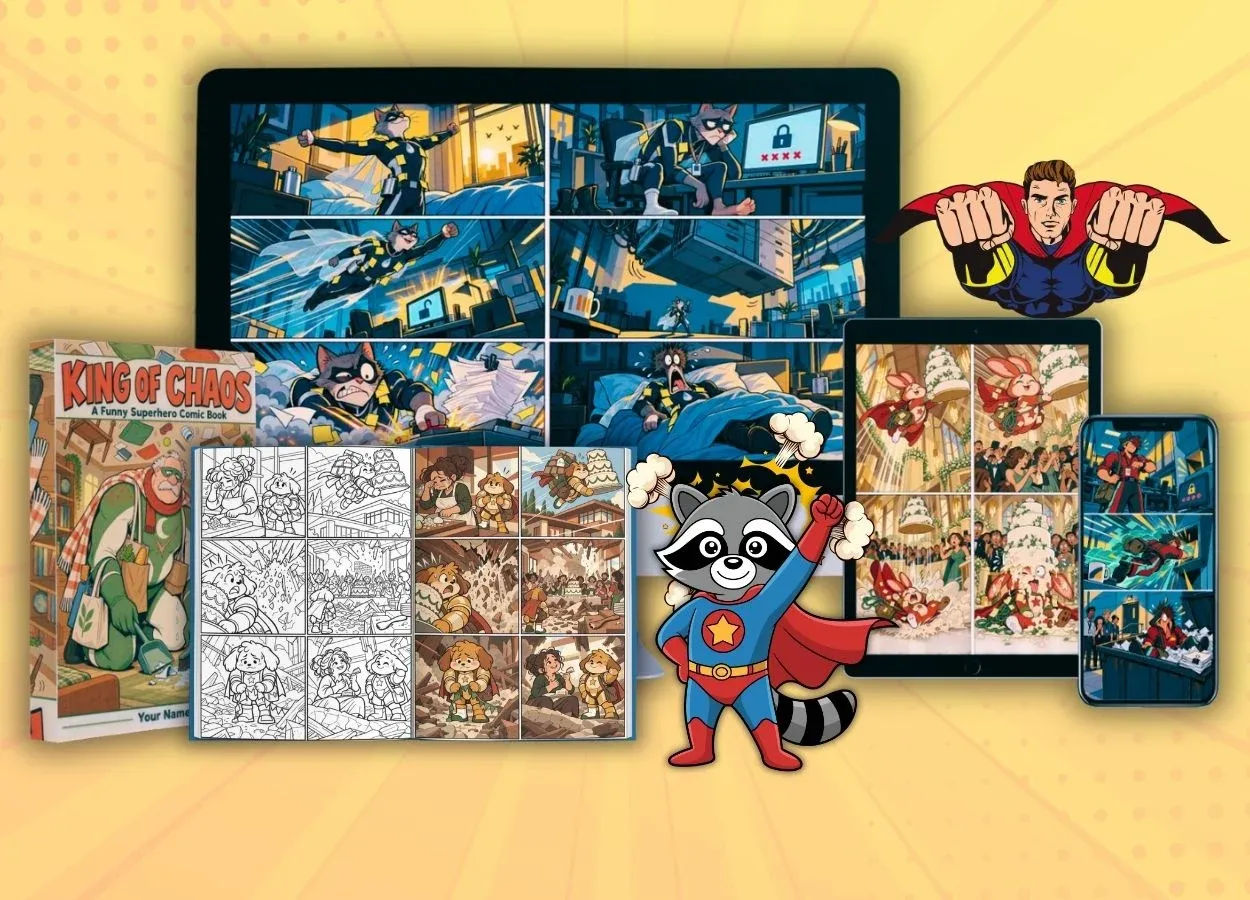
The fourth panel is where every AI comic I have made falls apart. Panel one, my hero has a square jaw and a charcoal raincoat. Panel four, he is a different man wearing a different coat, standing in the same room. I have thrown away more half-finished strips over that one problem than over anything else in this hobby. So when I saw Hero Comic Prompt Studio advertising a "CHARACTER LOCK" as its whole reason for existing, I paid the $17 to find out whether it actually holds.
Short answer: it holds better than anything else I have tried, and the way it does it is almost boringly simple. The app does not generate images. It builds prompts, and it builds them around a locked block of text describing your hero, which gets pasted word for word into every prompt it writes. You still need ChatGPT, Gemini or Midjourney to turn those prompts into pictures. That is worth knowing before you buy, because if you were expecting an image generator you will be disappointed on the first click.
What I actually got for my money was a prompt workshop with a very specific obsession. Everything in it exists to keep one character recognisable across many pictures, and then to point that character at products you can sell.
Our Verdict
Hero Comic Prompt Studio
A prompt builder that solves character consistency for AI superhero comics, with 59 joke engines and 35 product formats bolted on.
One-time payment, no monthly fee, no API keys
What You Actually Get
The core of the product is a browser app. The sales page says you sign in from any computer, there are no API keys and no monthly fee, and the $17 is a one-time payment. My access worked on a laptop and on my phone without any extra setup.
Inside, the listed contents are:
- 59 joke engines, each carrying five or six ready-made gags, for a stated total of 300+ gags
- 20 limitations written as visible consequences (can fly, but only when nobody is watching)
- 30 useless second powers (always finds a parking space, knows the exact battery level of any device)
- 40 day jobs, each with its own workplace, props and four everyday disasters
- 15 flaws and 12 secret fears, written as things an image model can actually draw
- 6 art styles and 11 panel layouts
- 35 product formats across print on demand, KDP, social and Etsy
- A 902 entry name blocklist, which exists to stop you accidentally naming your hero after an existing trademarked character
- Character Lock, which turns your hero's design choices into plain text that goes into every prompt
The four suggested joke engines at the top of the engine picker, matched to the hero you built, are the part I did not expect and ended up using most. You never scroll all 59.
Key Features and What They Do For You
Character Lock. This is the product. You pick a species and build, a face, headgear, a costume, an accent colour, an emblem, a cape, a signature prop and three locked colours. The app turns those into a plain text block with lines like NAME, SPECIES/BUILD, COSTUME and CONSTANT. That block is then inserted into every prompt the app writes, never shortened and never rewritten. You can copy it, save it, and paste it into any other tool you use later.
The CONSTANT line is the clever bit and it is easy to miss. It is one small visual oddity, in the example on the sales page a plaster wrapped around the left thumb. Image models redraw a small repeating detail more reliably than they redraw a whole face. So when the face drifts a little between panels, the plaster is still there and the reader still knows who they are looking at. That is a working trick, not a marketing line.
The limitation engine. Twenty powers with a stupid condition attached. Flying is not funny. Flying only when nobody is watching is funny, because it creates a scene you can draw. Each limitation is written as a visible consequence rather than an abstract rule, which matters because "can't control their power" is something an image model ignores and "clothes stay full size when they shrink" is something it draws.
Forty day jobs. Pick librarian and the strip takes place between tall bookshelves and SILENCE signs. Each job brings its own props and four everyday disasters, so your comedy has somewhere to physically happen instead of floating in a blank void.
Fifteen flaws and twelve secret fears. Written as drawable things. An AI cannot draw "anxious", but it can draw a hero wrapped in sticky notes with one eyebrow permanently raised. The flaw then becomes a running gag and the fear shows up exactly when it hurts most.
Five story rhythms. Standard, Tender, Epic Trivial, Contrast and Mystery. The rhythm decides the shape of the punchline and assigns camera angles per panel, which is the difference between a strip that reads like a comic and four unrelated funny pictures stacked vertically.
Six art styles. Saturday Cartoon, Newsprint Pulp, Flat Webcomic, Marker Sketch, Cinematic Painted and Chibi Sticker. Each one is described to the model using technical attributes only, linework, shading, palette, texture. No artist names, no film references, no studio names. That is deliberate and it is the reason your listings are less likely to get pulled.
35 product formats. Here is where it stops being a toy. Colouring Page produces clean outlines with no shading and no grey tones. Activity Page covers eight kinds including maze, spot the difference, dot-to-dot, hidden objects and draw the other half. Print on demand formats ask for flat colours and bold shapes that still read at thumbnail size. Eight image formats cover pins, carousels, feed posts, vertical stories, thumbnails, avatars and banners.
Actually Using It
I built a hero in about nine minutes. The Hero Forge screen asks two things up front, what they can do and the stupid catch, then draws the whole look with one button. There are twenty fields underneath if you want to fiddle, and the sales page says twelve of them accept your own wording. I used the defaults on the first pass to see what a beginner would get.
It gave me a hero with the limitation "can talk to animals, but they only ever complain". The app picked a late-night bus driver with a permanent squint, a high-vis vest, and a milk crate as a signature prop. Then it wrote the layout: panel one, normal bus stop. Panel two, pigeons line up on the shelter roof. Panel three, pigeons start listing grievances. Panel four, the hero's face doing something between despair and resignation.
I pasted that prompt into ChatGPT for the jokes and into Midjourney for the panels. Four panels came back. The face was the same face four times. The high-vis vest was the same high-vis vest. The milk crate was there in three of the four panels and possibly behind a bench in the fourth. I have never had that happen before without hand-editing.
Not everything survived. The squint softened in panel two and was gone by panel four. The milk crate picked up a dent in panel three that was not there in panel one. But the reader-facing problem, the one that makes a comic unreadable, was solved. The character looked like one person in a costume rather than four cousins wearing similar clothes.
The joke engines are where the app gets genuinely useful rather than just clever. I picked Sound Effect Betrayal for a librarian character, because the app suggested it and explained why in one line: their secret fear is sudden loud noises. Fine. I hit Another gag eleven times on the same engine and got eleven different jokes, all of them built around the same librarian, none of them repeating. The jar lid. The paper cut. The stubbed toe. The static shock. The engine is not a randomiser, it is a shape, and the gags fill the shape with different furniture.
Where it fell down: the prompts that come out are long. Mine ran to several hundred words each. Long prompts are usually good for image models, but if you are pasting four of them into Midjourney in one session you will be doing a lot of scrolling on a phone. I ended up on a laptop.
I also tried a KDP style colouring page from the same locked hero. The output was clean outlines, no shading, no grey. It printed fine. The line weight was too thin for a young child to colour comfortably, which is a limitation of the style, not a bug, but worth knowing if that is your plan.
The character lock is the whole product and it works
One-time $17, no subscription, sign in from any computer
Pricing and Value Analysis
Hero Comic Prompt Studio is $17. One-time payment, no monthly fee, no API keys. The only other figure on the sales page is $80, and that is not a second price tier I can verify, so I am treating this as a flat $17 purchase with no upsell I can confirm. The page does mention an optional upgrade inside the app for turning a finished strip into shot-by-shot video prompts, and twelve more art styles come with it. I have not seen that upgrade and the page is explicit that you do not need to buy it to use the app.
Here is how it compares to the obvious alternatives at the same job.
| Option | Cost | Character consistency | What you still have to do |
|---|---|---|---|
| Hero Comic Prompt Studio | $17 once | Built in, via a locked text block | Write nothing, but paste prompts into an image tool |
| Free prompt lists and Pinterest boards | $0 | None | Everything, including keeping the face the same by hand |
| Raw ChatGPT or Gemini | $0 to $20 a month | Possible, if you write your own consistency block and never shorten it | All the prompt engineering, every session |
| Hiring an illustrator | Varies wildly | Total | Nothing, but you pay per page and revisions cost more |
The honest comparison is the third row. If you are already comfortable writing your own character consistency block, pasting it into every prompt and maintaining it across months, you do not need this app. You have already built it yourself.
If you have not done that, $17 is roughly what you would spend on two coffees to skip the part where you learn how. I think that is the actual value here. Not the 59 engines, not the 35 product formats. The value is that somebody else worked out the formula for keeping a character on model and packaged it as a block of text you can copy.
One thing I want to be straight about: the $17 does not buy you a character brand. It buys you a method. The product formats, the Etsy shop, the KDP book, the Pinterest account, all of that is still work you have to do. The app removes the consistency problem and the blank prompt box problem. It does not remove the rest.
Pros and Cons
Pros
- The Character Lock genuinely fixes panel-to-panel face drift
- Suggested joke engines explain why they fit your hero instead of making you scroll 59
- 300+ gags from 59 engines means the same engine produces different jokes each time
- 35 product formats mean content and products come from one character build
- Art styles described by technical attributes only, no artist or studio names
- One-time $17, no monthly fee, works in a browser
Cons
- It is not an image generator, so you still need ChatGPT, Gemini or Midjourney
- Prompts are very long and get unwieldy to paste on a phone
- The CONSTANT detail survives better than the face does, so small drift still happens
- The optional video upgrade and 12 extra styles are not included
- The colouring page line weight is thin for young children
Who This Is For
Social content creators who want a running character instead of one-off funny pictures. Etsy sellers who want a shop where every sticker, card and pattern carries the same hero, because that is what turns a pile of files into a brand. KDP publishers making colouring and activity books, where the same face has to hold from page 3 to page 30. And anyone who has tried to write four panels that build to a punchline and discovered that is a different skill from having a funny idea.
If you already sell digital products and you have been avoiding comics because of the consistency problem, this is a cheap way to find out whether you like the format.
Who Should Skip It
Skip it if you want an image generator. It does not make pictures. It writes prompts, and you paste them into something that does.
Skip it if you already run a consistent character workflow. You have solved the problem this app solves, and $17 buys you nothing new.
Skip it if you are not going to do the work after. The app removes the two hardest technical obstacles. It does not open the Etsy shop, publish the book or post the carousel. If you are looking for a done-for-you product, this is not one, and I would rather say that than have you buy it and find out.
Frequently Asked Questions
Is Hero Comic Prompt Studio worth $17?
Yes, if character consistency is the thing blocking you. The Character Lock block solves panel-to-panel face drift better than anything I have tried, and $17 is a one-time payment. It is not worth it if you already maintain your own consistency prompts, because you have already solved the problem it exists to solve.
Does Hero Comic Prompt Studio generate images?
No. It builds text prompts that you paste into ChatGPT, Gemini, Midjourney or another model. The app handles character design, joke structure, panel layout and art style description. The image generation happens elsewhere. No API keys are needed, and there is no monthly fee for the app itself.
Do I need Midjourney to use it?
No, the sales page names ChatGPT, Gemini and Midjourney as the models it writes for. OpenAI's image tools, Google's, and Midjourney all work with the prompts. Any model that accepts a long text prompt and produces an image will do, though results will vary between them.
How does the Character Lock keep my hero consistent?
It turns your design choices, species, face, costume, emblem, colours and signature prop, into a block of plain text. That block is inserted into every prompt the app writes, word for word, never shortened. A CONSTANT line with one small repeating detail acts as a backup so readers still recognise the character when the face drifts slightly.
Can I sell what I make with Hero Comic Prompt Studio?
The art styles are described using technical attributes only, such as linework, shading, palette and texture, with no artist, film or studio names. That is deliberate and is described on the sales page as what keeps listings safe to sell. There is also a 902 entry name blocklist to reduce trademark risk. That is the claim the page makes, not a legal guarantee.
Is there a refund policy?
I cannot confirm one. The sales page I worked from does not state a refund window or a guarantee, so I am not going to invent one. Check the checkout page or contact the vendor directly before you buy if a refund policy matters to you.
What are the best alternatives?
Raw ChatGPT or Gemini with a consistency block you write yourself covers the same ground for free, if you know how to build one. There are free prompt lists around, but they do not hold a character across panels. Hiring an illustrator solves it completely but costs far more per page. Hero Comic Prompt Studio sits in the middle, and $17 is a low price for finding out whether that middle suits you.
Final Verdict
I got what I paid for, and slightly more. The Character Lock is not marketing fluff, it is a working method, and it is the reason I finished a four panel strip for the first time without hand-correcting the artwork. The suggested engines and the 300+ gags mean the joke writing does not stall, and the 35 product formats turn one hero into a shop rather than a single post.
Where it disappoints is where it was always going to. It does not draw. The face still drifts a little, and you still need an image model and a bit of patience with very long prompts. The optional video upgrade is not included and I cannot tell you much about it.
But for $17 once, with no subscription, it solves the one problem that has killed every AI comic I have started. If you have been circling superhero content and getting nowhere past panel two, this is the cheapest fix I have found. If you have already cracked consistency on your own, save your money and keep doing what you are doing.
Build one hero, then sell them 35 ways
One-time $17, no monthly fee, no API keys, sign in anywhere