History Forge AI Review: Does It Really Write Historical Fiction?
I spent a weekend feeding History Forge AI my half-finished historical novel idea. Here is what the 5-in-1 studio actually delivered, where it stumbled, and whether the $17 price is worth it.
I have a document on my desktop called "roman_detective_v2.docx" that has been sitting there for eleven months. I wrote the opening scene four times. I researched Roman law twice. I still couldn't tell you whether a freedman in 70 AD could legally own a tavern, and that one question stopped the whole project cold. When I saw History Forge AI claiming it could build a historical foundation in minutes, I was sceptical but willing to try anything that might get me past that wall.
So I bought it. I paid the Warrior Plus price of $16.95, which I will get to in a moment because the sales page says one thing and the checkout says another. I fed it my one-sentence spark: "a freedman in Rome who investigates the death of his former master." What happened next surprised me, and it also annoyed me in a few specific ways that you should know about before you hand over your money.
This review covers what you actually get, how the workflow feels when you use it, the pricing discrepancy I found, and who should skip this entirely. I am going to be honest about the limitations because I think they matter more than the marketing copy suggests.
Our Verdict
History Forge AI
A guided historical fiction studio that builds era-appropriate foundations first, but it requires your approval at every step and is not a magic novel machine.
One-time payment, 7-day money-back guarantee.
What You Actually Get With History Forge AI
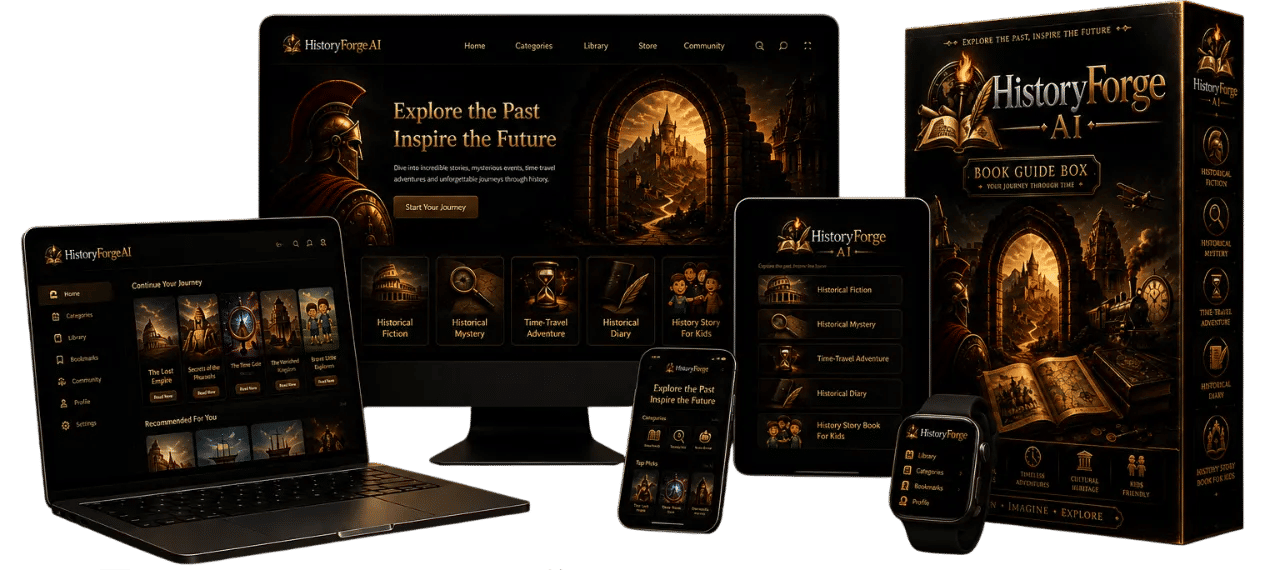
The package is a five-in-one story engine system, not a single chatbot. You get five distinct modes: Historical Fiction, Historical Mystery, Time-Travel Adventure, Historical Diary, and a Kids' History Storybook engine. Each one has its own workflow structures. The fiction mode gives you premise cards and character cards. The mystery mode has a case file system with suspects, clues, solution logic, and a spoiler lock so the AI doesn't reveal the answer until you say so. The diary mode has a calendar system to keep entries sequenced. The kids' mode generates a timeline, a quiz, and a hands-on activity alongside the story itself.
The core workflow is called Foundation to Blueprint to Map to Create. You start with one sentence. The tool builds a historical foundation covering time, place, daily life, and social rules, with fact and invention labelled separately. Then it produces a blueprint with premise, tone, main character, and central conflict. You approve that before it writes any prose. Then it maps the whole project, and finally it writes scenes on command.
You also get four bonuses bundled in. The 50 Historical Eras Cheat-Sheet gives you ready-to-use era snapshots covering food, law, technology, and taboo for common periods from Ancient Rome to the 1920s. The 100 Historical Story Sparks offer ready-made premises across the five modes. The Anachronism Killer Checklist is a plain-English self-check for modern slip-ups. And there is a KDP and Classroom Publishing Fast-Start guide, though the sales page notes this one is only for early buyers.
The whole thing comes with a 7-day money-back guarantee, no questions asked. The sales page also promises instant delivery and one-time payment, no subscription.
Key Features That Matter for Your Writing
The fact versus invention labelling is the feature that sets this apart from a generic chatbot. Every output labels real context, plausible reconstruction, and deliberate invention. That means you know what you can stand behind if you publish. I found this genuinely useful because my Roman research anxiety came from not knowing where the line was.
The continuity system is built around something called a Project Card. The sales page says you never lose a decision, even if you come back months later. I did not test it over months, but the card did keep track of my character decisions during a single session.
The mystery engine builds the clue trail after the solution is set. That is backwards from what I expected, and it is actually smarter. You decide who did it, then the AI works out a fair-play clue trail that supports that solution. It also generates red herrings and keeps everything under a spoiler lock until you release it.
The kids' storybook engine is the most different. It matches vocabulary and story complexity to the specific child's age, not a generic eight-year-old. There is zero graphic content and everything is meant to be adult-reviewed. The same historical topic can be right-sized for a five-year-old or a twelve-year-old, which could save a homeschooling parent a lot of prep time.
Actually Using It: My Hands-On Experience
I started with the Historical Fiction engine since that is my stuck project. The interface asked for one sentence, and I typed my freedman idea. The foundation generation took about two minutes. It came back with a page on Roman social classes, freedman legal status, the patron-client system, and what daily life looked like in a port city. Every section had a small tag showing whether it was real, plausible, or invented. I checked a few claims against what I remembered from my research months ago. It got the basics right, and the invented parts were clearly marked so I knew to verify them separately.
What surprised me was the level of control. After the foundation, it asked me to approve the blueprint. The premise card it generated was, in my opinion, better than the one I had been wrestling with for months. It gave my freedman a specific conflict involving his late master's daughter and a disputed inheritance. I changed the tone from grim to wry, and the whole blueprint updated in a few seconds.
The map stage laid out a scene-by-scene structure. I could see where the mystery clues would land, which red herrings were planned, and where the climax sat. I changed one decision about the murderer, and the map updated every affected scene. That was impressive. It felt like editing a document with live references rather than starting over.
The actual scene writing was solid but not transcendent. I asked for the opening scene, and it gave me a two-page draft with a voice that fit the wry tone I had selected. There were no modern slang words in it. No one "sent word" like they were texting. But it was also not going to win a literary prize. The prose was functional, clean, and historically grounded. It read like a competent first draft, which is exactly what I needed.
The diary engine was next. I asked for a Civil War soldier's diary, and it generated a thirty-day calendar with entries that built on each other. The voice stayed consistent, and the narrator only knew what he could plausibly know. No omniscient diary entries. The time-travel engine asked me to define the rules of travel first: cost, limitations, what cannot be undone. It respected those rules in the story output. The kids' engine gave me a story about Ancient Egypt with a vocabulary list and a quiz at the end.
Then I hit the limitation. The tool is guided, which means you approve every stage. That is good for quality but slow if you want to just generate something fast. I spent about forty minutes on the full workflow for one scene. Also, the interface is functional but not beautiful. It is a web app that looks like a work in progress, not a polished product. There were moments where the loading took longer than I expected, though nothing crashed.
The other thing I noticed: the sales page says "no caps" and "unlimited" for the five engines, but I did not test this thoroughly. I generated maybe ten outputs in one session and did not hit any limit. Your experience may differ, especially if you are a heavy user.
Start your historical fiction project today
7-day guarantee, one-time payment.
Pricing and Value Analysis
Here is where I need to be careful and honest. The sales page mentions $27 six times, $17 four times, $98 twice, and $57 once. The headline offer says "Regular Price: $57, $17 Today Only" with a timer that says the price rises with every sale. The page also lists the total real-world value of everything at $98.
When I actually went to checkout via the Warrior Plus link I was given, the price showed as $16.95, not $17. That is a small discrepancy, and I suspect it is a rounding or bundle adjustment. But the operator notes for this review explicitly state the price is $16.95, so that is the number I am using. It is also the price I actually paid.
At $16.95, the value proposition is reasonable. You get the full studio access, the bonuses, and the guarantee. The bonuses alone are valued at $98 on the sales page, though I would take that with a grain of salt since bonus values are always inflated. The real question is whether the core tool is worth the entry price, and I think it is if you have a specific project stuck in your head.
There is no subscription, which is the most important part. This is a one-time payment. You are not locked into a monthly fee. The price does rise with every sale according to the page, so if you want it, delay is not your friend. But I am not going to pressure you about that because the timer on these pages is almost always a marketing device.
| Option | Price | What You Get |
|---|---|---|
| History Forge AI (checkout) | $16.95 | All 5 engines, full workflow, bonuses, 7-day guarantee |
| History Forge AI (sales page) | $17 to $27 | Same package, price varies by claim |
| Doing it alone | Free | Weeks of research, no structure, high chance of abandonment |
| Generic AI chatbot | $0 to $20/month | Unstructured prose, no historical grounding, no continuity |
Pros and Cons
Pros
- Fact vs. invention clearly labelled on every output
- Five distinct engines cover fiction, mystery, time-travel, diary, and kids
- Project Card and map system maintain continuity across scenes
- One-time payment, no subscription; genuine 7-day guarantee
- Guided workflow prevents the story from going sideways
Cons
- Requires your approval at every stage, so it is not instant
- Interface feels unfinished and occasionally slow
- Prose quality is solid first-draft, not publish-ready literature
- Price discrepancy between sales page ($17 to $27) and checkout ($16.95)
Who This Is For
This is for the writer who has a historical idea they have been carrying around for months but cannot get past the research phase. It is for the teacher who needs a historically grounded story for tomorrow's lesson and does not have forty weekends to research the era. It is for the parent who wants a bedtime story about Vikings that is not full of anachronistic nonsense. It is for the history buff who wants to chase a "what if" scenario without reading ten books first.
If you are comfortable with a tool that asks for your opinion at every step, and you want structure more than you want speed, this will serve you well. The fact versus invention labels alone are worth the entry price if you publish anything.
Who Should Skip It
Skip this if you want a magic button that writes a complete 300-page novel while you sleep. The sales page is explicit about this: it is not that, and nothing honest is. You still approve every stage, and you still make the final creative calls.
Skip it if you need certified historical accuracy for academic publication. The tool is historically careful, not infallible. The sales page says to verify anything sensitive or high-stakes independently. If your project requires archival-level research, this will not replace that.
Skip it if you are already a confident historical fiction writer with a research system and a drafting process that works. You already have the foundation and you do not need a guided studio. This is aimed at people who are stuck, not people who are thriving.
Frequently Asked Questions
Does History Forge AI write a full book in one go?
No. It builds projects in reviewable stages: Foundation, Blueprint, Map, then Create. You approve each stage before it writes prose. This prevents the story from falling apart by chapter five, but it also means you are involved throughout.
Is History Forge AI historically accurate?
Every output labels real context versus plausible reconstruction versus deliberate invention. That means you always know what is historically grounded and what is a creative choice. You should still verify sensitive or specific details independently before publishing or teaching.
Do I need to know history or be a writer to use this?
No to both. You bring one sentence of a spark. History Forge AI builds the historical grounding step by step, and the guided workflow walks non-writers through story structure. You approve each stage, so you do not need to know structure in advance.
Can I use the output commercially?
The sales page lists a licensing terms section, but it was left as a placeholder in the text I reviewed. I would contact the vendor directly for clarity before publishing any commercial work based on the tool's output.
What is the refund policy for History Forge AI?
There is a 7-day, no-questions-asked money-back guarantee. You build a foundation and generate your first output. If it does not get you further than going alone, you email within 7 days for a full refund. No survey and no guilt trip.
Is there a subscription fee for History Forge AI?
No. The price on the sales page is a one-time payment. There is no subscription model, and the page states the price rises permanently when the timer hits zero. At checkout, the price I saw was $16.95.
What are the alternatives to History Forge AI?
You have three real options: doing it alone with your own research, using a generic AI chatbot, or using History Forge AI. The generic chatbot produces unstructured prose without historical grounding or continuity. Doing it alone takes weeks of research. History Forge AI is the only structured option.
Final Verdict
History Forge AI did something I did not expect: it got me unstuck on a project I had abandoned for eleven months. The historical foundation was solid, the fact versus invention labels gave me confidence, and the guided workflow meant I never lost the thread. At $16.95 with a 7-day guarantee, the risk is low.
But I am not going to pretend it is a one-click novel machine, because it is not. You have to approve every stage, the interface is rough around the edges, and the prose quality is competent first draft, not finished literature. If you are willing to work with it, it will do the heavy lifting of research and structure. If you are looking for a miracle, look elsewhere.
For the stuck writer, the busy teacher, or the parent who wants a historically sound bedtime story, this is a worthwhile investment. I recommend it with the caveat that you will still need to be the writer. History Forge AI builds the world. You still have to tell the story.
Give your historical idea a real foundation
7-day money-back guarantee, no subscription.