KDP Keyword Gold Rush Review: The One Publishing Lever Most Sellers Ignore (And Why It's Costing You Sales)
I remember sitting in front of my KDP dashboard staring at a book that had been live for seven weeks.
Forty-three KENP pages read. Two sales. Both to friends who probably felt obligated.
This wasn't my first rodeo. I'd published before. I'd followed the YouTube tutorials. I'd commissioned a decent cover. I'd written a description that hit the emotional notes. I'd even run a small Facebook ad campaign that burned through $50 with exactly one sale to show for it.
And here I was, watching another book sink into the Amazon abyss where millions of titles go to die quietly.
The frustrating part? I knew the content was solid. The niche existed - people were buying something in this category. Just not from me. My book was technically on Amazon, but it might as well have been printed on paper and buried in my backyard.
Sound familiar?
If you've published anything on KDP - fiction, non-fiction, a journal you designed in Canva - you know this feeling. You did the work. You followed the steps. You hit publish. And then... silence.
Most people blame the cover. So they tweak the cover. Nothing changes. They blame the price. They run a countdown deal. Still nothing. They blame Amazon's algorithm for being mysterious and unfair.
I almost quit twice. What stopped me wasn't some viral breakthrough or a "make money while you sleep" course. It was stumbling onto something so fundamental that I couldn't believe I'd missed it for years.
The keywords.
Not the obvious ones. Not the broad, competitive terms everyone fights over. The specific phrases real people type into that search bar when they're ready to buy something.
That's what finally made me look at. KDP Keyword Gold Rush when it crossed my radar. Not because I believed in magic bullets - I've tested enough products to know those don't exist. But because I'd finally accepted that I'd been guessing about something Amazon had given me seven slots to get right.
Why I Was Skeptical (And Why You Probably Are Too)
Let me be honest about something.
When I first saw KDP Keyword Gold Rush, my internal skeptic filter activated immediately. Another keyword tool? Another "system" that promises visibility without ads? Another person telling me I've been doing it wrong and they have the secret?
I've tested enough products in this space to know that most of them fall into two categories: either they're so basic that you could find the information in a free blog post, or they're so complicated that you need a background in data science to use them effectively.
What caught my attention with this one was the approach.
Amy Harrop (the creator) didn't lead with "make millions overnight" or "discover the secret Amazon doesn't want you to know." She led with a stat that stopped me mid-scroll: Amazon paid KDP Select authors almost $65 million in December alone. Not "you could make this." Just... this is happening. The money is moving. The question is whether your books are positioned to catch any of it.
The second thing that made me pause? The emphasis on the seven keyword slots.
If you've published on KDP, you've seen these slots. Seven boxes. Seven opportunities to tell Amazon's algorithm what your book is and who wants it. Most people - including me, for years - treat these like an afterthought. Type in some variations of your genre, hit save, move on to the next book.
But here's what I learned the hard way: Amazon is a search engine. It works exactly like Google. When someone types "ADHD morning routine for adults" or "grumpy small town romance with firefighter" into that search bar, Amazon's algorithm scans those seven slots plus your title and description to decide which books to show.
If your keywords don't match what real people are actually typing? You don't exist. It's that simple.
So I decided to test KDP Keyword Gold Rush on two books: one new release I was preparing, and one dead book that hadn't sold in eight months. No expectations. Just curiosity about whether better keywords could actually move the needle.
What's Actually Inside (The Parts That Matter)
Before I walk you through my experience using this, let me clarify what you're actually getting. Because "keyword tool" can mean a lot of things, and most of them involve expensive monthly subscriptions and spreadsheets that make your eyes glaze over.
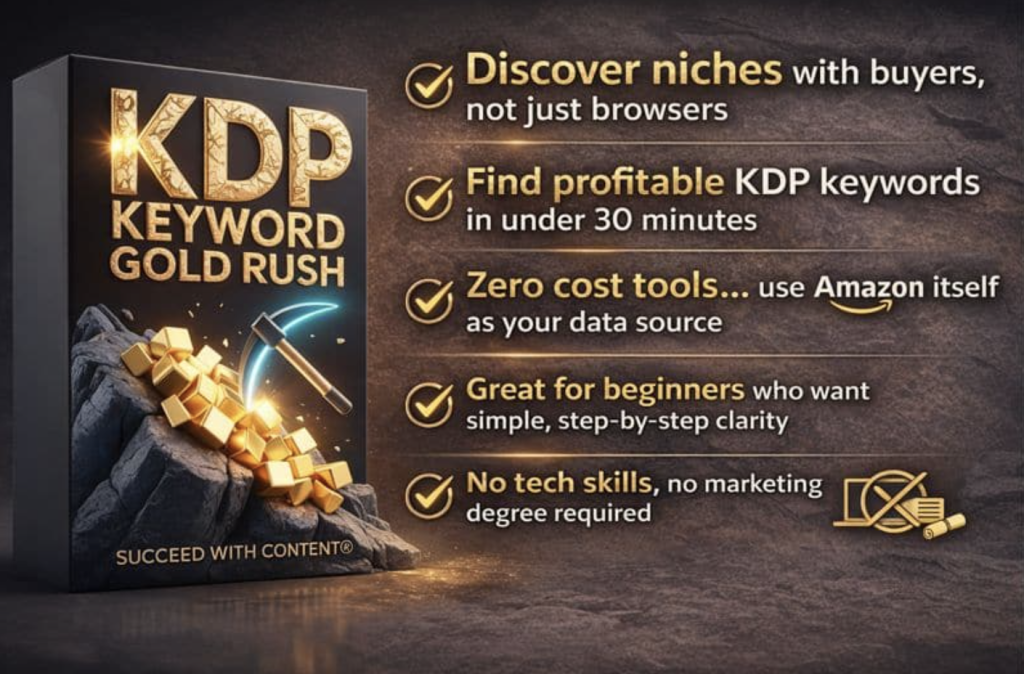
Here's what's included in KDP Keyword Gold Rush:
The Core Guide (About 60 Pages)
This is the actual training. Not a fluff PDF with screenshots of things you already know. It walks through why Amazon's algorithm prioritizes certain books, the four types of reader intent (this insight alone was worth the price of entry for me), and a repeatable process for finding keywords that real people actually search for.
KDP Keyword Prospector Custom GPT
This is the automation piece. It's a custom version of ChatGPT trained specifically on Amazon keyword strategy. You feed it your book topic or niche, and it generates 50+ keyword ideas organized by buyer intent, then helps you narrow down to the seven that actually matter for your backend slots.

Video Walkthrough + Transcript
If you're not a reader (or you want to watch someone else do it first), this shows exactly how to use both the guide and the GPT with real examples across different genres.
The Power Pack
Three quick-reference tools that I've actually used more than I expected:
- A Reader Intent Card that helps you judge any keyword in ten seconds
- Title Formula Sheets for different genres (fiction, non-fiction, low-content)
- A 7-Day Pre-Launch Sprint that tells you exactly what to do before hitting publish
Bonus: 487 Online Niche Markets
A curated list of validated niches with active audiences. Not keyword research per se, but idea generation for what to write about in the first place if you're running low on inspiration.
My Experience Using KDP Keyword Gold Rush on Real Books
The Onboarding: No Tech Headaches
I'll start with the part that usually frustrates me about products like this: the setup.
The guide is delivered as a PDF. The video training is hosted on a standard platform. The Custom GPT requires ChatGPT access (the free version works fine - I tested on both free and paid to confirm).
I was up and running in about twelve minutes. No software to install. No accounts to create. No "you need this other tool first" surprises. Just download, open, start.

The Keyword Harvest: Where It Got Interesting
I decided to test the system on a non-fiction book I was preparing about meal planning for families with picky eaters. The niche exists. Competition exists. I'd normally just guess keywords like "meal planning", "family meals", "picky eaters cookbook" - the obvious stuff that probably has millions of competing results.
The process in the guide walks you through something called "The 30-Minute Keyword Harvest." It's a manual method using Amazon's own search bar and a few free techniques to find what real people are actually typing.
I won't give away the exact method (that's what the guide is for), but here's what surprised me: within twenty minutes, I had a list of 47 keyword phrases I would never have thought of. Not random variations - specific phrases with clear intent behind them. Things like:
- "meals picky eaters will actually eat"
- "family dinner ideas no fights"
- "weeknight meals for sensory kids"
- "dinner solutions for autistic children"
These weren't just keywords. They were problems. Real problems that real parents were typing into Amazon hoping to solve. And none of them were things I would have guessed on my own.
Then I ran the same book topic through the KDP Keyword Prospector GPT.
This part honestly impressed me. The GPT didn't just spit out a list of keywords. It organized them by intent type (which the guide explains in detail), suggested which ones would work best in backend slots versus title versus description, and explained why each recommendation made sense for that specific book type.
Total time from opening the GPT to having my seven optimized keywords selected? About four minutes.
The Resurrection Test: Can You Really Fix a Dead Book?
This was the real test for me.
I picked a low-content book - a gratitude journal for new moms - that had been sitting dead for eight months. Twelve sales total in its lifetime, none in the last four months. I'd written it off as a failed experiment and moved on.
Using the resurrection strategy from the guide, I:
- Ran the book through the Keyword Prospector GPT
- Got a list of keywords I hadn't considered (things like "postpartum mental health journal," "new mom self care notebook," "fourth trimester diary")
- Updated my title and subtitle to include the primary keyword phrase naturally
- Rewrote my description using the formula sheets
- Updated the seven backend keyword slots
- Republished
Total time investment: about twenty-five minutes, mostly because I overthought the description rewrite.
The result? In the first week after republishing, the book got 847 KENP page reads and three sales. Not life-changing numbers, but for a book I'd completely given up on? Significant. More importantly, the trend continued - that book has now consistently outsold its pre-resurrection numbers every week for two months.
Here's what I didn't expect: the keyword changes didn't just affect Amazon search. The same keywords helped the book get discovered on Google searches too, which led to a few off-Amazon sales I wouldn't have gotten otherwise.
What Surprised Me (Good and Bad)
The good surprises:
The Reader Intent Card is genuinely useful. It's a one-page cheat sheet that helps you look at any keyword and instantly judge whether someone typing it is browsing or ready to buy. I've started using it on every book I work on, and it's saved me from wasting keyword slots on phrases that sound good but don't convert.
The system works across platforms. I tested the same keyword approach on a Draft2Digital upload, and within two weeks, that book was getting more visibility than anything I'd put there before. Keywords aren't just an Amazon game - they're how all search-based platforms work.
The resurrection section alone justified the purchase. If you have even one published book that isn't selling, the ability to fix it in under an hour is worth more than the cost of entry.
The limitations (real ones):
The Custom GPT occasionally generates keyword ideas that are too long or too niche. You still need human judgment to filter the results. If you're the type who wants a tool to do everything and make all the decisions, this will frustrate you. It's an assistant, not a replacement.
The resurrection method works better for non-fiction and low-content than fiction. Fiction keyword strategy is different - more genre-focused, less problem-focused - and while the guide covers it, the GPT seems optimized for non-fiction and low-content books. If you write fiction, you'll still get value, but you'll need to adapt more manually.
The 7-day guarantee is shorter than I'd like. Most products in this space offer 30-60 days. Seven days is enough to test the system on one book, but barely. If you're the type who buys and forgets, you might miss the window.
How It Compares to Other Options (Mentally)
I've tested several keyword tools over the years, and I think context is helpful here.
Most keyword tools fall into one of two camps: the expensive monthly subscription tools that give you more data than you know what to do with, or the free Chrome extensions that show you basic metrics but don't teach you strategy.
For context, there are tools like Publisher Rocket (one-time payment around $199) that offer comprehensive keyword and category research . Others like KDSPY (paid subscription) provide competitor tracking and niche discovery . There are even free Chrome extensions like KDP Miner that automate some keyword analysis . And for those on tight budgets, tools like Keyword Tool Dominator offer limited free searches with paid upgrades .
KDP Keyword Gold Rush sits in a different spot entirely. It's not a software tool with a dashboard and metrics and graphs. It's a training system with an AI assistant that applies the training for you.
The difference matters. With most keyword tools, you get data and then you have to figure out what to do with it. With this, you get the strategy first, then the AI helps you execute it. If you're the type who wants to understand why something works (I am), this approach clicks better than just getting a list of keywords and hoping for the best.
The closest comparison I can think of is hiring a consultant to teach you their process versus buying a piece of software. One gives you a fish; the other teaches you to fish. This leans toward the teaching side, which I personally prefer even though it requires more upfront learning.
At $19.99, it's also significantly cheaper than most dedicated keyword tools. Publisher Rocket, for comparison, costs $199 . KDSPY requires a paid account . Even the more affordable options like Keyword Tool Dominator's paid plans add up over time .
Pros and Cons (No Sugarcoating)
What Works Well
The strategy is sound. This isn't made-up SEO theory. It's based on how Amazon's A9 algorithm actually prioritizes books. The emphasis on buyer intent over search volume alone is something most keyword tools completely miss.
Time savings are real. The manual keyword harvest method works, but the GPT cuts that process from 30 minutes to under 5. For someone publishing multiple books, that time adds up fast.
The resurrection section alone justifies the price. If you have even one published book that isn't selling, the ability to fix it in under an hour is worth more than the cost of entry.
No recurring fees. This is a one-time purchase. Compared to keyword tools that charge $30-100/month or even $199 one-time, that's significant .
Works with free ChatGPT. You don't need the paid version to use the Custom GPT. I tested on both, and the free version handled everything fine.
The bonus niche list is actually useful. 487 validated markets with active audiences. I've used it to brainstorm three new book ideas already.
Beginner-friendly. If you're new to KDP, the step-by-step approach is much easier to follow than raw data tools that assume you know what you're looking at.

The Limitations (Real Ones)
The Custom GPT isn't perfect. It occasionally suggests keywords that are too long-tail or too narrow. You need to apply your own judgment, which means you actually have to learn the strategy, not just outsource it.
Fiction coverage is thinner. The system works for fiction, but the examples and GPT optimization lean toward non-fiction and low-content. Romance, mystery, and sci-fi authors will need to adapt more.
It's not a "push button, get sales" solution. Nothing is. This fixes visibility, but visibility doesn't guarantee sales. Your cover, content, and pricing still matter. A lot.
The 7-day guarantee is short. Seven days is enough to test the system on one book, but barely. If you're the type who buys and forgets, you might miss the window to evaluate properly.
Requires ChatGPT access. If you're philosophically opposed to AI tools or don't want to use ChatGPT, you'll miss the main automation feature. The manual method still works, but it's slower.
No built-in search volume data. Unlike tools like Publisher Rocket or Helium 10 that provide estimated monthly search volumes , this system relies on understanding intent rather than volume metrics. Some people prefer having those numbers.
Pricing: What You're Actually Paying For
The current price is $19.99 (regularly listed at $37).
Here's how I think about the value in practical terms:
Time saved: The manual keyword method works, but it takes 30-60 minutes per book. If you publish 10 books, that's 8-10 hours of research time. At $19.99, you're paying roughly $2 per hour of time saved if you use the automation. That's a reasonable trade.
Mental load reduced: For me, the bigger value was eliminating the "am I guessing wrong?" anxiety. Knowing that my keywords are based on real search behavior rather than my assumptions removes a mental weight I didn't realize I was carrying. That's harder to quantify but maybe more valuable.
Skill replacement vs enhancement: This doesn't replace the need to understand keywords. It enhances your ability to execute that understanding faster. If you want a tool that does all the thinking for you, this isn't it. If you want a tool that speeds up your execution while teaching you the strategy, this delivers.
Total package value: If you bought all the components separately - the training, the GPT access, the templates, the bonus niche list - you'd be looking at significantly more than $20. The pricing feels intentionally low for the launch phase, which makes sense for a newer product.
Comparison to alternatives: Publisher Rocket costs $199 one-time . KDSPY requires ongoing payment . Helium 10's paid plans start around $29/month . Even the more affordable Keyword Tool Dominant charges for upgraded access . At under $20 with no recurring fees, KDP Keyword Gold Rush is priced for accessibility.
Who This Is Perfect For
- Publishers with existing books that aren't selling (the resurrection strategy alone is worth it)
- New publishers who want to start with visibility instead of guessing
- Anyone publishing non-fiction, how-to, or low-content books (planners, journals, workbooks)
- Sellers who want to understand why keywords work, not just what to type
- People publishing across multiple platforms (the strategy works everywhere search exists)
- Authors who are tired of throwing things at the wall and hoping something sticks
- Budget-conscious publishers who can't justify $199 for dedicated keyword software
Who Should Skip It
- Fiction authors who only write in ultra-competitive genres and want a complete fiction-specific solution (this will help, but you'll need to adapt it more)
- People looking for a "push button, get rich" tool (doesn't exist, and this isn't pretending to be that)
- Anyone who isn't willing to spend 2-3 hours learning the system first
- If you have zero books published and no plans to publish, this obviously isn't for you
- People who want software with dashboards and graphs and real-time metrics (this is training + AI, not software)
- Authors who prefer raw data and metrics over strategic understanding
The Question You're Probably Asking
Here's the thing about keyword research that most people don't realize until they've wasted months (or years) guessing wrong:
Amazon gives you seven slots. Seven opportunities to tell its algorithm exactly who wants your book. Most people treat these slots like an afterthought. They type in a few broad terms and move on.
Meanwhile, the publishers who are getting consistent visibility? They're using those seven slots strategically. They're telling Amazon exactly which search queries their book should appear for. And Amazon, being a search engine that wants to show relevant results, rewards them with visibility.
That's all this is. It's not magic. It's not a secret Amazon doesn't want you to know. It's just understanding how the platform actually works and using that understanding to position your books properly.
KDP Keyword Gold Rush won't make you a millionaire. It won't replace bad content or ugly covers. It won't magically make people buy books they don't want.
What it will do is fix the visibility problem that's probably killing your sales right now. It will show you exactly what real people are searching for, tell you which of those searches actually lead to purchases, and give you a repeatable system for applying that knowledge to every book you publish - including the ones you'd already written off.
For me, that was worth the $20 just to stop the mental noise of "am I doing this right?" For the book I resurrected, it paid for itself in the first week. For the new books I've published since, it's saved me hours of second-guessing.
Final Verdict
If you're publishing on KDP and you're not getting the visibility you want, the problem is almost certainly your keywords. Not your cover. Not your description. Not your pricing. Those things matter, but they only matter if people can find your book in the first place.
KDP Keyword Gold Rush gives you a system to fix that. Not a magic bullet. Not overnight success. Just a clear, repeatable process for making sure your books show up when people search for what you've written.
The $19.99 price feels fair for the training alone. The Custom GPT is genuinely useful (imperfect, but useful). The resurrection strategy paid for the product multiple times over in my first week of testing.
If you have one book that's underperforming, this is worth trying. If you have multiple books collecting dust, this is a no-brainer. If you're just starting and want to avoid the "publish and pray" trap that catches most new publishers, this will save you months of frustration.
Your books deserve to be found. You did the hard part - you created something. Now give it a chance to actually reach the people who are looking for it.
About the author: ThanhDaisy9x has been publishing on KDP since 2018 and has tested dozens of tools claiming to "fix" visibility problems. He writes honestly about what works, what doesn't, and what's actually worth your time and money. This review is based on personal experience with the product and real books.
You might also like our roundup of the Best AI SEO/Marketing Now!