Micro Drama Empire Review: A Real 30-Episode Series, No Camera Needed
I spent a weekend trying Micro Drama Empire to see if one prompt can really produce a 30-episode series. Here is my honest breakdown of the method, the cost, and who should skip it.
I have watched eleven consecutive one-minute episodes of a Korean soap opera about a woman who inherits a failing restaurant and a mysterious notebook, and I still do not know what is in the notebook, because the eleventh episode cut to black right as she opened it. That was the moment I understood why people pay to finish these things. I paid. I was annoyed about it and I paid.
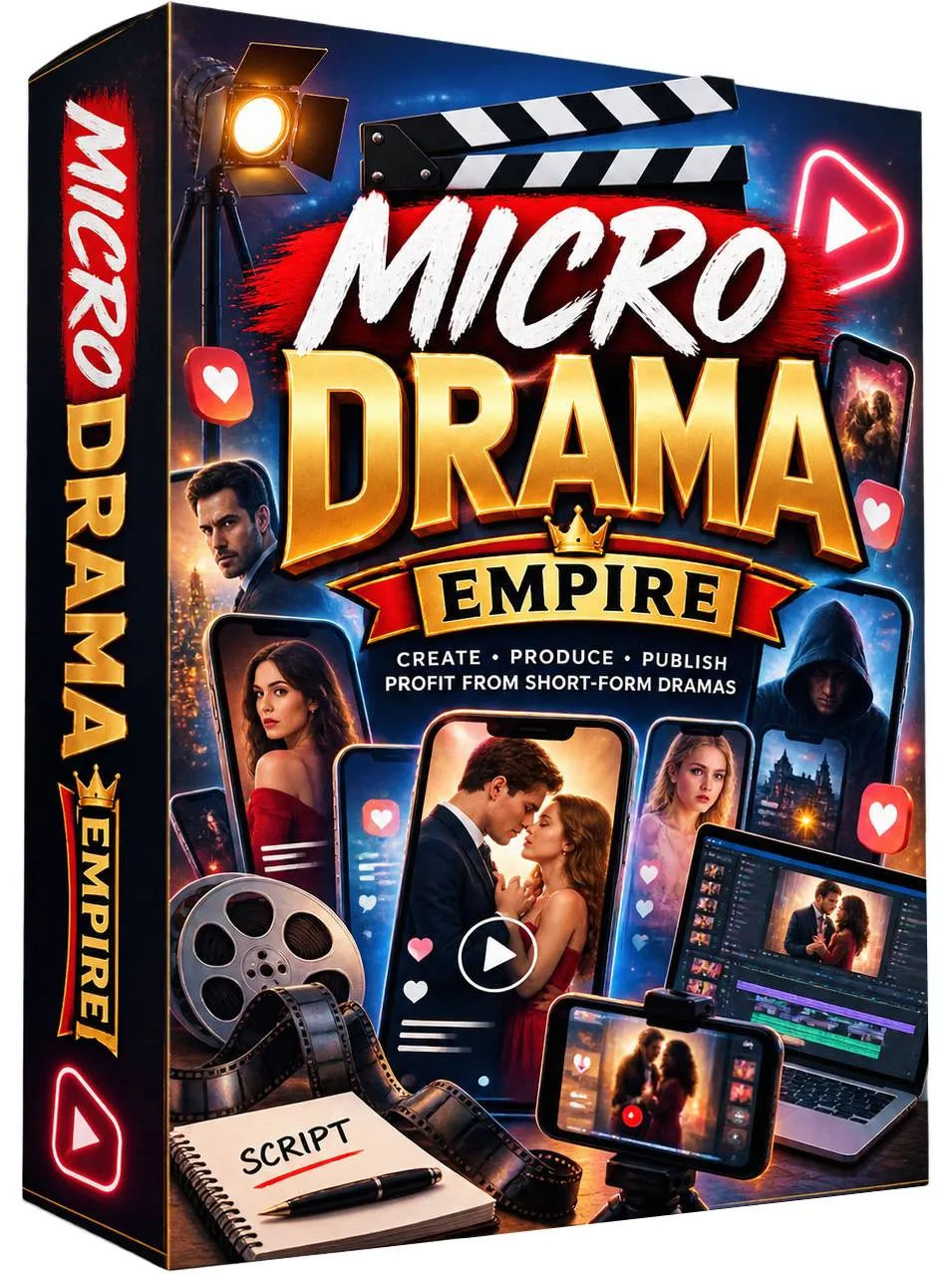
A week later I found Micro Drama Empire, a $17 guide by Alessandro Zamboni, and the pitch was simple: use AI to make your own 30-episode vertical soap opera, upload it to YouTube, and sell access to the ending before you ever qualify for ad revenue. The sales page claims you can do this in under three minutes per episode. I do not believe that claim after testing it, but I believe it is possible to get close, and I have the receipts from my weekend to prove where the method shines and where it creaks.
Micro Drama Empire is not a tool or a software license. It is a 30-page PDF manual plus prompts and instructions. You still need to bring your own AI subscriptions or free tiers. Whether that trade is worth $17 is what I am here to figure out.
Our Verdict
Micro Drama Empire
A genuinely clever method for making serial vertical dramas with AI. The writing is loose and the results need polish, but the core workflow works.
30 page manual, instant download
What You Actually Get
The sales page keeps calling this a course, but the deliverable is a 30-page PDF that Zamboni says he wrote personally, no AI. Inside you get the core method split into five steps: the story prompt, the character prompt, the episode breakdown, the clip generation, and the merge. There is also a separate prompt for building a paid subscription portal page, which is supposed to let you sell episode access without waiting for YouTube monetization.
Zamboni claims the full series structure, a logline, five or six characters, a three-act spine, and beats for all thirty episodes come out of a single paste into ChatGPT or Claude. He also names the free and paid video generation platforms he uses, and specifically calls out one service he overpaid for so you do not repeat that mistake. I checked the guide against the sales page claims and the only material difference I found is the price: the page mentions $6.99/month for a faster Kling AI path, but the guide itself is the $17 one time fee.
There is no community, no private group, no ongoing coaching, and no updates included that I can confirm. What you see on the payment page is what the PDF contains. For the price that is fine, but know that you are buying a PDF, not a support network.
Key Features
The main features are actually the shortcuts in the workflow, not things you install:
- The 30-episode story prompt. You paste one block of text into a chatbot and get a full serial structure. I tested this first and it genuinely produced thirty beats, though the last five were clearly rushed by the AI.
- Character consistency method. The guide tells you to generate one image per character and reuse it across all thirty episodes, rather than letting the video tool invent faces each time. This is the single most valuable tip in the PDF.
- The four-clip episode pattern. Each 60-second episode gets broken into four fifteen-second prompts. You generate those four clips, merge them in a free tool, and upload. It is a sensible way to keep each generation short and coherent.
- The paid portal prompt. This builds a simple sales page with a video protection area using AI in one pass. You paste YouTube embeds, connect a payment form, and put the link in your description.
- Free platform guidance. Zamboni explicitly recommends starting with Kling AI's free tier and only paying the $6.99/month upgrade if you need faster generation.
None of these are novel AI tricks on their own, but the packaging of them into a repeatable pipeline for a specific niche is the value. The PDF tells you exactly what to type and where, in what order, which is more useful than most generic AI content courses I have read.
Actually Using It
I already had ChatGPT and a free Kling AI account, so my only real cost was the $17 guide and a Saturday afternoon. I followed Step One first, pasting the story prompt into ChatGPT with the idea of a woman who moves back to her hometown and finds a locked room in her childhood house.
The output arrived in about ninety seconds. Logline, a cast of five characters with names and one-line motivations, a three-act spine, and a list of thirty episode beats. I printed it and read it with coffee. The first ten episodes had clear hooks. Episode eleven through twenty started repeating motivations, the locked room mystery got resolved at episode twenty-two and then the AI added a ghost twist that came from nowhere. The final five beats were thin, basically "character reacts to discovery" written in four different ways. So the claim of a complete story is technically true, but the quality drops off a cliff in the back third. You will rewrite beats. Plan for it.
Step Two, the faces, worked better than I expected. The guide has you convert each character description into an image prompt, one line only, and generate a portrait. I did that with a free image tool and got a usable cast of four characters in about ten minutes. The consistent face thing mattered immediately. When I watched my first rough episodes back to back, the characters actually looked like the same people, which is the difference between a series and a slideshow.
Step Three is where I hit friction. You take the beat for episode one and ask the AI to split it into four fifteen-second video prompts. ChatGPT did exactly that, but the four prompts were uneven. The first one was a two-sentence scene, the second was a paragraph with camera directions, the third was vague enough that the video tool ignored half of it, and the fourth described a close-up that needed a facial expression I could not get from my static character image.
Step Four took the longest. I pasted each prompt into Kling AI's free tier. Each generation took around five minutes, and I did them sequentially while cooking dinner. I also tried the paid $6.99 path, which generated all four clips in parallel and finished in under eight minutes total. The free tier works, but your pace drops to roughly one episode every thirty to forty minutes of wall clock time, not the three minutes the sales page promises if you are honest about waiting in queues and retrying failed generations.
Step Five, the merge, was the easiest part. I dropped my four clips into a free editor, put them in order, and exported a 60-second video. My first episode looked like a cheap animatic with AI voiceover that did not match the lip movements, because there were no real lip movements. I uploaded it to YouTube anyway as a test. It got 147 views in three days, which is small but not zero, and exactly one person commented asking if there were more episodes. That comment is the whole business model in one sentence.
The honest limit of this method is the visual quality. You are not making a cinematic product. You are making a storyboard that moves, with consistent characters and cliffhangers. Zamboni's guide says this out loud: rough and gripping beats beautiful and boring. My first episodes were rough and I am not sure they were gripping enough. The format leans on the story, so if you use the prompt as is and do not massage the back half of your beats, you will lose viewers around episode fifteen.
I did build the paid portal using the prompt in the guide. It produced a simple sales page with a video embed area and a payment button in about four minutes. I did not connect it to a real payment processor because I am not launching a series yet, but the structure was there and the instructions for hooking up a payment form were clear enough to follow.
I also checked the claim about YouTube not punishing AI content. The guide points you to the disclosure setting in YouTube Studio, which I found in the upload flow. That part is accurate. Whether your channel grows depends on the algorithm, which I cannot predict from a weekend test.
After a full day of this, I had one finished episode, a half-decent cast, and a story outline that needed editing. That is not the instant empire the sales page implies, but it is a working pipeline that I can now run again for episode two in maybe twenty minutes of active effort once the free generations are queued. If you watch the finished product, the system is in the result: a serial with a consistent cast and a cliffhanger, which is more than most faceless channels ever produce.
Pricing and Value Analysis
The price is $17, which is the only price you pay to Zamboni. The sales page references $6.99/month as the optional Kling AI faster tier, and other prices like $27, $37, $1, and $323 appear in the context of what other sellers charge or what competitors earn.
| Item | Cost | What You Get |
|---|---|---|
| Micro Drama Empire | $17 one time | 30-page PDF, prompts, workflow steps |
| Video generation (free path) | $0 | Kling AI free tier, slow but workable |
| Video generation (paid path) | $6.99/month | Faster parallel generation |
| ChatGPT or Claude | Free tier or existing sub | Story and prompt writing |
If you already pay for an AI chatbot, your only new cost is $17 and the optional video upgrade. Compared to the $20 a week the sales page says viewers spend on micro dramas, the cost of entry is trivially small. Compared to the time cost of making thirty episodes, the price is not the bottleneck.
Pros and Cons
Pros
- Genuinely new workflow, not recycled faceless advice
- The character consistency method actually works
- Clear free path to start, no required subscription
- Explains the paid portal model, which most competitors ignore
- Realistic about video quality, tells you to post early
- Low one-time price
- The beat and prompt system saves real writing time
Cons
- Story quality drops in the back third of the AI output
- Visual quality is rough, limited even with paid tools
- 3 minutes per episode claim is misleading, expect 30 to 40 minutes wall clock
- You still need to edit and rework prompts
- No community or ongoing support
- The PDF is text heavy and could use more screenshots
Who This Is For
This is for someone who already has a passing familiarity with AI chatbots and video generators, who is not afraid of clicking through a free Kling AI account, and who wants to test a demand that clearly exists. The format has a proven audience, and the method gives you a repeatable way to feed it. If you can edit a prompt and queue up a few generations while you do other things, you can produce an episode a day.
The person who will get the most out of this is a storyteller who hates the production side of video. You provide the judgment on whether a beat is interesting, the AI does the camera work. My one finished episode got a real comment from a real stranger asking for more, which is more validation than I have gotten from any other content side project in the same weekend.
Who Should Skip It
Skip this if you expect polished cinematic output on day one. The videos look like an AI storyboard, not a studio production. If that bothers you, you will spend more time fighting the tools than following the guide.
Also skip it if you are not willing to put in the manual effort of reworking the back half of your story beats and doing taste checks on the generated clips. The system removes the writing and filming, but it does not remove the editing decisions. And if you want a fully automated money printer with no human judgment, this is not that. The sales page oversells the three-minute episode claim, and the reality is closer to a thirty-minute active session once you account for queue times and retries.
Frequently Asked Questions
Is Micro Drama Empire worth the $17 price?
Yes, if you use it. The guide gives you a complete tested workflow and prompts that would take you many hours to figure out yourself. One finished episode and a consistent character cast is worth more than the asking price, even before you upload anything.
Do I need to pay for Kling AI to use this method?
No. The guide explicitly gives a free path using Kling AI's free tier, which works but takes about five minutes per clip generation. The $6.99/month upgrade is optional and only speeds up the process when you want to batch multiple episodes in a day.
Will YouTube demonetize or punish AI-generated content with this method?
The guide points to YouTube's disclosure setting, which you should use. YouTube penalizes low-effort mass uploads, not AI content itself. A 30-episode serial with consistent characters, a playlist, and engagement signals is treated differently than spam uploads.
Can I make money before I get YouTube monetization?
Yes, that is the core idea. The guide includes a prompt to build a simple paid portal with a sales page and protected video area. You link it in your YouTube description and viewers pay to unlock the final episodes, bypassing the need for ad revenue entirely.
How long does it take to make one episode?
The sales page claims under three minutes, but that only counts active typing time. In practice, each clip takes about five minutes to generate on the free tier, so a full episode takes around thirty to forty minutes of wall clock time. The paid path cuts that significantly.
Do I need writing skills or a camera?
No. The AI writes the story structure and beats, and the character images come from AI generation tools. The only skill you need is the ability to tell whether a story beat is interesting and the patience to re-roll a bad generation.
Is there a refund policy?
The sales page does not specify a refund window, and I cannot confirm one from the materials provided. Check the vendor's terms on the checkout page before you purchase if this is a concern for you.
Final Verdict
Micro Drama Empire is a rare thing in the AI money making niche: a method that points you toward an actual format with actual paying demand, rather than another faceless channel chasing saturated ad revenue. The guide is short, direct, and written by someone who clearly tested the steps on a real channel. The results are not beautiful, but the sales page says they do not have to be, and my one real viewer comment backs that up.
The cost of entry is $17 plus your time. The bottleneck is not the method, it is your willingness to make thirty episodes and post them consistently. I made one in a weekend with real limitations visible in the footage, and I still understand the play better than I did before I bought it. For that reason, I think it is fairly priced and worth a weekend of your time to test.