Niche Prose Detox Lab Review: Stop Rewriting 1,500 Words to Fix 3 Lines
I kept polishing with ChatGPT and losing my voice. Niche Prose Detox Lab changed that with line-level flags. Read my full hands-on review before you buy.
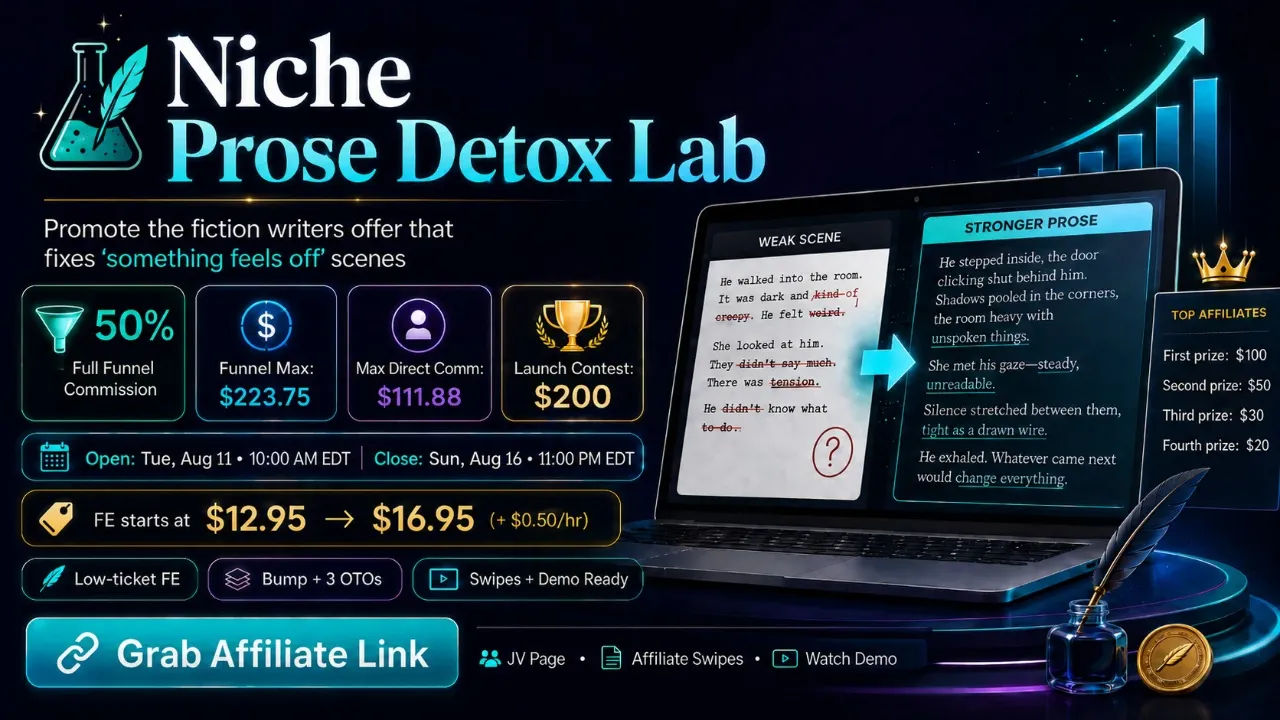
I spent three hours on a Tuesday deleting good paragraphs because a beta reader said my chapter felt "off." She could not name a single bad sentence, and neither could I. So I did what frustrated writers do. I started cutting. By the end I had a smoother scene that sounded like nobody in particular, and I still did not know if I had fixed the actual problem.
That is the exact moment I went looking for a tool called Niche Prose Detox Lab. It is a custom GPT you run inside your own ChatGPT account, built by a writer named Nhan Scope. The pitch is simple: paste one scene, get the specific lines that make readers distrust your prose, and only rewrite the ones you approve. No full-scene overwrite. No "make it more human" guessing game. I bought it for $12.95 and put it through a scene I had already rewritten twice.
Here is how it went.
Our Verdict
Niche Prose Detox Lab
A line-level diagnostic that shows you exactly which sentences leak trust, without touching the rest. Worth the $12.95 if you polish with AI and fear losing your voice.
One-time payment. 30-day refund.
What You Actually Get
The sales page lists a bundle, and it is more than just the prompt. The core is the Niche Prose Detox Lab Custom GPT, which you access inside your own ChatGPT account. It scans a scene and flags three categories of problems: Trust Leak, Voice Break, and Scene Mismatch. Each flag comes with a named signal, like hedge inflation or polished abstraction, plus a plain English reason for why that line reads as anonymous or off.
The revision kit that comes with it includes a handful of PDF and TXT files. I got the Seven-Signal Revision Cheat Sheet, a Scene Prep Checklist, a Genre Contract Worksheet for romance, thriller, or fantasy, a Diagnostic Sample Pack, a What to Ignore Guide, and something called Continuity Protection with offline backup. That last one is just the files saved locally so your workflow survives if ChatGPT changes its interface.
There is also a Slop Score, which is a 0 to 100 working estimate of how much attention a scene needs. The page is upfront that this is not a detector and not science. It is a triage number to help you decide whether to dig deeper or move on. I appreciated that honesty.
Key Features
The main feature is the flag-first workflow. You paste a scene of roughly 1,000 to 2,000 words, and the Lab reviews the lines before it offers any rewrites. That alone separates it from pasting into a generic prompt and asking for a polish.
The seven named signals are concrete. Trust Leak covers emotion-telling, polished abstraction, and cliché clusters. Voice Break handles hedge inflation, rhythm flattening, and voice drift. Scene Mismatch checks genre-contract misses using the subgenre you specify. I typed "low-fantasy political intrigue" and it adjusted the scan accordingly.
The controlled rewrite option is the part that makes this safe. You do not get a blind new version of the whole passage. You get a line-level alternative that keeps the POV, the beat, and the intent. You can accept it, edit it, or reject it. There is also an explicit what-to-ignore guide so you can protect deliberate style choices, like intentional narrator distance or unusual phrasing that serves character voice.
Actually Using It
I ran a 1,200 word scene from a fantasy draft where the protagonist negotiates with a rival house. I had already polished it once with ChatGPT and felt the voice flatten, but I could not see the damage. I used the Scene Prep Checklist first, which took about three minutes. It asks for POV, subgenre, scene purpose, and essential context. I gave it "third limited, political fantasy, the negotiation is about a hostage exchange, she is terrified but hiding it."
Then I pasted the scene and ran the scan. The results came back in about a minute. It flagged eight lines across the categories. The standout was a line I had felt proud of: "The silence wrapped around her like a second skin, heavy with everything neither of them dared to say." The Lab called it a familiar metaphor plus abstract emotional summary. It was right. The sentence sounds meaningful but asks the reader to do all the work. I did not see it because it read familiar to me.
Another flag was subtler. In the same scene I wrote "Mira understood that the council's decision would reshape the balance of power across the northern holds, and that her silence now would be interpreted as consent." The Lab flagged it as voice drift. It reads clean, but it drifts into explanatory narrator voice. "Understood that" lectures the geopolitics instead of staying in Mira's body. The suggested rewrite was "If she stayed quiet, the council would count her with them. Mira kept her mouth shut anyway." I accepted that one.
Not every flag was correct. It flagged a line where my character repeats a phrase deliberately, and the Lab called it rhythm flattening. I checked the What to Ignore guide, which explicitly says deliberate repetition can be protected. I rejected that flag and kept the line. That took fifteen seconds.
The whole session from prep to decisions took about eighteen minutes. That matches the sales page claim of a first useful scan in about fifteen minutes. I did not need a free afternoon to learn anything. The quick start guide is two pages long.
I did notice one limitation. The Lab does not host your manuscript, so it relies on ChatGPT's platform policies for privacy. If you are writing something you want kept quiet, you are trusting OpenAI's data handling, not the product's. That is worth knowing before you paste an unpublished chapter.
The Slop Score gave me a 34, which felt low for a scene I had already edited twice. But the Lab clarified that the score is just a working estimate of attention needed. I ended up rewriting four of the eight flagged lines, and the scene read tighter without losing the character's voice. My beta reader noticed the difference.
Pricing and Value Analysis
The price you see depends on when you land on the page. The sales page warns that it increases by $0.50 every 60 minutes until it reaches $16.95. I bought at $12.95, and the page references that price multiple times. The full value comparison is a bit odd. The breakdown shows $29 for the diagnostic engine alone, with the rest of the kit valued incrementally, but the actual checkout price is far lower. I paid $12.95 for everything.
For context on what you get for that price, here is my honest comparison against the alternatives I have tried.
| Approach | What It Does | Cost | Catch |
|---|---|---|---|
| Niche Prose Detox Lab | Flags exact lines with reasons, optional controlled rewrite | $12.95 one-time | Requires your own ChatGPT account |
| Generic "make it less AI" prompt | Rewrites the whole passage | Free | Smooths away your voice, rewrites before reviewing |
| Re-reading your own scene | Manual line check | Free | Your eye skips familiar patterns |
| Paid ChatGPT plan | Better model access | $20/month | Not included with the Lab, no line-level flags |
The value only makes sense if you already use AI to polish. If you write entirely by hand and never touch ChatGPT, this tool has nothing to scan. But if you polish with AI and fear the voice loss, $12.95 is cheaper than the writing day you burn over-editing the wrong places. The 30-day refund on the diagnosis covers the risk if the tool cannot point to anything useful on your scene.
Pros and Cons
Pros
- Flags exact lines with written reasons, not vague judgments
- Optional line-level rewrites that keep POV and intent
- Explicit what-to-ignore guide protects deliberate style
- Includes genre-contract check for romance, thriller, fantasy
- Fixed repeatable workflow you can use every scene
- One-time payment, no subscription, instant access
- 30-day refund if it cannot point to anything useful
Cons
- Requires your own ChatGPT account, not included
- Free chat AI can work but paid plan is not included
- Privacy depends on ChatGPT platform policies, not hosted locally
- Slop Score is a working estimate, not a true diagnostic
- False flags happen, so you still need editorial judgment
Who This Is For
This is for fiction writers who polish with AI and know they are losing something. If you write romance, thriller, or fantasy, and a beta said a scene feels off but could not name the lines, this gives you the map. It is also for writers who want to keep final editorial control, because it flags lines and lets you decide. The workflow is fast enough that you can run it before every beta pass without burning an afternoon.
Who Should Skip It
Skip it if you do not use AI tools in your writing process. The Lab is useless for pure handwriting drafts. Skip it if you want a full rewrite that turns your prose into something more polished. That is the opposite of what this does. And skip it if you are looking for an AI detector to prove authorship, because the page says clearly it flags how prose reads, not who wrote it.
Frequently Asked Questions
How much does Niche Prose Detox Lab cost?
The price starts at $12.95 and increases by $0.50 every 60 minutes until it reaches $16.95. It is a one-time payment with no subscription, and you get instant access after purchase.
Do I need a paid ChatGPT plan to use Niche Prose Detox Lab?
No. The Lab runs inside your own ChatGPT account, and free chat AI works, according to the sales page. A paid plan is optional but not included in the price.
What is a Trust Leak?
A Trust Leak is a few polished, empty sentences that make readers distrust the pages after them. The Lab flags these lines with named signals like polished abstraction, emotion-telling, and cliché clusters, and explains why each one matters.
Does Niche Prose Detox Lab rewrite my entire scene?
No. It flags specific lines first and offers controlled line-level rewrites only if you ask and only on lines you approve. You keep, edit, or reject each suggestion, so you keep final editorial control.
Is there a refund policy?
Yes. The sales page states a 30-day refund on the diagnosis. If the Lab cannot point to anything useful on your scene, or it is simply not for you, you get every dollar back within 30 days with no questions asked.
Which genres does Niche Prose Detox Lab support?
The Lab is built for romance, thriller, and fantasy. It uses a genre-contract check that asks you to name your subgenre, so the scan can catch lines that break the promises your genre demands.
Can I use Niche Prose Detox Lab on my whole manuscript?
The product is built for one scene at a time, roughly 1,000 to 2,000 words. However, the Continuity Protection and offline backup files are included so you can carry the workflow chapter by chapter across a manuscript.
Final Verdict
Niche Prose Detox Lab did what it promised for me. It pointed to the exact lines that made my scene feel off, explained why they leaked trust, and let me keep or reject every suggestion. I paid $12.95, spent eighteen minutes on my first scan, and cut four lines that were flattening the voice. The price is fair for a one-time tool that saves you from burning writing days on guesswork.
The limitation is real. It relies on ChatGPT's platform, so privacy depends on OpenAI's policies, and you still need your own editorial judgment for false flags. But if you polish with AI and want the voice back, this is the best Niche Prose Detox Lab investment I have found. The 30-day refund makes it easy to test on your least trusted scene. I would run that test before your next beta pass.
Run your least trusted scene through the Lab
30-day refund. Instant access.