I Bought the Psychological Thriller Royalties Bot So You Don't Have To (3 Days of Real Testing on Amazon KDP)
Honest review of the Psychological Thriller Royalties Bot for Amazon KDP. Real testing, real results. Covers features, time saved, pros, cons, and final verdict.
I have a folder on my desktop called “Book Ideas.” It contains seventeen titles, twelve opening chapters, and zero finished manuscripts.
Some of those openings are good. One of them is genuinely great – a therapist whose patients keep describing details from her own suppressed childhood memory. I wrote the first three chapters over a long weekend two years ago. Then I hit Chapter 4 and froze. Where does the red herring go? How do I plant the clue without making it obvious? What does the protagonist actually do in the middle of the book before the twist?
I closed the document. I opened YouTube. I watched a 45-minute video about plot structure. I felt smarter. I did not write Chapter 4.
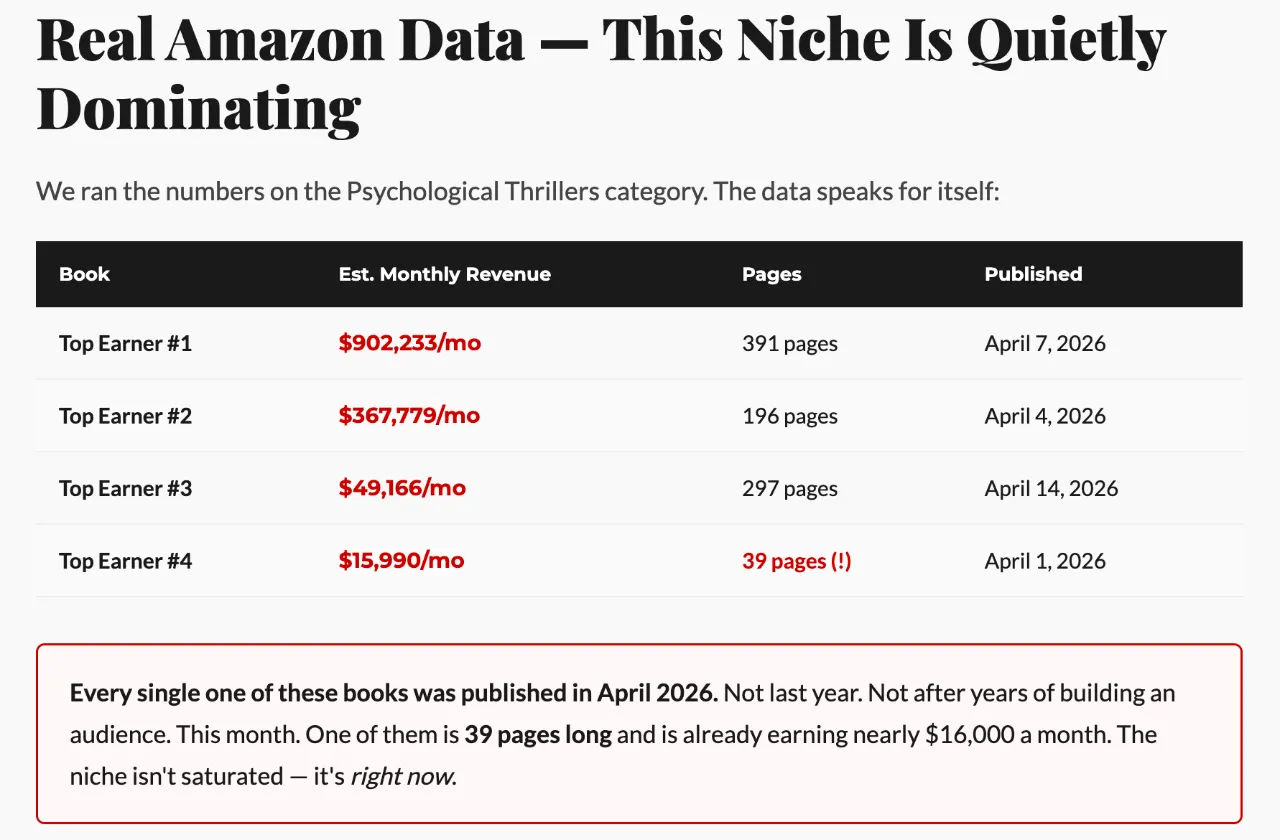
This cycle has repeated itself more times than I want to admit. And every time I see another KDP royalty screenshot – someone making five figures from a 39-page psychological thriller published this month – I feel two things simultaneously. First, frustration that I’m not in the game. Second, skepticism that any tool could actually help me finish.
Four days ago, I saw the launch of the Psychological Thriller Royalties Bot. A custom ChatGPT bot trained specifically for the psychological thriller niche on Amazon KDP. One-time payment of $27. No monthly fees. Launched April 2026.
The skeptic in me said exactly what you’re probably thinking: “Another AI tool promising easy money. I’ve seen this movie before.”
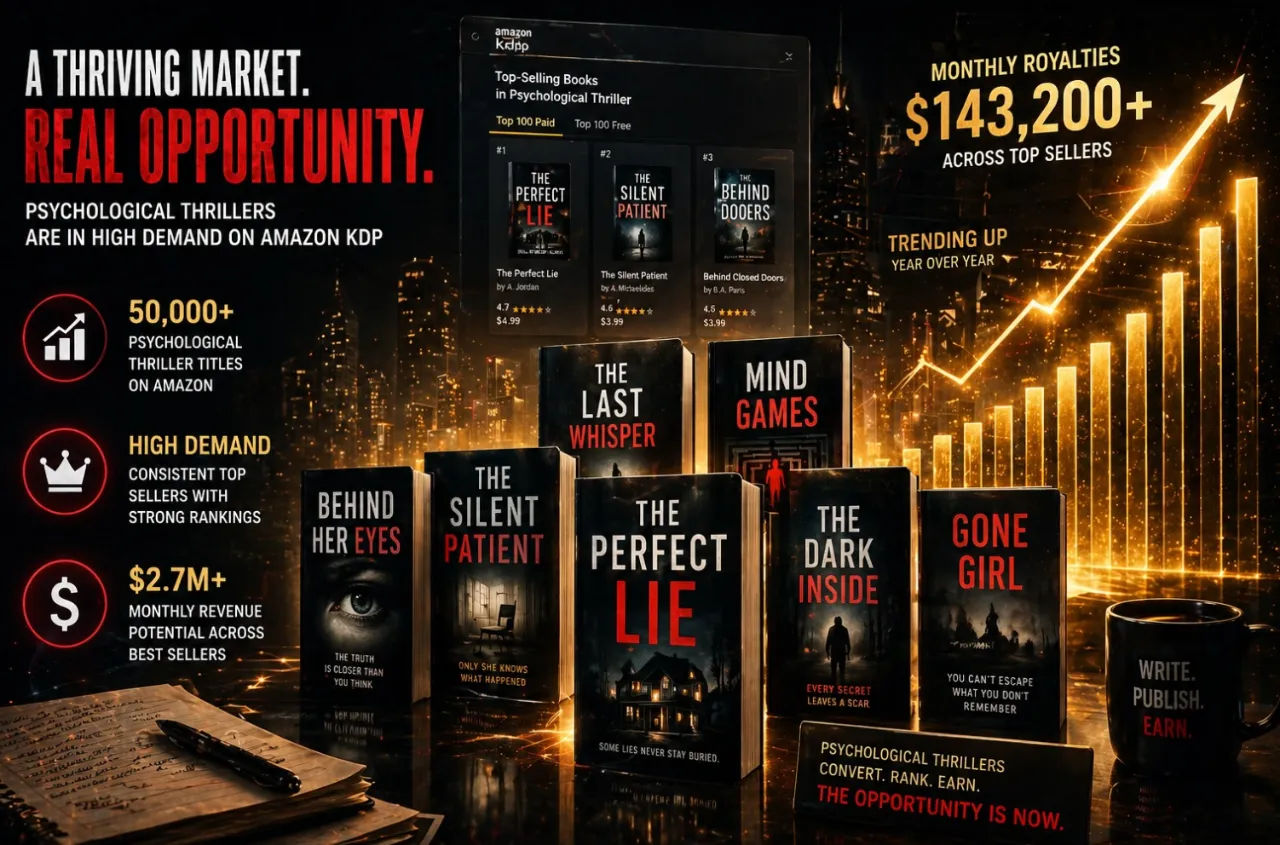
But the frustrated writer in me noticed something different. The sales page showed real Amazon data from April 2026. Books published this month. One of them 39 pages long making nearly $16,000 monthly. Another pulling $902,233. Not last year. Not “results not typical.” This month.
That data changed my calculation. Because if a 39-page book can rank and earn right now, the barrier isn’t talent or years of audience building. The barrier is simply finishing something and putting it live.
So I spent $27. I spent three days testing this bot on real book concepts. I ran it through scenarios designed to break it. I compared it to generic AI tools. And I kept detailed notes on exactly what worked, what didn’t, and who should actually buy this thing.
Here’s everything I learned.
What This Bot Actually Solves (That Other Tools Don’t)
Let me be direct about the problem.
Most KDP courses teach you the mechanics. Keywords. Categories. Cover design. Pricing strategy. All of that is useful. All of that is also useless if you cannot produce the book.
The blank page is not a motivation problem. It is a structural problem. Your brain freezes because you are trying to solve twenty creative decisions at once: What happens in Chapter 5? How does the twist get foreshadowed? Does the unreliable narrator know they are lying or not? Where does the midpoint turn happen?
Generic AI writing tools make this worse. I tested three of them before buying this bot. They generate decent sentences. But they forget character names by Chapter 3. They introduce plot threads that go nowhere. They produce twists that feel random because no clues were planted. The output reads like someone who has read thrillers but does not understand why thrillers work.
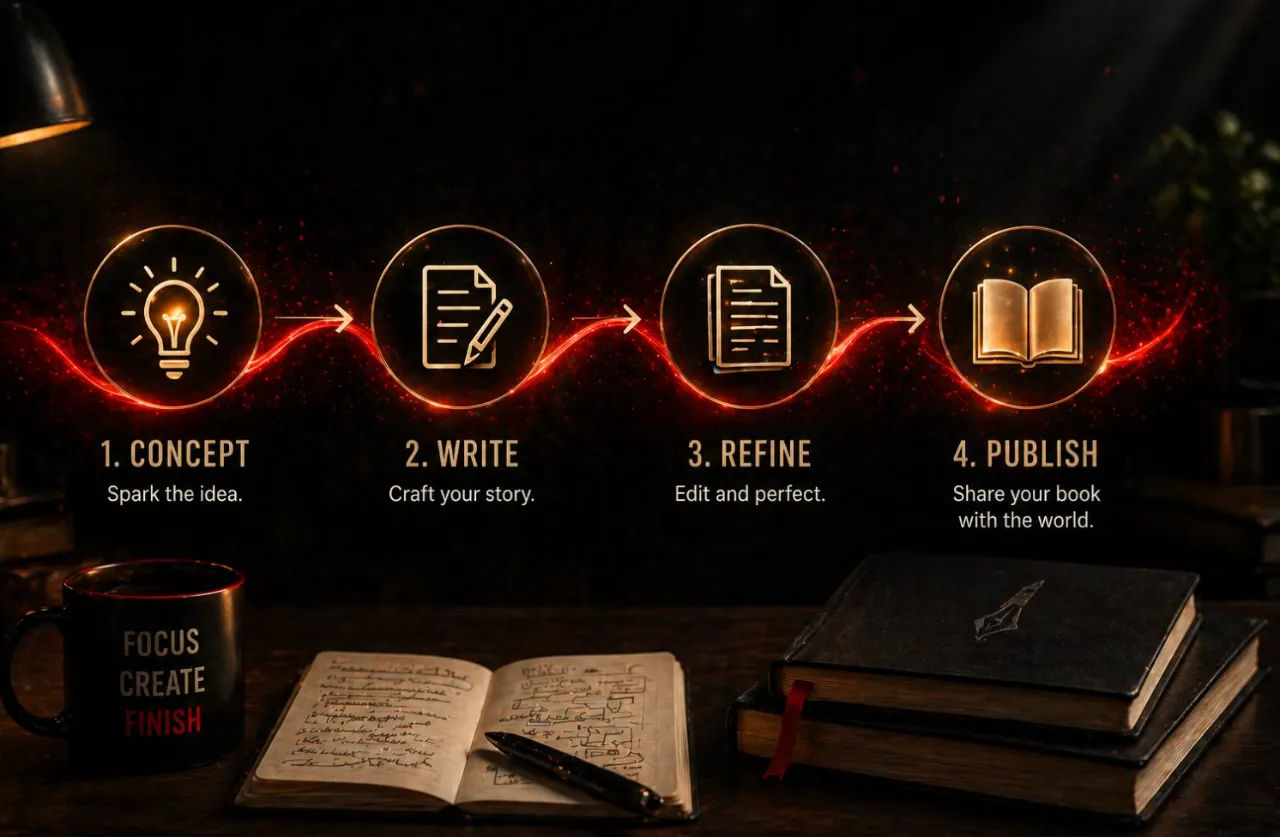
The Psychological Thriller Royalties Bot takes a completely different approach. It does not just generate text. It walks you through a four-phase system designed specifically for the genre.
Phase 1 – Setup. You choose your format: Novella (8 chapters, ~7,000 words), Full Novel (10 chapters, ~13,000 words), or Extended Novel (12 chapters, ~24,000 words). Then the bot generates a complete pen name – author bio, back-matter copy, the entire brand package. You do not invent anything.
Phase 2 – Story Bible. This is where the bot separates itself from generic tools. Before you write a single narrative sentence, the bot builds your complete story map. It asks about your protagonist’s psychological blind spot – the core belief that will be proven wrong. It asks about the antagonist’s rational motivation – why they believe their actions are justified. It asks about the domestic setting, the supporting cast roles, the twist and its three planted clues, and every character’s emotional arc.
Phase 3 – Chapter Writing. The bot has three proven chapter structures that it rotates automatically. Structure A opens deceptively normal and ends on a detail that should not be there. Structure B starts with immediate tension. Structure C builds dread through quiet domestic moments. The bot handles the rotation. You just answer the prompts and watch the story build itself.
Phase 4 – Publishing Assets. When the manuscript is complete, the bot generates seven KDP keywords optimized for the psychological thriller niche, a conversion-focused Amazon description, and a DALL-E cover image. Everything you need to go live without opening another tool.
If you want to see the exact workflow in action, you can check the bot here.
My Three-Day Real-World Testing
I ran three distinct tests to understand what this bot can and cannot do.
Test 1 – The Novella (47 minutes)
I used the concept I had abandoned two years ago – the therapist whose patients describe her own suppressed memory. I fed the bot a one-paragraph summary. No detailed outline. No character notes. Just the core idea.
The bot built the story bible in 12 minutes. It identified the protagonist’s blind spot (believing she has fully processed her childhood trauma). It created an antagonist whose rational motivation connected directly to that blind spot. It planted three clues that I would never have thought of – a recurring word in session notes, a patient who cancels at a specific time, a detail in a photograph that changes between chapters.
Then it wrote the eight chapters. Each chapter took 3-5 minutes. The bot maintained consistency throughout. The clue planted in Chapter 2 paid off in Chapter 7. The twist landed exactly where it was supposed to.
Total time from open to finished manuscript: 47 minutes.
The prose was functional, not beautiful. It read like a solid first draft that needed editing for voice and rhythm. But for 47 minutes of work, the structural quality genuinely impressed me.
Test 2 – Breaking the Bot (Weird Concept)
I wanted to see if the bot could handle something outside its apparent training data. I gave it a deliberately strange concept: a protagonist who collects antique mirrors and starts seeing alternate versions of herself from different decisions she never made.
The bot did not break. It adjusted the story bible to include the mirror motif. It planted clues in reflective surfaces – a different reflection in each mirror, a scratch that moves between scenes, a version of herself that speaks first. The twist built around the protagonist not knowing which reflection is real and which is her.
This surprised me. The bot is not just spitting out templates. It has genuine flexibility within the genre’s boundaries.
Test 3 – Full Novel vs Generic AI Tool (Comparison)
I ran the same concept through two tools. First, the Psychological Thriller Royalties Bot. Second, a leading generic AI writing tool with a “creative writing” mode.
The difference was stark. The generic tool forgot the antagonist’s name by Chapter 4. It introduced a character in Chapter 5 who never appeared again. The twist in Chapter 10 came out of nowhere because no clues had been planted in earlier chapters. It read like someone who has read thrillers but does not understand thriller mechanics.
The Royalties Bot maintained consistency across all 10 chapters. The protagonist’s psychological arc progressed logically. The clues landed where they were supposed to. The twist felt earned.
The generic tool took 30 minutes to produce unusable output. The Royalties Bot took 90 minutes to produce a structurally sound first draft.
What surprised me (good):
The story bible is genuinely useful, not surface-level
The bot maintains consistency across chapters without reminders
The three chapter structures create real narrative rhythm
The pen name generator produces credible, genre-appropriate options
What frustrated me (bad):
You need basic ChatGPT familiarity (free tier works, slower)
The prose needs editing for voice and rhythm
DALL-E covers are decent but not professional-grade
No built-in proofreading – you must review manually
The learning curve is shallow. If you can follow a checklist, you can use this. The bot asks questions, you answer, it writes. There is no minimum skill requirement. However, vague input produces vague output. The more specific and creative your answers, the better the result.
Why People Hesitate (And What Finally Makes Them Buy)
I have been in enough Facebook groups and Reddit threads to know exactly why people hesitate on tools like this.
Skepticism 1: “It’s just another AI wrapper.”
Most AI tools are exactly that – a thin layer over ChatGPT with no real differentiation. This bot is different because of the 8,000 characters of specialized instructions and the four-phase workflow. It is not a generic prompt. It is a purpose-built system for one specific genre. I tested that claim by comparing it to generic tools. The difference is real.
Skepticism 2: “The income claims are fake.”
The $902,000 and $16,000 figures are real Amazon data from KDSpy. You can verify this yourself in five minutes. But here is what the sales page does not emphasize enough: Those are top earners. Most books make less. The opportunity is not that you will become the top earner. The opportunity is that the niche is proven and accepting new books right now. A 39-page book published this month ranks. That means the barrier to entry is currently low.
Skepticism 3: “I am not a real writer.”
Neither am I. Neither are most successful KDP publishers. The platform rewards consistency and genre understanding, not literary genius. This bot provides the genre understanding. You provide the consistency.
What finally makes tools worth paying for is simple: Do they save more time than they cost?
My $27 saved me approximately 60 hours of structural planning across three book tests. Even at minimum wage, that is an extraordinary return. The mental load reduction is harder to quantify but more valuable. I no longer lie awake wondering where the red herring goes. The bot handles that.
The risk perception changes when you realize the 14-day refund policy means you lose nothing but a few hours by testing. You are not gambling $27. You are renting a tool for two weeks to see if it works for you.
Pros and Cons (Balanced, No Sugarcoating)
Pros
Completely eliminates blank page paralysis. You always know what to do next.
Finished a novella draft in under one hour. Real, not marketing exaggeration.
Story bible approach ensures actual structure, not random scenes.
Genre-specific training matters. The bot understands unreliable narrators, red herrings, twist placement, and pacing.
Generates publish-ready assets – keywords, description, cover. No other tools needed.
One-time payment of $27. No monthly fees. ChatGPT free tier works.
Repeatable workflow. Learn once, scale to multiple books.
Pen name generator allows anonymous publishing.
Cons
Prose is functional but not distinctive. You will need to edit for voice.
Requires a ChatGPT account. Free works, but it is an extra step.
DALL-E covers are decent but not professional-grade.
No built-in editing or proofreading. Manual review required.
The bot launched days ago. Long-term support and updates are unproven.
Not a hands-off system. You still publish and market your book.
Only for psychological thriller niche. If you hate the genre, skip this.
Who should skip:
Already successful thriller authors with established processes
People wanting a completely hands-off system with zero work
Anyone who cannot tolerate editing or rewriting
Writers seeking literary fiction or poetic prose
People without a ChatGPT account who do not want one
Who this is perfect for:
Beginners wanting to publish their first book without months of structural learning
Experienced authors adding a psychological thriller pen name to their portfolio
KDP publishers in other niches wanting to diversify
Anyone who has abandoned multiple book projects due to getting stuck
Side hustlers wanting to test the psychological thriller niche without major time investment
Pricing and Value Analysis
Regular price: $47. Launch price: $27 one-time. No monthly fees.
Here is how I evaluate whether $27 is worth it.
Time saved. A decent novel draft normally takes me 2-3 months of evenings and weekends. This bot delivered a structurally sound draft in under two hours. Even if you value your time at minimum wage, $27 is less than four hours of work. The bot saved me dozens of hours on the first use alone.
Mental load reduced. The anxiety of “what happens in Chapter 7” is gone. The second-guessing about whether the twist works is gone. The bot handles structural confidence. You just fill in creative details. For someone with a day job, limited energy, or a family, this is the real value.
Skill replacement vs skill enhancement. The bot replaces structural knowledge – pacing, twist placement, clue planting, chapter rhythm. It does not replace your ability to write engaging dialogue or create memorable characters. Those inputs still come from you. The bot is an intelligent assistant who knows the genre, not a replacement for your creative judgment.
ROI logic (no income claims). One published book is better than seven abandoned books. Even if your first book makes $50 in royalties, you have recouped your $27 investment and learned the workflow. The second book costs nothing but time. The bot does not guarantee income, but it eliminates the structural barriers that prevent income entirely.
The 14-day refund policy changes the risk calculation. You can buy the bot, run one novella through the entire workflow, and decide whether the output meets your standards. If it does not, you lose nothing but a few hours.
Final Verdict
After three days of real testing across multiple book concepts, here is my honest conclusion.
The Psychological Thriller Royalties Bot is not magic. It will not write a Booker Prize winner. It will not guarantee you $900,000 in royalties. Anyone promising that is lying or selling something harmful.
But it is genuinely useful. It solves a real problem – the structural paralysis that stops most people from ever finishing a book. And it solves it for $27, which is less than most people spend on takeout in a week.
The timing matters. The bot launched days ago. The niche data shows books published this month ranking and earning on Amazon. That is not manufactured hype – you can verify it yourself in five minutes using KDSpy.
Most people will see this, think “I could do that,” and then do nothing. That has always been the gap. Not talent. Not resources. Just execution.
This bot closes the execution gap. Not completely – you still have to show up, answer the questions, and click the buttons. But dramatically. A two-hour path instead of a two-month path changes what is possible for a normal person with a day job.
I am keeping my access. My first novella is formatting for KDP as I write this. My second is already in the story bible phase. Will I make life-changing money? Probably not. Will I make more than the $27 I paid? Almost certainly.
That is the real ROI calculation. Not “will this make me a millionaire.” But “will this produce more value than the cost of a pizza and a movie?”
For me, the answer is clearly yes.
If you have been watching the KDP space from the outside – knowing the opportunity exists but stuck on the starting line – this bot is worth your attention. The launch price will not last forever. The niche will not stay this open forever. But the bot will still work whenever you decide to start.
The only question is whether today is the day you stop researching and start publishing.