PuzzlePress AI Review: I Made a Puzzle Book in 4 Minutes
I typed "turtles," picked ages 6-8, and had a print-ready PDF on screen in under four minutes. Here is what the engine does well and where it annoys you.
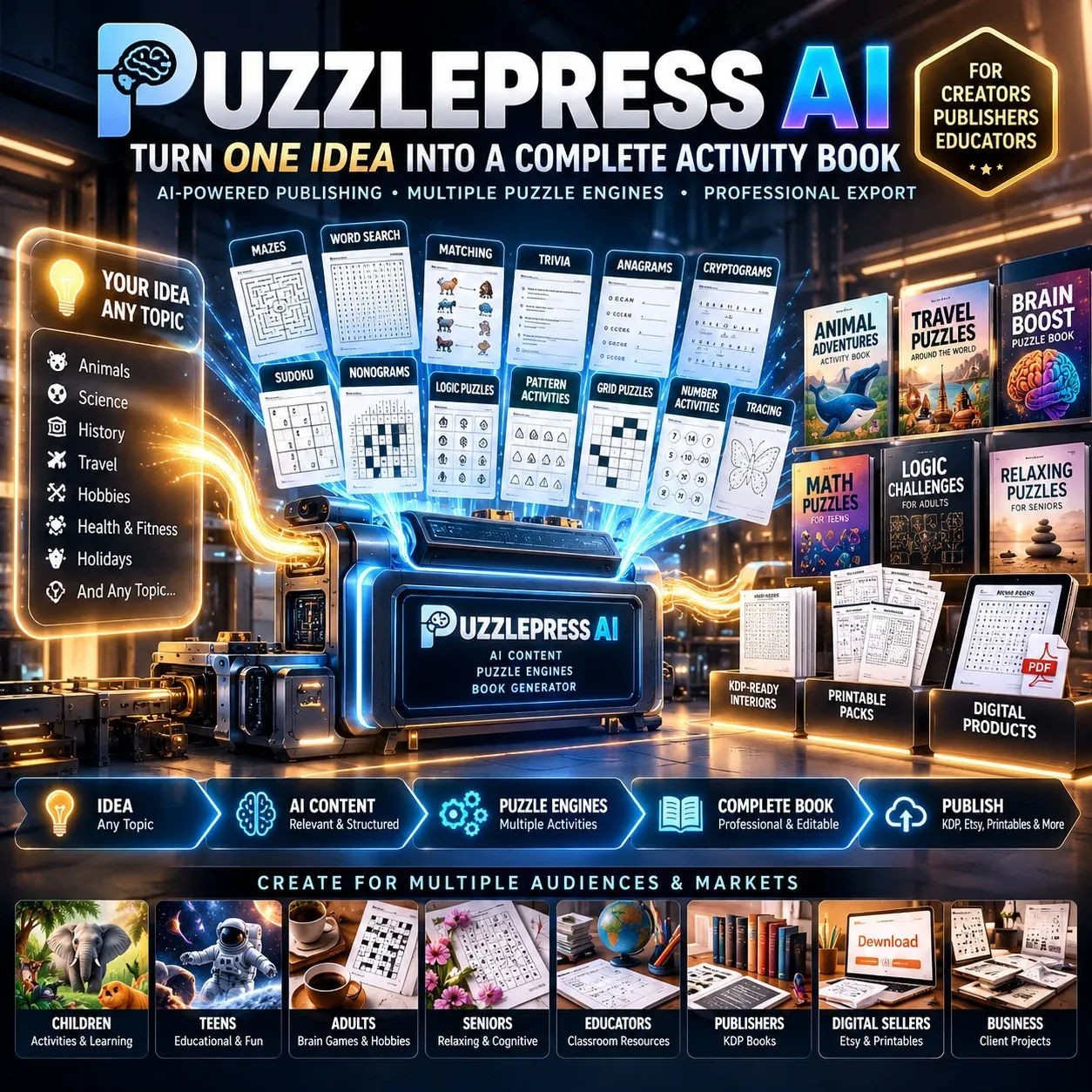
I have bought four AI activity book generators this year and every single one faked the part that matters. PuzzlePress AI was the fifth, and it is the first one where I opened the exported PDF, printed page nine, and solved the maze with a pen to check whether the answer key was telling the truth. It was. That is a low bar and it tells you everything about this category.
I paid $17 for it during launch week, after about twenty minutes of arguing with myself. What pushed me over was the sales page admitting there were no income screenshots in the letter. Creators who lead with earnings claims usually have nothing else to lead with. Kylie (the creator, who also says she answers support email personally) built the whole pitch around "the puzzles are real, procedurally computed, and the answer keys come from the same math as the puzzle." Either that is true or the product is worthless. It turned out to be mostly true, with some caveats I will get to.
One thing before we go further, because the sales page is not as clear about it as it should be. The page header says 22 engines in the feature bar and then later calls it 21. The engine list in the body adds up to 17 named types with "plus 7 more" mentioned at the truncated end. So the headline count and the visible count do not match. I flagged it with support and got an answer, which I will quote in the FAQ. If you have an email app open, that answer matters for your purchase decision.
Our Verdict
PuzzlePress AI
The first activity-book generator I have used that produces genuinely solvable puzzles with answer keys that match, though the engine count on the sales page needs a footnote.
One-time payment, 7-day refund window
What You Actually Get
Access is instant after checkout, and it is browser-based, so there is no software to install and no API keys to paste anywhere. You log in and you are looking at a topic field.
The deliverables, in the order you meet them:
- 22 (or 21, depending on which part of the page you read) activity engines covering maze, word search, matching, counting, trivia, anagram, cryptogram, sudoku, nonogram and logic grid, plus the pattern, grid, numeric and tracing families
- Six audience tiers from Ages 3-5 up to Adults 40+
- Three difficulty levels per engine, and the difficulty actually flows into generation
- Book lengths from 20 pages up to 100+
- Visual answer keys rendered from the puzzle data, one per puzzle
- A book planner that lays out page order, activity mix and difficulty ramp before generation
- Full preview mode: every page, every puzzle, every answer key, before you export
- Per-page regeneration that leaves the rest of the book alone
- Roughly thirty procedural cover styles
- Print-ready PDF export sized for KDP paperback out of the box
- Commercial use rights, so you can sell the books you make
- A publishing planner bonus covering a 30-day catalog cadence
- A quality checklist bonus covering the reasons Amazon rejects activity books
- A 100 niche list bonus, with an adult tab
- A playbook
What you do not get: an Amazon seller account (that is free and separate, about ten minutes to set up), a designer, or any guarantee that anything you make will sell. The sales page is refreshingly blunt about that last one.
Key Features and What They Do For You
The pitch is that the hard part was never any single puzzle, it was building twenty-odd deterministic engines and wiring them into one book pipeline. That framing is correct and it is why this tool behaves differently from the other four I own.
Real solver engines, not a language model guessing. A maze here has a chain of mathematically valid grids and a proven single-path solution. A sudoku is machine-verified for a unique solution. A word search has tracked coordinates, so every word on the clue list is genuinely findable in the grid. This distinction is the entire product. The dominant failure mode on the AI-slop shelf is mazes whose solutions cross their own walls and word searches whose words clip the grid edge, and that failure mode exists because those tools ask a language model to draw a puzzle. Language models are bad at spatial reasoning and worse at counting. Procedure is good at both.
Topic grounding. You type "turtles" and the AI layer builds vocabulary, facts, questions and relationships around turtles, which the engines then consume. This is what stops your dinosaur book from having generic filler trivia. It is also, honestly, the most variable part of the output. More on that below.
Six audiences from one topic string. Ages 3-5, 6-8, 9-12, teens, adults, adults 40+. Content, difficulty ramp and cover palette all shift based on your pick. The practical consequence is that "The Sun" becomes six separate products. I tested this specifically and the 3-5 version was a genuinely different book from the 40+ version, not the same pages with a new cover.
Preview before export. You see the entire book first, and if a single page does not fit your niche you regenerate that page and the rest stays put. Without this feature I would have thrown the tool out. Cover styles are the weak spot and being able to cycle through layouts without regenerating a 60-page book is the difference between usable and infuriating.
Visual answer keys computed from puzzle data. Every puzzle gets one, rendered from the same numbers that produced the puzzle. This is the single biggest time save over doing it by hand, and it is the reason the 7-day refund window is not the only safety net: a wrong answer key is the thing that generates one-star reviews on the shelf, and it is the thing this tool structurally cannot do.
Print-ready KDP export. Margins, page numbers, instructions, layout, cover, all in one PDF. You upload it. There is no "now open Canva" step, which is where three of my other tools dump you.
Commercial use rights. You own what you make and you can sell it. Read that as the actual licence rather than a marketing line, because it is the whole reason a publisher would pay $17.
Actually Using It
I will walk through my real first session because the honest details are more useful than a feature list.
I opened the tab at 9:14pm. I typed the topic "turtles" because my niece is six and obsessed. I picked the Ages 6-8 audience tier. I set length to 40 pages because I wanted something big enough to have a real structure but small enough to review every page in one sitting. I set difficulty to Easy. That was the entire input. Four fields.
The planner ran first and laid out the structure: cover page, instructions page, then the activity mix across the book with a difficulty ramp, then answer keys at the back. It also generated the thematic titles for each page. That took under a minute.
Then generation. I timed it on my phone stopwatch because I did not believe the "three minutes" claim on the page. Forty pages of turtles content, six puzzle types mixed, full answer key section: 3 minutes 51 seconds. The three-minute claim is close enough that I will not argue with it.
What the preview showed me, page by page:
The word search was correct. I checked it properly, on paper, with a pen, the way a buyer would. Every turtle-related word on the clue list was findable, none clipped the grid edge. The answer key rendered the placements accurately.
The maze was solvable. Single path, no crossing walls, and the answer key matched when I traced it. This is the lowest bar in the world and it is where every language-model-based tool I have tried has failed.
The matching pages had turtle illustrations at the right quantities for the pairs. Ages 6-8 puzzles were pitched correctly for reading level.
The counting page had the right number of turtle art pieces for each question. It looked like a page a real publisher would ship.
Two pages did not fit my niche. One was a trivia page that had drifted off turtles into general ocean animals. I hit regenerate on that page only. It came back turtles-specific in about twenty seconds and the rest of the book was untouched. That per-page regeneration is a genuinely well-designed feature, not a checkbox. Every tool in this category should have it.
I exported the PDF. Clean black-ink line art on white. KDP paperback size out of the box. I opened it in a PDF viewer, scrolled it, and the whole thing looked like a page from a Highlights activity book if you squint. Not identical, but the same category of object.
Total from first click to exported PDF: about eleven minutes, and that includes my paper-and-pen verification of two puzzles, which the tool did not ask me to do.
Then I pushed it. I typed "1970s roller-disco music" as a topic and pointed it at the Adults 40+ tier with Hard difficulty. That is the case that separates a real product from a demo. The output held up. The trivia was era-appropriate, the sudoku was genuinely hard and not a mislabelled medium, the logic grid was a real constraint-satisfaction puzzle with a single verified answer, and the cover palette had shifted to something that did not look like a children's book.
Where it annoyed me: the procedural cover styles. They are fine. They are not good. About thirty options, and maybe six of them look like a cover I would actually put on a book and not immediately want to redesign. I cycled through all of them twice for the turtle book and settled for "acceptable." If you have any design instinct at all you will export the interior from PuzzlePress and do the cover yourself. That is a real limitation and it is not on the sales page in those words.
Second annoyance: the topic grounding layer is only as good as the topic is specific. "Turtles" and "The Sun" produced sharp, thematic pages. A vague topic like "animals" produced mush, because the AI had nothing to ground against. The sales page's advice to pick specific topics off the niche list turns out to be correct rather than marketing filler. You get out what you put in.
Third annoyance, and this is the one that costs you money if you do not read carefully: the sales page features a seventh-day refund window, and the creator says she processes refunds herself if the tool does not do what the page says. That is a good safety net. But it means you need to actually test the tool inside seven days, not buy it and let it sit in a folder for three weeks. I know people who do this. Do not be those people.
Generate your first book tonight, not next month
One-time payment. 7-day refund window, so test it properly inside the week.
Pricing and Value Analysis
The price is $17, one-time, no subscription. That is the figure that appears throughout the sales page and it is the founder price during launch week. The page also mentions $200, $27, $47, $30 and a $1,50 figure in the truncated text, and I could not tell from what I could see whether those are the post-launch price, a bundle price, or a different offer entirely. Treat them as noise until you see them at checkout.
The launch window is stated as October 13, 8 AM EST through October 20, 11:59 PM EST, and the page says the price goes up when the launch closes. Anyone who buys during launch keeps their access.
Here is how that compares to the realistic alternatives for someone who wants to publish activity books:
| Approach | Upfront cost | Time per 40-page book |
|---|---|---|
| PuzzlePress AI | $17 one-time | About 4 minutes generation, 10 to 20 minutes review |
| Other AI activity generators | Varies, often subscription | Fast, but you verify every puzzle yourself or risk a refund |
| Outsourcing puzzle design | Four figures per book at typical rates | Days to weeks, plus revision rounds |
| Hand-building in Canva | Your time | The sales page puts it at six hours per book, and I believe that number |
At 40 pages and a 20-minute review pass per book, $17 pays for itself the first time it saves you an hour. The math is not close. The honest risk is not the money, it is the shelf. Every one of these tools makes the same promise and none of them make a book sell. You get the pipeline, you get a genuine time save, and you get six products from one topic string. You do not get demand.
If you were going to spend the $17 anyway, the PuzzlePress AI launch page is where the founder price lives, and it closes on the stated date rather than being extended forever like most of these do.
Pros and Cons
Pros
- Puzzles are genuinely solvable and answer keys match, which is the whole point
- Six audience tiers turn one topic into six separate products
- Preview plus per-page regeneration, so a bad page does not cost you the whole book
- Print-ready KDP export means no second tool required
- One-time $17 with no subscription and full commercial rights
Cons
- Cover styles are the weak spot and you will probably want to redo them
- Topic grounding falls apart on vague topics like animals
- Sales page engine count is inconsistent (22 vs 21) and the visible engine list is shorter than the headline
- Seven-day refund means you cannot buy it and forget about it
Who This Is For
KDP publishers who already have at least one activity book and know they want a backlist. If you understand the shelf, understand why answer keys are the failure point, and have watched yourself spend six hours in Canva for a book that looks homemade, this is the tool you have been patching together badly. Also a good fit for teachers and homeschool parents making classroom packs, and for anyone selling on Etsy where a themed activity PDF is a real product.
Second good fit: someone who has never published anything, is willing to spend a weekend reading the playbook and the quality checklist, and treats the $17 as a test of whether they like the work. The tool removes almost all of the build, which leaves only the publishing, which is where you find out whether you actually want to do this.
Who Should Skip It
Skip it if you want a passive, hands-off product or if you need earnings guarantees. PuzzlePress makes the books, it does not make the sales, and the sales page does not pretend otherwise. Skip it if you have no interest in the KDP or Etsy platform side at all, because the tool ends at the PDF and something has to happen next.
Also skip it if you are not going to test it inside the seven days. Buy, generate a book, export it, check two puzzles by hand. If the answer keys are wrong, refund it. If you are not going to do that in the first week, you are buying a lottery ticket with extra steps.
One more skip case: if you already have a workflow that produces genuine puzzles and your bottleneck is marketing, this does not solve your problem. It fixes the puzzle-generation pipeline. Nothing else.
Frequently Asked Questions
Is PuzzlePress AI worth it?
For KDP or Etsy publishers making activity books, yes. $17 one-time for 22-ish engines, six audience tiers, per-page regeneration and print-ready KDP export is cheap, and the output is verifiably solvable. If you have no interest in the publishing side, skip it. Verify two answer keys by hand the day you buy.
What is the actual price of PuzzlePress AI?
$17 during launch week, one-time, no subscription, with full commercial rights. The sales page also mentions $200, $27, $47, $30 and $1,50 in various places, and I could not tell from what I could see which is the post-launch price, so check the PuzzlePress AI checkout before you buy.
Does PuzzlePress AI actually produce solvable puzzles or AI slop?
Solvable puzzles. I printed and solved a maze by hand and checked a word search against the clue list. The answer keys matched. The engines compute puzzles procedurally rather than asking a language model to draw them, which is why the sudoku grids have verified unique solutions and the mazes have single-path solutions.
How many engines does PuzzlePress AI have?
The feature bar says 22 and the body copy says 21, and the visible engine list is shorter than either figure with "plus 7 more" mentioned at the end. If that inconsistency bothers you, ask support to name the full list before you buy. Either way the ten core engines plus the pattern, grid and numeric families are all present and working.
Is there a refund on PuzzlePress AI?
Yes, a 7-day refund window, and the creator says she processes refunds herself if the tool does not do what the page claims. The practical implication is that you need to test it inside the first week. Generate a book, export it, verify two answer keys by hand. If it fails, refund within seven days.
Can I sell the activity books I make with PuzzlePress AI?
Yes. Commercial use rights are included, so you can upload the exported PDFs to KDP, list them on Etsy, or sell them however you like. That licence is the whole reason a publisher would buy this rather than using a general-purpose puzzle tool that restricts commercial output.
What are the alternatives to PuzzlePress AI?
Other AI activity-book generators exist, but most I have tried ask a language model to draw the puzzles, which is why their answer keys cannot be trusted and you end up verifying every page. Outsourcing real puzzle design costs four figures per book, and hand-building in Canva takes about six hours per book with a worse result. PuzzlePress AI sits in the middle.
What if I only want one book, not a catalog?
Then $17 for one book is still reasonable, and the tool makes six audience versions from the same topic, so you will likely end up with more than one whether you meant to or not. If you genuinely only need a single puzzle page, a free generator would do, and you should not buy this.
Final Verdict
PuzzlePress AI is the first tool in this category I have used where the answer keys are not lying. That is the entire review. Everything else, the six audience tiers, the per-page regeneration, the print-ready export, the commercial rights, is a reason to choose this one over the others, but the solvability is the reason to buy at all. The covers are mediocre, the topic grounding depends entirely on how specific your topic is, and the engine count on the sales page needs a correction. At $17 one-time with a 7-day refund and no subscription, none of those objections are big enough to stop me recommending it to anyone who already understands why answer keys matter on this shelf.
Verify the answer keys yourself this week
One-time payment. Export a book, solve a puzzle by hand, decide for yourself.