Spy Academy Powered by Activity Book Generator Review: A Fresh Publishing Angle for Creators Tired of Saturated Puzzle Book Niches
Spy Academy helps creators build spy puzzle books, cipher challenges, decoder missions, and printable activity products for KDP, Etsy, and TPT.
Creating activity books sounds simple until you try to create one that does not look like everything else already selling online.
I have worked with digital products, AI tools, SaaS platforms, printable systems, and publishing workflows for years. One pattern keeps repeating: most creators do not fail because they lack effort. They fail because they enter product categories where the format is already too familiar.
Word search books are everywhere.
Sudoku books are everywhere.
Basic kids’ activity books are everywhere.
Crossword packs, tracing worksheets, printable bundles, and simple low-content interiors still sell in some cases, but they are no longer easy wins. Buyers have seen the same structures again and again. Sellers compete on covers, keywords, pricing, bundles, and small design differences, but the product underneath often feels almost identical.
That is why Spy Academy Powered by Activity Book Generator caught my attention.
This product was launched only a few days ago, so I approached it carefully. New product launches often sound exciting at first, but many of them turn out to be repackaged versions of older tools. Spy Academy feels more interesting because it is not trying to help creators make another generic puzzle book.
It focuses on a very specific angle: spy, mystery, detective, cipher, decoder, and secret mission activity books.
That is a meaningful difference.
According to the product information, Spy Academy includes 5 dedicated spy puzzle generators, a Spy Mission Books Builder, print-ready PDF output, commercial rights, 16 page sizes, full-color or black-and-white options, answer keys, no monthly fees, and a launch price of $37 one-time. The Story Mission Builder currently includes 25 complete stories every month, while the main puzzle generators allow unlimited PDF downloads.
For a creator, the big question is not simply whether the tool can generate puzzles.
The better question is:
Can this tool help me create a more sellable product angle in a market where most activity books feel too similar?
After reviewing the product details and thinking through real publishing use cases, I think Spy Academy is one of the more practical activity book tools for creators who want to build something different without spending months designing puzzle systems manually.
Why Spy Academy Caught My Attention
The first thing that stood out to me was the niche positioning.
Spy Academy is not positioned as a general puzzle generator. It is built around the spy and mystery genre. That matters because mystery content has a strong psychological hook.
People like solving clues.
Kids like secret missions.
Parents like screen-free activities that still feel fun.
Teachers like activities that encourage logic, attention, and problem-solving.
Adults like puzzles that feel more engaging than basic busywork.
That is why spy, mystery, detective, and adventure content works across so many age groups. It is not just entertainment. It gives the reader a sense of participation.
A normal activity page says, “Complete this puzzle.”
A spy mission says, “Decode the message. Find the clue. Complete the operation.”
That difference may sound small, but from a buyer psychology perspective, it is powerful.
When people buy activity books, especially for children, classrooms, gifts, or screen-free entertainment, they are not only buying pages. They are buying engagement. They want something that can hold attention.
Spy Academy gives creators a way to package puzzles as experiences.
That is where the product becomes interesting.
The Real Problem With Most Activity Book Tools
Most activity book tools solve the wrong problem.
They help creators generate pages faster, but they do not always help creators make something meaningfully different.
Speed is useful, but speed alone does not create demand.
A faster word search generator still creates word searches.
A faster crossword generator still creates crosswords.
A faster worksheet generator still creates worksheets.
The issue is not only production speed. The issue is product differentiation.
If everyone is using similar tools to make similar interiors, the market becomes crowded quickly. Sellers then have to fight harder with SEO, ads, covers, pricing, and bundles.
Spy Academy approaches the problem differently. It gives creators puzzle formats that are less common in typical low-content publishing workflows: ciphers, secret messages, decoder challenges, code word puzzles, and mission-style activities.
That is useful because it gives you a stronger product concept from the beginning.
Instead of publishing “Activity Book for Kids,” you can create something like:
Junior Spy Code Breaker Workbook
Secret Agent Puzzle Missions for Kids
Detective Decoder Activity Book
Spy Cipher Challenge Book for Ages 9–12
Mystery Mission Puzzle Book for Teens
Secret Code Adventure Workbook
Those concepts immediately feel more specific than generic activity books.
Specificity helps buyers understand why your product exists.
What Spy Academy Actually Includes
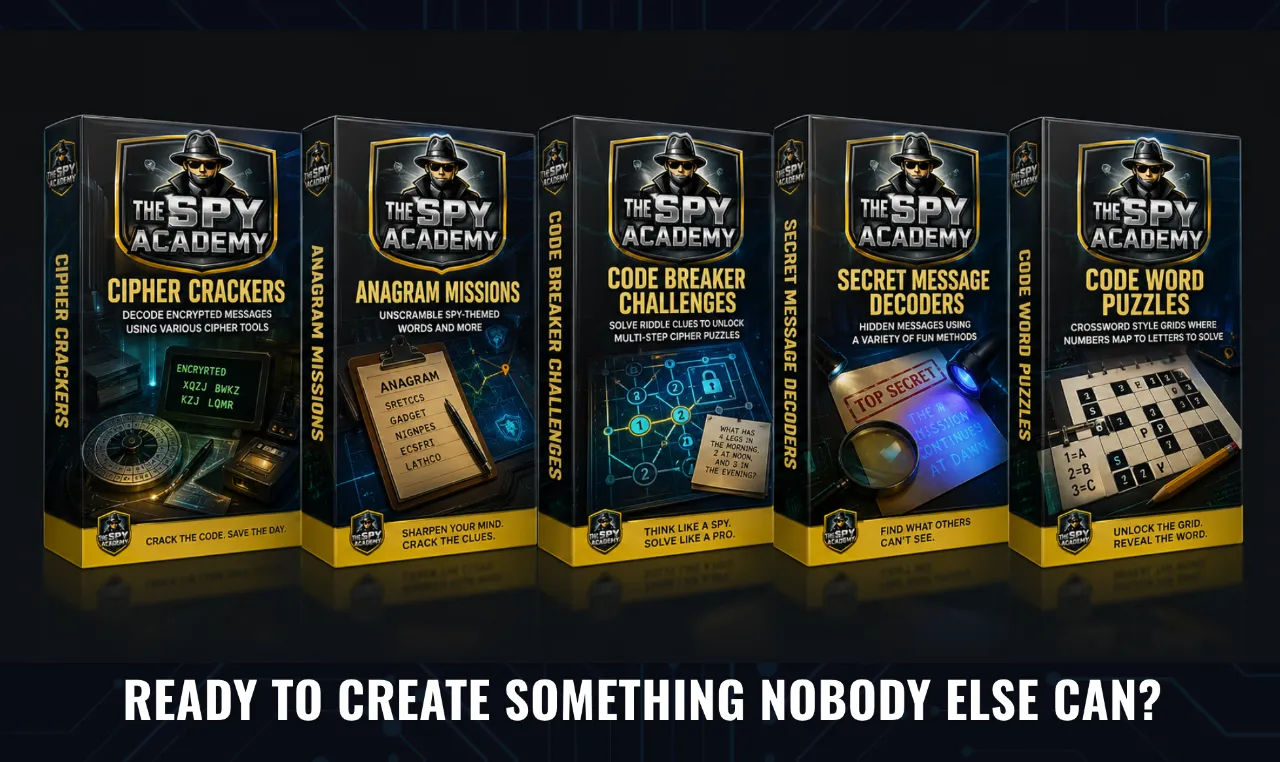
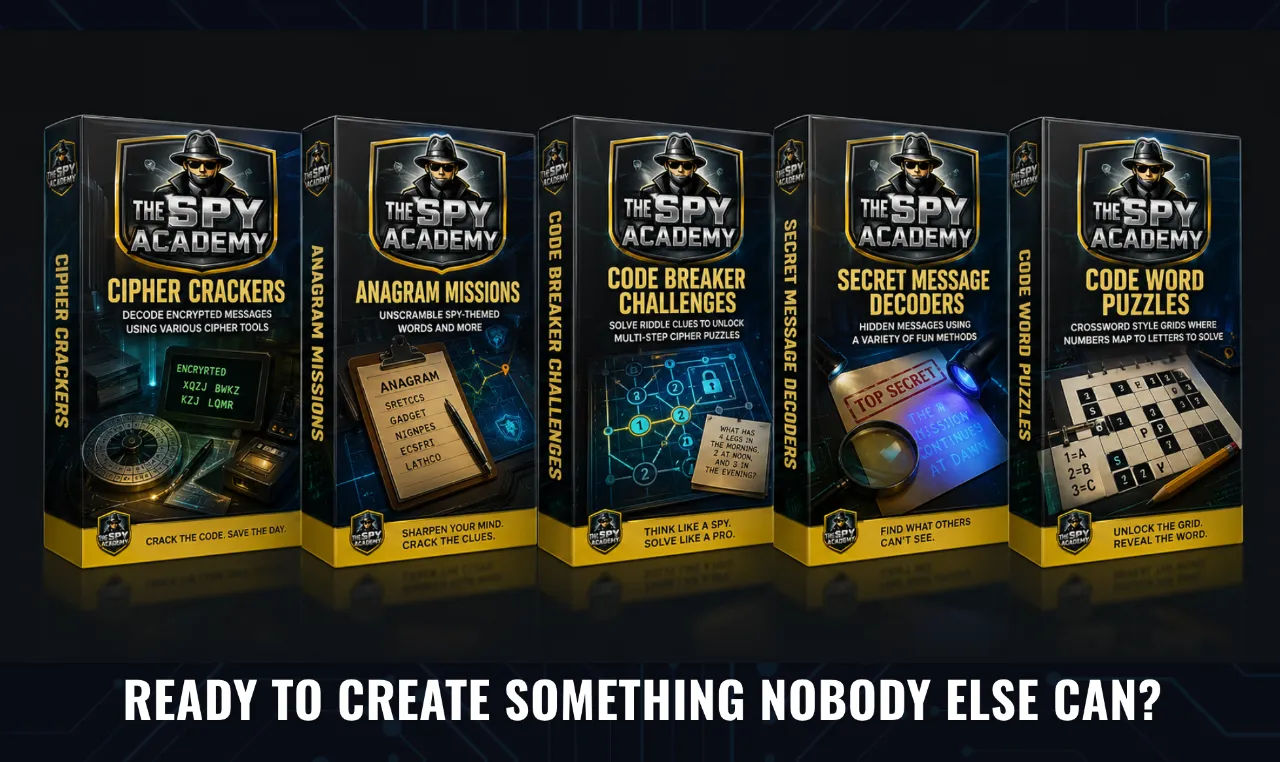
Spy Academy includes 5 main generators, each designed around spy-style activity content.
1. Cipher Crackers
This generator creates encrypted spy messages using different cipher methods. The product information mentions cipher types such as Caesar Shift, Atbash Mirror, Number Code, Reverse Words, Substitution, Morse Code, Keyboard Code, Rail Fence, and Mirror Writing.
This is one of the strongest parts of the tool because cipher puzzles naturally feel more connected to the spy genre. They are not just random word games. They make the reader feel like they are decoding something hidden.
For KDP publishers, this can become a full puzzle book series.
For Etsy sellers, this can become printable activity packs.
For teachers, this can become classroom logic activities.
For parents, this can become screen-free fun that still feels educational.
2. Anagram Missions
Anagram puzzles are familiar, but Spy Academy packages them with spy-themed framing.
That matters because packaging changes perceived value.
A basic unscramble worksheet feels ordinary. But an “Anagram Mission” where the reader has to unscramble intercepted clues feels more exciting.
This type of content can work well for younger readers, classroom packs, quick printable bundles, and beginner-level spy activity books.
3. Code Breaker Challenges
Code Breaker Challenges appear to be more advanced because they involve multi-step solving.
This is important for creators who want to build higher-engagement products. Multi-step puzzles can feel more premium than single-action worksheets because the reader has to think through the process.
This type of generator could be useful for older kids, teens, adult puzzle fans, and themed challenge books.
4. Secret Message Decoders
Secret message activities are commercially attractive because they are easy to understand and emotionally appealing.
Kids love hidden messages.
Parents understand the value quickly.
Teachers can use them for classroom engagement.
Etsy buyers can use them for party games, homeschool activities, rainy-day packs, and road trip printables.
This generator could be one of the easiest to package into small digital products.
5. Code Word Puzzles
Code Word Puzzles use number-to-letter logic in grid-style formats. These can appeal to readers who enjoy structured puzzles and letter-based deduction.
This adds another format to the product catalog, which is important because one tool becomes more valuable when it lets you create multiple product types.
The Feature That Makes Spy Academy More Than A Puzzle Generator
The most interesting feature is the Spy Mission Books Builder.
This is the part that separates Spy Academy from basic puzzle software.
According to the product information, the Spy Mission Books Builder can generate full spy narrative stories with characters, objectives, plot twists, cipher challenges, code-breaking puzzles, and secret missions woven into the plot. The output is designed as a ready-to-publish PDF, and each generated book is unique.
That is a strong concept because it turns puzzle content into a reading experience.
Most activity books are page-based.
A mission storybook is journey-based.
That difference can improve perceived value.
A child is not just completing random puzzles. They are moving through a story. They are solving challenges to progress through a mission. That creates a stronger reason to keep turning pages.
For creators, this opens a more interesting publishing angle.
You could create:
Spy adventure puzzle storybooks
Detective mission books for kids
Code-breaking storybooks for classrooms
Mystery challenge books for homeschoolers
Printable mission adventures for Etsy
Commercial PLR-style puzzle story packs
This matters because story-based products can often feel more premium than isolated worksheets.
The current limitation is that the Story Mission Builder includes 25 complete stories every month. I actually see this as reasonable because AI story generation has real cost behind it, but buyers should understand the difference: the main activity generators have unlimited PDF downloads, while the story builder has a monthly story limit.
Real-World Use Case: KDP Publishing
For KDP publishers, Spy Academy is interesting because it gives you a more specific activity book category.
A practical workflow could look like this:
You choose an audience, such as ages 8–12.
You select 2 or 3 puzzle types.
You generate beginner-friendly cipher and decoder activities.
You create a branded cover in Canva or another design tool.
You upload the book to KDP.
You then create follow-up volumes with different difficulty levels and puzzle types.
This is where Spy Academy becomes useful as a catalog-building tool.
The real money in publishing usually does not come from making one random product. It comes from testing concepts, improving positioning, and building product lines.
Spy Academy gives you enough variation to create multiple related products:
Volume 1: Beginner Spy Codes
Volume 2: Secret Message Missions
Volume 3: Detective Code Breakers
Volume 4: Advanced Spy Cipher Challenges
Volume 5: Complete Spy Mission Storybook
That kind of structure is better than publishing one disconnected book and hoping it works.
Real-World Use Case: Etsy Printables
Etsy buyers often want quick, useful, themed digital downloads.
Spy Academy could work well for:
Road trip activity packs
Birthday party spy games
Homeschool spy missions
Classroom detective worksheets
Rainy-day printable puzzles
Escape-room-style kids activities
Screen-free family challenge packs
The advantage here is that Etsy products do not always need to be huge books. A focused printable pack can still be valuable if it solves a specific buyer need.
For example, a parent might buy a spy printable pack for a weekend activity. A teacher might buy a detective-themed worksheet bundle for a classroom lesson. A homeschool parent might buy a code-breaking pack to make learning feel more fun.
Spy Academy gives creators a way to create these types of products faster.
Real-World Use Case: Teachers And Educators
Spy-themed puzzle activities can be useful in education because they combine entertainment with cognitive skill-building.
Ciphers, anagrams, code words, and decoder missions can support:
Pattern recognition
Logical thinking
Spelling
Vocabulary
Focus
Problem-solving
Reading comprehension
Attention to detail
The key is that the activity feels like play.
That is why spy-themed educational content can work well. Students may not feel like they are doing another worksheet. They feel like they are solving a mission.
For Teachers Pay Teachers creators, this can become a useful content angle.
What I Like Most About Spy Academy
The biggest strength is differentiation.
Spy Academy gives creators access to a less common activity book format. That matters because most low-content publishing tools create similar outputs.
The second strength is speed.
Manually creating cipher puzzles, decoder activities, answer keys, and formatted pages takes time. Spy Academy reduces that production burden.
The third strength is commercial rights.
The product information says users can sell what they create on platforms like KDP, Etsy, TPT, Gumroad, their own websites, craft fairs, and local print shops.
For business-minded creators, that is essential.
The fourth strength is format flexibility.
With 16 page sizes, full-color or black-and-white output, answer key options, and font size controls, the tool appears built for real publishing use instead of just casual puzzle generation.
The fifth strength is the storybook angle.
The Spy Mission Books Builder makes the tool more ambitious because it allows creators to build experience-driven puzzle books rather than only isolated puzzle pages.
What I Do Not Like As Much
Spy Academy is not a complete business system by itself.
This is important.
It can help you create content, but it does not replace market research, cover design, keyword selection, pricing, listing optimization, branding, or traffic generation.
If someone buys Spy Academy expecting instant income, they will likely be disappointed.
The tool helps with production. It does not guarantee sales.
Another limitation is language support. The product information says multi-language support is on the development list, including Dutch, French, German, Italian, Spanish, and Portuguese, with an expected timeline of 1–2 months. But if you need non-English support immediately, you should check the current feature status before buying.
Also, because the product launched only a few days ago, there is limited long-term marketplace feedback. Early buyers may benefit from entering before the niche becomes more visible, but they are also buying before there are many public case studies.
That is not necessarily a problem. It is simply part of the risk-reward balance of buying early.
Pricing And Value Analysis
Spy Academy is currently listed at $37 one-time, with the regular price shown as $67. The product information also mentions founder pricing and says the price increases to $47 after launch.
For me, the $37 price point is reasonable because the value is not based on one finished book.
The value is based on repeatable production.
If you can use Spy Academy to create several books, printable packs, classroom resources, or digital product bundles, the cost becomes easier to justify.
The ROI logic should be practical:
How many hours would it take to create cipher puzzles manually?
How long would it take to format pages and answer keys?
How much mental energy would you spend designing puzzle logic?
How many product variations could you create with the tool?
Could this help you test a new niche faster?
That is how I would evaluate Spy Academy.
Not as a guaranteed income tool.
Not as a push-button business.
But as a production accelerator for a more specific publishing angle.
Bonuses And Extra Value
The launch offer includes several bonuses, according to the product information:
Bonus 1: Field Report + Monetization Playbook
Bonus 2: Spy Mission Quick-Start Video Training
Bonus 3: Spy & Detective Printable Activity Pack
Bonus 4: Spy & Mystery Prompt Vault with 150 recipes
The stated total bonus value is $558, while the total claimed offer value is $1,152.
I do not usually judge a product only by bonus value because bonus values can be subjective. But in this case, the bonuses are relevant to the core use case.
The most useful bonuses are likely the playbook and quick-start training because many buyers need help deciding what to create first. A tool is only useful if you actually turn it into products.
The printable activity pack and prompt vault may also help buyers move faster instead of staring at a blank screen.
Who Spy Academy Is Best For
Spy Academy is best for creators who already understand the value of digital products and want a faster way to create differentiated activity content.
It is a good fit for:
KDP publishers who want a less saturated activity book angle
Etsy sellers creating printable activity packs
Teachers Pay Teachers creators building classroom resources
Homeschool content creators
Parents who want custom screen-free activities
PLR sellers creating themed puzzle bundles
Digital product creators looking for fresh product ideas
Educational content sellers
Puzzle book creators who want more variety
It is especially useful for people who already know that publishing success depends on packaging, positioning, and consistency.
Who Should Skip Spy Academy
You should skip Spy Academy if you expect the tool to do everything for you.
It will not automatically find winning keywords.
It will not design your perfect cover.
It will not guarantee KDP rankings.
It will not create your Etsy traffic.
It will not replace product strategy.
You should also skip it if you only want traditional puzzle formats like word searches or Sudoku. Spy Academy is more focused than that.
And if your main business requires immediate non-English publishing, you should verify the current language support before buying.
My Final Verdict
Spy Academy Powered by Activity Book Generator is one of the more interesting activity book tools I have reviewed recently because it addresses a real problem: sameness.
Most creators do not need another way to make the same type of puzzle book faster.
They need a better product angle.
Spy Academy gives creators that angle by focusing on spy missions, cipher puzzles, secret messages, decoder activities, code-breaking challenges, and story-driven puzzle books.
That makes the tool useful not because it promises easy money, but because it helps creators produce more distinctive content faster.
My recommendation is positive but realistic.
If you are serious about KDP publishing, Etsy printables, TPT products, homeschool resources, PLR bundles, or educational digital products, Spy Academy is worth considering at the current founder price.
It is not a magic button.
It is not a guarantee.
But it is a practical tool for creators who understand that speed matters only when it is combined with a strong product concept.
And in this case, the concept is strong: spy and mystery activity books that feel more engaging than ordinary worksheets.
That is why I think Spy Academy stands out in practice.