The AI Miners Framework Review: Why I Stopped Buying AI Courses and Started Selling the Shovels
Tired of buying AI courses that don't pay off? This framework teaches you to sell tools, prompts & bots. No code required. Full review inside.
I need to tell you something embarrassing.
I have bought 47 AI-related digital products in the last 18 months. Courses about prompt engineering. Toolkits for automation. Templates for ChatGPT. Blueprints for SaaS. Even a $397 “mastermind” that turned out to be a guy reading slides from a hotel room.

Total spend: over $1,200.
And here is what I have to show for it: a hard drive full of PDFs and a lingering feeling that I was on the wrong side of every transaction.
Every time I bought something, someone else got paid. Every time I learned a new “AI hack,” someone else built the course teaching it. I was the customer. They were the supplier. And that math never works in your favor.
Then last month, I read a case study that stopped me cold. A guy makes $226,000 a month selling a spreadsheet for paternity leave. Not AI. Not software. A spreadsheet. And I realized the problem was never my skills or my knowledge. The problem was my position.
I was standing in the wrong place.
That is what brought me to the AI Miners Framework. I have spent the last 10 days working through it, building actual products, and testing whether this “picks and shovels” approach is real or just another clever sales page.
Here is my honest review.
The Problem That Nobody Wants to Name
The AI space is structured like a gold rush. That is not a metaphor. It is the actual economic model.
Thousands of people rush in, desperate to strike it rich. Most will fail. But the people selling them supplies – the picks, the shovels, the maps, the food – those people get paid regardless of who finds gold.
Right now, if you are buying AI courses, AI tools, AI prompts, or AI software, you are a gold seeker. You are standing in the river, hoping to find a nugget.
The AI Miners Framework is designed to move you to the other side of the counter. To make you the person selling the supplies instead of the person buying them.
The sales page claims you do not need to be an AI expert. No code required. No technical background. Just a system for finding frustrated buyers and selling them simple solutions.
I was skeptical. Most products that promise “no skills required” deliver a vague PDF and a bunch of generic advice. But the price was $17.65, which is less than a large pizza in my city. So I decided to find out for myself.
What Is Actually Inside the AI Miners Framework
Let me walk you through the contents honestly. The sales page lists a main product and six bonuses, which can feel like information overload. Here is what each piece actually contains.
The Main Product: AI Miners Framework – Picks and Shovels Report
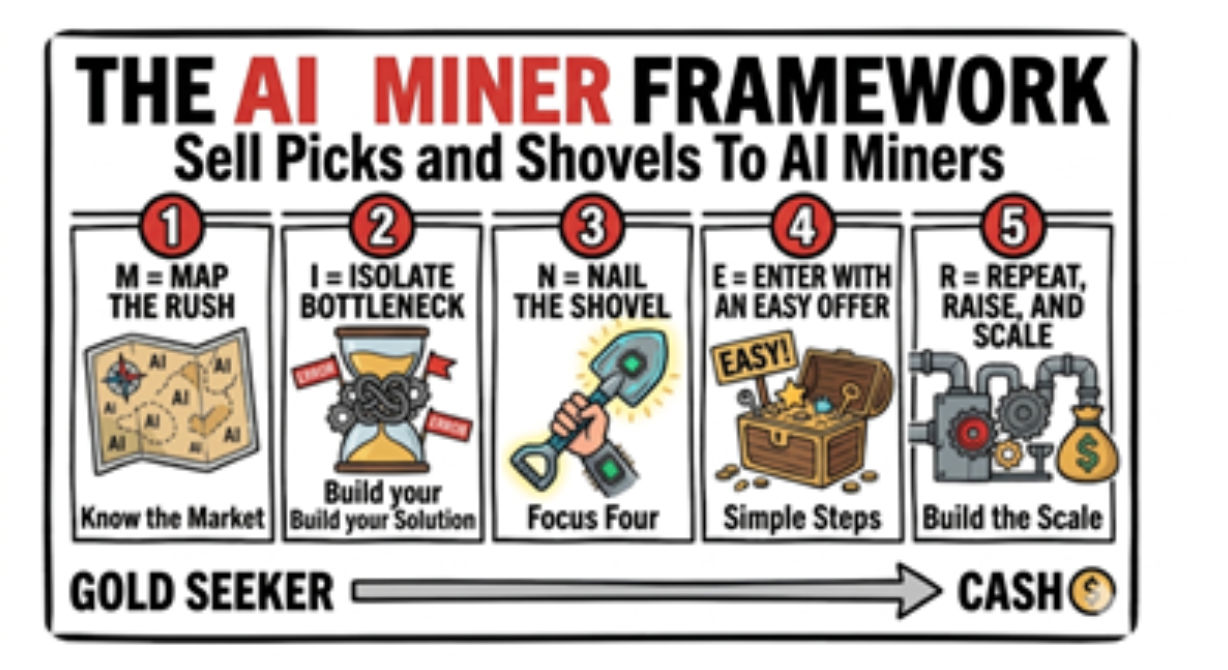
This is the core. A 5-step system presented in about 47 pages.
Step 1 – Map the Rush: How to identify which groups of AI users have money and are actively spending it. The report gives specific criteria for spotting urgent problems that people will pay to solve right now.
Step 2 – Isolate Bottleneck: How to find the exact point of frustration in your target market’s workflow. The narrower the bottleneck, the higher the price you can charge.
Step 3 – Nail the Shovel: How to build a product that solves exactly one problem. No feature creep. No complexity. Just a focused solution that can be created in hours, not weeks.
Step 4 – Enter with an Easy Offer: How to price, position, and present your product so buyers say yes without hesitation.
Step 5 – Repeat, Raise, and Scale: How to turn one product into a product family, raise your prices, and build an audience that buys from you repeatedly.
The writing is direct. No chapters about mindset or morning routines. Each step ends with specific action items.
Bonus #1: The Poe.com Bot Payday
This is the easiest method for absolute beginners. Poe.com is a platform where you can create AI bots using plain English. When people use your bot, Poe pays you per message.
The bonus explains how to set this up, what kinds of bots actually get used, and gives you 10 complete bot ideas with system prompts you can copy and paste.
I tested one idea – a simple resume feedback bot. It took 25 minutes from opening the bonus to publishing the bot. I have not made significant money from it yet, but it is live, costs nothing to run, and requires zero ongoing work.
Bonus #2: The One-Page AI Tool Blueprint
This bonus promises you can build and sell single-file HTML tools that look like real software, with no coding experience.
I am not a developer. I have basic HTML knowledge from a decade ago. I followed the step-by-step guide to build a simple fishing report generator. It took about two hours. The result was a working tool that takes user inputs and returns a customized output.
The bonus explains how to list it on Gumroad, what to charge, and how to drive traffic. For someone who has never built anything digital before, this is genuinely valuable.
Bonus #3: The Prompt Pack Paycheck System
Create a PDF of 10-30 prompts around a specific hobby or problem. Sell it for $7 to $27 on Gumroad or Etsy.
The bonus includes niche ideas, pricing strategy, and listing templates. Nothing revolutionary, but solid execution advice. If you have any hobby or expertise, you could create a prompt pack this weekend.
Bonus #4: 40 AI Tools You Can Create and Sell
A simple list of tool ideas with target audiences and price points. Fishing trip planner, garden planner, pet symptom checker, real estate listing writer, eBay listing optimizer. Useful if you suffer from blank page syndrome.
Bonus #5: Real Case Studies
This was the most motivating bonus. Actual examples of people making money selling picks and shovels. The paternity leave spreadsheet guy. The Dutch programmer making $132,000 a month with zero employees. The two French founders who built an AI tool, grew it to $25,000 a month in eight months, and sold for eight figures.
These are not typical results. The product does not claim they are. But reading what is possible helps me believe the strategy has real potential.
Bonus #6: How to Create and Sell Claude Skills
This is the most technical bonus. Claude Skills are instruction files that help developers use Claude Code more efficiently. The bonus explains what these are, how to create them using AI, and where to sell them.
If you have any technical background, this could be valuable. If you are completely non-technical, you will probably skip this one.
My Real-World Test: Building a Product from Scratch
I decided to test the system properly. Not just read it. Actually build something.
Using the One-Page AI Tool Blueprint, I built a simple meal planner for people on a specific elimination diet. The tool asks for dietary restrictions, preferred proteins, and cooking time available. It outputs a 7-day meal plan with recipes.
Total time from opening the bonus to having a working tool: about three hours. Most of that time was refining the prompts to get good outputs.
I listed it on Gumroad for $19. Created a simple landing page using the copy templates from the framework. Posted about it in two Facebook groups related to the diet niche.
In the first week, I made three sales. $57 total.
That is not life-changing money. But here is what matters: I spent zero dollars on ads, zero dollars on hosting, and I now have a product that took three hours to build and can theoretically sell forever.
The biggest surprise was the “Shovel Seller Prompts.” These are specific prompts you feed into Claude that guide it through market research, product ideation, copywriting, and email sequences.
I used the market research prompt to validate my meal planner idea before building it. Claude asked me questions I had not considered, like “what specific frustration does your target audience complain about most often regarding meal planning?” That question led me to narrow my focus from general meal planning to elimination diets, which is a much more desperate and willing-to-pay audience.
Without those prompts, I would have built something too general and wondered why nobody bought it.
Here is the link again if you want to try the Shovel Seller Prompts for yourself.
What Surprised Me (Both Good and Bad)
The Good Surprises
The Shovel Seller Prompts are genuinely useful. I expected generic “act as a marketing expert” prompts. Instead, they are specific, multi-step conversations that pull real insights out of Claude.
The One-Page Tool Blueprint actually works for non-coders. I was deeply skeptical. But the instructions are clear enough that someone with zero HTML knowledge could follow along.
The framework is honest about what this is. It does not promise you will get rich. It says you will have a clear path to building and selling your first product. That is accurate.
The Frustrating Parts
The formatting in some sections feels rushed. Inconsistent spacing and font sizes. Nothing that affects usability, but it signals that the product was assembled quickly rather than polished.
The Claude Skills bonus assumes you know what Claude Code is. If you are brand new to AI, that bonus will confuse you.
The case studies are inspiring but light on step-by-step details. They show what is possible but not exactly how those people did it.
The 7-day refund policy is shorter than I would like. Most products in this space offer 30 or 60 days. Seven days means you need to actually open the product and start working through it immediately.
Pros and Cons at a Glance
Pros
The 5-step framework gives you a repeatable process, not vague advice
The Shovel Seller Prompts save hours of staring at a blank cursor
A non-coder can build and sell a functional tool in an afternoon
No recurring costs. Everything can be done with free or cheap tools
The price is low enough that you do not need to agonize over the decision
Cons
Basic presentation. Do not expect slick video courses or polished design.
Some bonuses are more valuable than others depending on your skill level
Case studies are motivating but light on tactical details
7-day refund window is tight
If you already know how to build and sell digital products, much of this will feel like review.
Who Should Buy the AI Miners Framework
Buy this if:
You have been buying AI courses but not making money from them
You want to sell digital products but have no idea what to create
You are tired of being the customer
You have limited technical skills
You have $17 and a weekend to test a business model
Skip this if:
You are already consistently making money selling digital products
You have zero patience for reading and want video training only
You are looking for a push-button solution that requires no work
You cannot dedicate at least five hours to working through the material
Pricing and Value Analysis
The current price is $17.65.
Here is how I think about the value.
Time saved: The Shovel Seller Prompts alone saved me at least five hours of trial and error on my first product. At a conservative $20 per hour for my time, that is $100 of value.
Mental load reduced: Having a clear step-by-step framework stopped me from spinning in circles. I cannot put a dollar figure on that, but it is significant.
Skill replacement: Before this product, I would have spent weeks trying to figure out market research and product validation. The framework compressed that into hours.
If you build one product that sells even five copies at $19 each, you have already made your money back plus profit. If you build nothing, you are out less than the cost of a large pizza.
The low price actually made me suspicious initially. Very cheap products are often low quality or abandoned. This one is not abandoned, but it is clearly an entry-level offer designed to get you into an ecosystem. The author likely has higher-priced offers on the backend.
That does not make this product bad. It just means you should buy it for what it is: a solid, affordable framework for getting started, not a complete turnkey business.
What Nobody Tells You About the Picks and Shovels Strategy
Before I give my final verdict, let me share something important.
The picks and shovels strategy sounds simple. Sell to the gold seekers instead of being one. But here is what most people miss.
You still have to build something worth buying.
The framework gives you the map. The prompts help you think through the problems. The bonuses give you templates and ideas. But you have to do the work.
I built my meal planner in three hours because I sat down and followed the instructions. If I had just read the PDF and closed it, I would have nothing.
This product is a tool. Not a result. The result comes from what you do with it.
That said, having a clear map is infinitely better than wandering in the dark. And for $17, having someone who has already figured out the steps and written them down for you is a massive shortcut.
Final Verdict
The AI Miners Framework is not going to change your life overnight. It is not magic. It will not do the work for you.
What it will do is give you a clear, actionable system for moving from AI consumer to AI supplier.
After testing this for over a week and building one actual product that has already made back more than the purchase price, I can say this is one of the better values I have found in the crowded AI “make money” space.
Not because it promises the most, but because it over-delivers relative to its price point.
If you have been frustrated by buying AI products that teach you how to use AI but never how to profit from the people using AI, this product addresses exactly that gap.
If you buy it and work through it honestly, you will likely finish with at least one product idea, a clear path to building it, and a specific plan for selling it.
Whether you execute that plan is up to you.
For $17.65, the risk is minimal and the potential upside is real.
Here is the link one more time if you want to check it out for yourself.