Signal Trail Review: Map Clue Puzzle Books
I built a 30-case detective puzzle book in an evening and only cried once. Here is what Signal Trail actually does, and where it annoyed me.
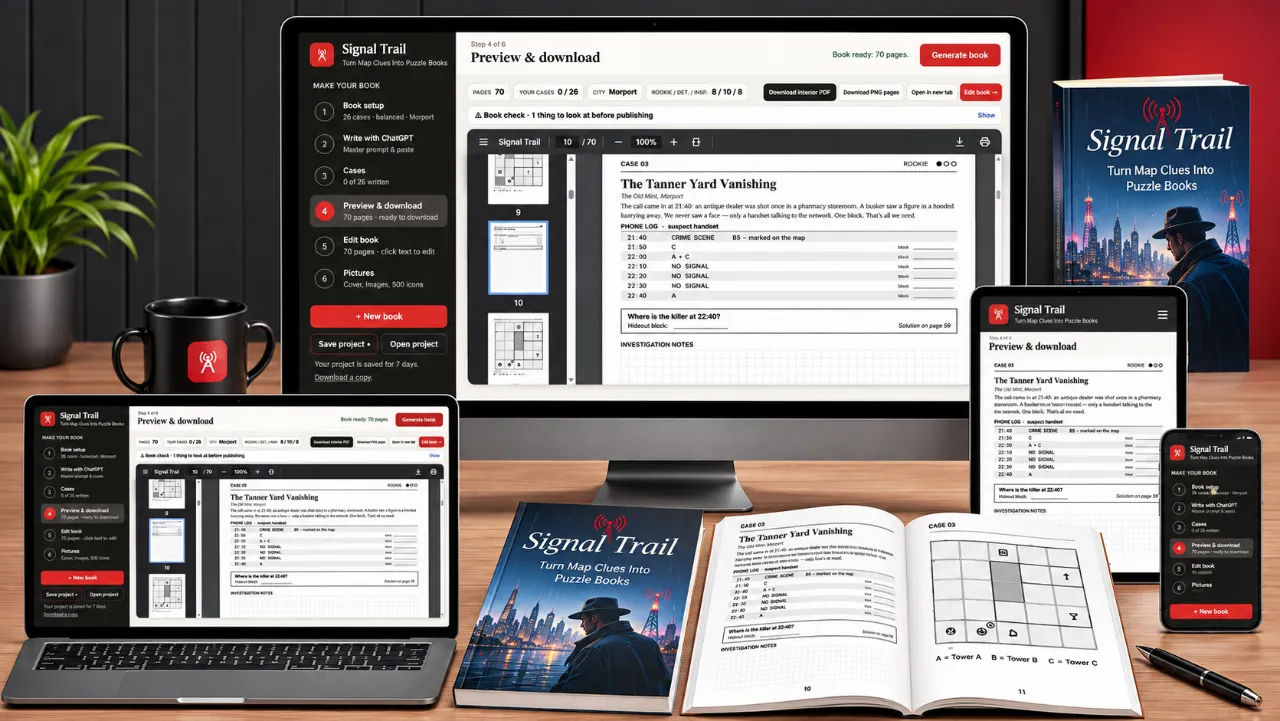
Signal Trail is the first puzzle book tool I have used that did not make me want to throw my laptop at a wall. I want to be careful with that sentence, because I have tried this kind of thing before and I have a specific grudge to explain. Last spring I spent a whole Saturday building a ten-case logic book by hand in a spreadsheet. Ten cases. By the end of it a friend had already found two possible answers for case four and I had to rebuild the map three times, and I still have the file sitting on my desktop as a warning to myself. So when I read the sales page for Signal Trail and it promised "two independent solvers" to check every case, I was suspicious. That is a big claim for a $17 tool.
I bought it. I generated a thirty-case book set in a made-up city called Harrow Point. It took me most of an evening, plus a second evening for the stories, and I did not rebuild a single map. That is the headline. The rest of this review is the detail: what you get, where it hurts, and whether it fits what you are trying to do.
Our Verdict
Signal Trail
A $17 map-clue puzzle book builder that genuinely checks every case for a single answer. Best for KDP and Etsy sellers who can live with ChatGPT stories and a browser-only workflow.
One-time payment, commercial and PLR rights included
What You Actually Get
The thing that surprised me is how little of Signal Trail is guesswork. You are not handed a blank canvas. You get a browser app that builds a complete book from a few settings:
- Up to 30 cases per book. Each case gets its own district map, cell towers, a suspect phone log, field reports and a question.
- Two separate solvers that check every case before the book is built. A case only makes it through if exactly one hideout fits.
- A set of exactly 14 kinds of place on the maps, and no others: cafes, hotels, metro stations, churches, pharmacies, bars, museums, libraries, theatres, cinemas, hospitals, markets, bakeries and art galleries. A park or a bank never appears.
- A ChatGPT master prompt with five tones (classic noir, police procedural, cozy, dark thriller without gore, and pulpy) plus your own custom theme.
- All the front and back matter: title page, copyright page, How to Play rules, a worked example, contents, case pages, maps, investigation notes grid, field notes pages, and solutions with the route drawn.
- US Letter or A4 export, as a print-ready interior PDF and as PNG pages.
- Save and open up to three projects, kept in your browser for 7 days, with a download option so you can keep a copy.
- Commercial and PLR rights to sell what you make.
A thirty-case book in US Letter comes out at around eighty pages, which matches what I got. There is no design software involved and no monthly fee. That last bit matters to me, because half the tools in this space charge you a subscription to keep your own books.
Key Features, and What They Do For You
The two-solver check. This is the whole reason the tool exists. Every case is run through two independent solvers and only reaches the book if one hideout and only one fits. If you have ever found a second answer in your own puzzle after publishing it, you know why this is the feature you are really paying for. I cannot verify the maths of two solvers from the outside, but I can tell you my book did not throw up a second answer in the cases I spot-checked by hand.
The map generator. You type a city name or let the app invent one, and every case gets a district map with towers and a route. The maps stay fixed inside your project, which means when you come back to write the stories the map facts still line up. This is the part that would have saved me a full day last spring.
The ChatGPT master prompt. The prompt carries each map's facts into ChatGPT, from the time and crime scene to the hideout and the places on the map, so the story does not accidentally describe a bar where the map has a church. That was one of the specific snags the sales page listed, and I hit exactly that problem in my spreadsheet book, so I felt seen.
The paste-and-match case filling. You paste ChatGPT's replies back into the app, each story lands on its own case, and red notes flag anything that does not match the map's 14 kinds of place. You can also leave cases blank and press Generate book, and the app fills them with text so you can flip through a complete book before you have written a word.
The right to sell. Every book is yours. You can publish under your own name on Amazon KDP, Etsy, Gumroad, Payhip, Shopify or your own site, sell printed copies at markets, bundle them, or sell them as PLR packs that other sellers rebrand. You cannot sell the Signal Trail software itself or pass PLR rights to it, and you cannot sell PLR packs on WarriorPlus or JVZoo.
Actually Using It
The build runs in five steps and I want to walk through them honestly, including the bits that got on my nerves.
Step one is setup: title, pen name, a city, and how many cases. I put in 30 because I wanted to see if it would hold. I picked US Letter because A4 felt like the wrong choice for an Amazon KDP experiment. That took a minute.
Step two is the stories. Here is where you pick a tone and a theme and copy the master prompt into ChatGPT. I went with classic noir and a vague "rain-soaked industrial city" theme. The prompt is split into replies so you are not trying to feed one giant instruction in at once. I did not count them, but it took several pastes before I had all thirty.
Step three is pasting the replies back. This is the least glamorous part. You are copying and pasting between two browser tabs for what felt like twenty-five minutes, and a couple of stories landed with a red note because ChatGPT had written someone into a school that does not exist in the 14 place types. The red note pointed right at the line. I fixed it, pasted again, and it cleared. Annoying, but honest. The app tells you when something is wrong instead of quietly publishing a map that disagrees with the story.
Step four is Generate book. This is where the two solvers do their thing. It ran while I made tea and I did not see it fail. When I came back the book was done.
Step five is the flip-through. You can page through the whole book before downloading, then grab the interior PDF or every page as PNG. I downloaded the PDF and opened it in my usual reader. Title page, copyright, How to Play, a worked example that actually walks through a case, contents, then the case pages with the maps and the phone logs, then the notes pages, then the solutions with the route drawn on each map. Every "Solution on page" note pointed to the right page, which sounds small until you have moved a page after doing that by hand.
The thing I did not expect to enjoy was reading my own book. I have made printables before. I have never made something that felt like a paperback. Harrow Point looked like a paperback.
What annoyed me: the three-project limit and the seven-day storage. I understand why it exists (it is browser storage and there is a real cost to keeping everything), but if you are the sort of person who likes ten half-finished books on the go, this will frustrate you. Download your project copy the moment you are happy with it. The other thing is that this is not a one-click book. You still spend real time on ChatGPT, you still check the book, and the sales page says as much when it tells you not to publish without flipping through the preview first. If you expected a magic button, you will be disappointed.
Build your first 30-case book tonight
One payment, no subscription, commercial and PLR rights
Pricing and Value Analysis
Signal Trail is a one-time $17. The sales page mentions $197 once, in what looks like a comparison against the full-access or bundle tier, so treat that as the larger package rather than the price of the tool. For the base tool, seventeen dollars.
Is that good value? It depends entirely on what you compare it to. Here is the honest comparison:
| Approach | Typical cost | Time per 30-case book | Second-answer risk |
|---|---|---|---|
| Signal Trail | $17 one-time | One to two evenings | Checked twice before build |
| Doing it by hand | Your weekend | A whole weekend, or more | High, and you will lie awake |
| Hiring a puzzle designer | Hundreds per book | Days, with back and forth | Depends on the designer |
If you sell even a handful of copies of your first book, the $17 is already back. If you never sell a thing, $17 is cheaper than the Saturday I wasted last spring. The maths is not complicated. What I would say is that the tool is worth $17 to anyone who intends to make two or more books. If you only ever plan to make one, you could argue it is a fine purchase anyway, because one decent paperback on KDP can return the cost.
I do not have a reliable figure for how much the books sell for, because that depends on your listing, your cover and your category, and I am not going to invent one. You decide what to price your book at. Signal Trail just gives you the interior.
Pros and Cons
Pros
- Cases are checked twice for a single answer before the book is built
- Complete interior from front matter to solutions, no design software
- Commercial and PLR rights to sell what you make
- One-time $17, no subscription and no upsell required to finish a book
Cons
- Stories come from ChatGPT, which means copy-paste time and the odd red note to fix
- Browser storage is limited to three projects kept for 7 days, so download your copy
- Not a one-click book, you still have to check the preview before publishing
- Illustrated and children's books are not what this is for
Who This Is For
KDP publishers who want a puzzle format that is not another word search, and who can put a book out without a designer. Etsy printable shops that want themed case files or seasonal packs. Mystery-night hosts who want to print case files for a table of competitive friends. Anyone who wants a book set in their own town, with someone they love as the detective. If you are happy to use ChatGPT for the stories, or you want to write them yourself, you fit.
Who Should Skip It
Skip Signal Trail if you need illustrated books, or books for young children. The 14 place types and the black-and-white map format do not suit a picture book. Skip it if you want a done-for-you business rather than a creative tool, or if you will not spend a few minutes checking each book before you publish. And skip it if you want a button that produces a finished, story-complete book with no input from you. That button does not exist here, and the sales page is fairly upfront about that.
Frequently Asked Questions
Is Signal Trail worth it?
For $17, yes, if you plan to publish more than one map-clue puzzle book. The two-solver check alone saves the hours you would spend verifying every case by hand, and you keep commercial and PLR rights to every book you create. It is less compelling if you only ever make a single book.
Who is Signal Trail for?
It is built for KDP publishers, Etsy printable sellers, escape-room and mystery-night hosts, puzzle clubs, and crime writers who want a companion puzzle book. It also suits gift makers who want a case set in a home town. Anyone who can use ChatGPT for the stories fits.
How much does Signal Trail cost?
The base tool is a one-time $17, with no monthly fee. The sales page also mentions a $197 full-access option, which appears to be the larger package rather than the core product. Confirm which tier you are buying before you check out.
Does Signal Trail check that every case has only one answer?
Yes. Two independent solvers check every case before the book is built, and a case only makes it through if exactly one hideout fits. That is the central promise of the tool and the feature I would pay for on its own. I spot-checked cases by hand and did not find a second answer.
Is there a refund on Signal Trail?
I did not find a refund window stated in the material I had access to, so I cannot confirm one. Check the WarriorPlus checkout page for the current policy before you buy, and keep your receipt. If a refund is important to you, get that answer from the checkout page first.
What are the alternatives to Signal Trail?
You can build the cases by hand with a spreadsheet, which is what I did before this and would not wish on anyone. Or you can hire a puzzle designer, which costs far more than $17 per book. Or you can publish a themed word search, which is a different, more crowded market. Signal Trail sits in a narrow gap between those three.
Can I sell the books I make with Signal Trail?
Yes. You have commercial and PLR rights and can sell under your own name on Amazon KDP, Etsy, Gumroad, Payhip, Shopify or your own site, including printed copies and bundled case packs. You cannot sell the Signal Trail software itself or use PLR packs on WarriorPlus or JVZoo.
If you want to check it before you decide, the sales page is right here.
Final Verdict
I went in sceptical, with a spreadsheet grudge and a friend who once found two answers in my book. Signal Trail did the thing it promised: it built a thirty-case book, checked every case for a single answer, and gave me a PDF I would actually pay money for. The $17 price is a joke compared to the weekend I would have spent doing it by hand. The one downside I would flag to anyone is the browser storage limit, so download your project copy as soon as you are happy with it, and the copy-and-paste back and forth with ChatGPT, which is fiddly but honest. If you want a detective puzzle book you can sell this month, this is the shortest route I have found.
Make your map clue puzzle book with Signal Trail
One-time $17, commercial and PLR rights included
Related Posts

Luxury Lace Holiday Collection Review: 714 PLR Prompts
I spent a weekend generating sheets from the Luxury Lace Holiday Collection to see if 714 ChatGPT prompts actually produce sellable printables. Some sheets impressed me, one needed three retries.

WellPrint Review: I Made a 30-Day Wellness Plan in Four Minutes
I timed WellPrint from blank page to a finished 30-day plan PDF. Under four minutes, and the words were the part I'd normally lose a weekend to. Here's the honest breakdown.
Prepper Book Builder Review: 72 KDP Topics, One Prompt
I turned one prepper topic into a full editorial brief and pasted it into my AI. Here is what the Prepper Book Builder actually does, and where it falls short.
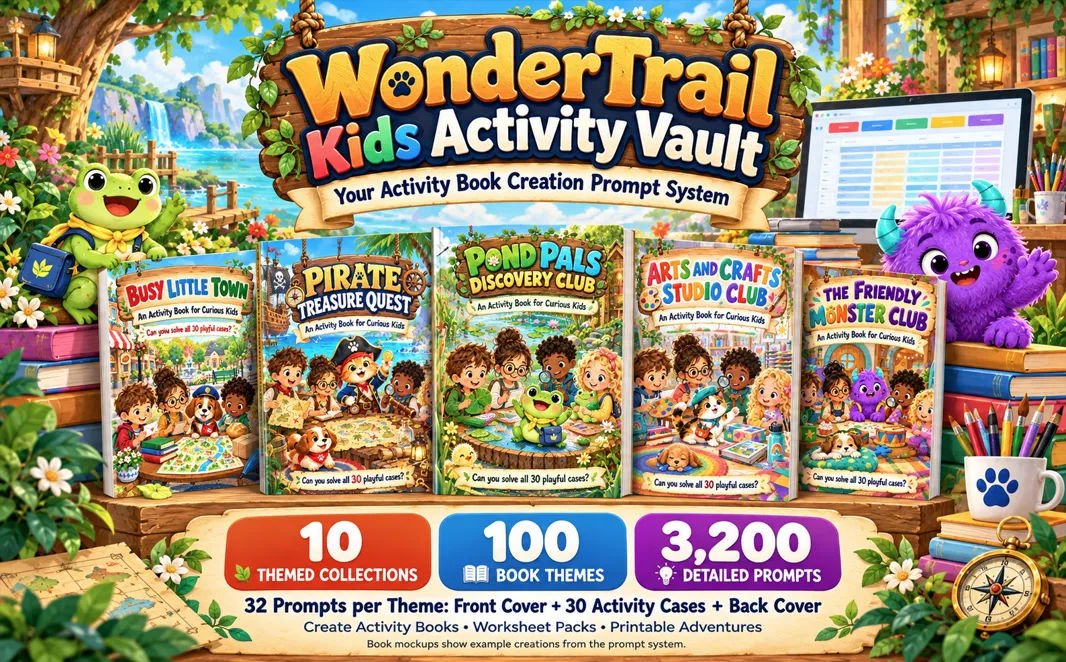
WonderTrail Kids Activity Vault Review: 3,200 Prompts for $17
I bought WonderTrail Kids Activity Vault to see whether 3,200 structured prompts really beat starting from a blank page. It does, with one big caveat about ChatGPT.

Flower Fairy Fantasy Journal Studio Review
I spent an afternoon with a $17 prompt app that writes fairy journal prompts for AI image tools. It does one narrow job well, and it does not make pictures.
Vintage Museum Crafts AI: 627 Prompts, Honestly Reviewed
A prompt library of 627 image prompts across 19 museum niches, plus an online app for prepping files. I ran it through ChatGPT and here is what came out.