329 Prompts for History’s Most Critical Hours: I Built 12 Publishable History Books in 3 Days (No Archives Required)
No archives. No history degree. Just 329 prompts that reconstruct Titanic, Pearl Harbor, Chernobyl, and 44 more critical hours into complete books. I tested 12 prompts in 3 days. Here’s the honest verdict + output samples.
For 7 years, I’ve bought, tested, and either loved or hated over 200 digital products. AI prompt packs are usually at the bottom of that list.
Most prompt products promise the world and deliver a text file full of one‑line questions like “Write about the Roman Empire.” You paste them into ChatGPT, and the AI gives you a 500‑word Wikipedia summary with better grammar. No tension. No structure. No reason a human would pay for it.

So when I first saw 329 Prompts for History’s Most Critical Hours, my internal skeptic went on high alert.
But then I noticed something different. The creator wasn’t selling “magic words.” He was describing a specific narrative architecture: temporal anchoring, dramatic irony, sensory reconstruction, character‑driven narration, and something called “Punch Paragraphs.” These are craft mechanics, not marketing buzzwords.
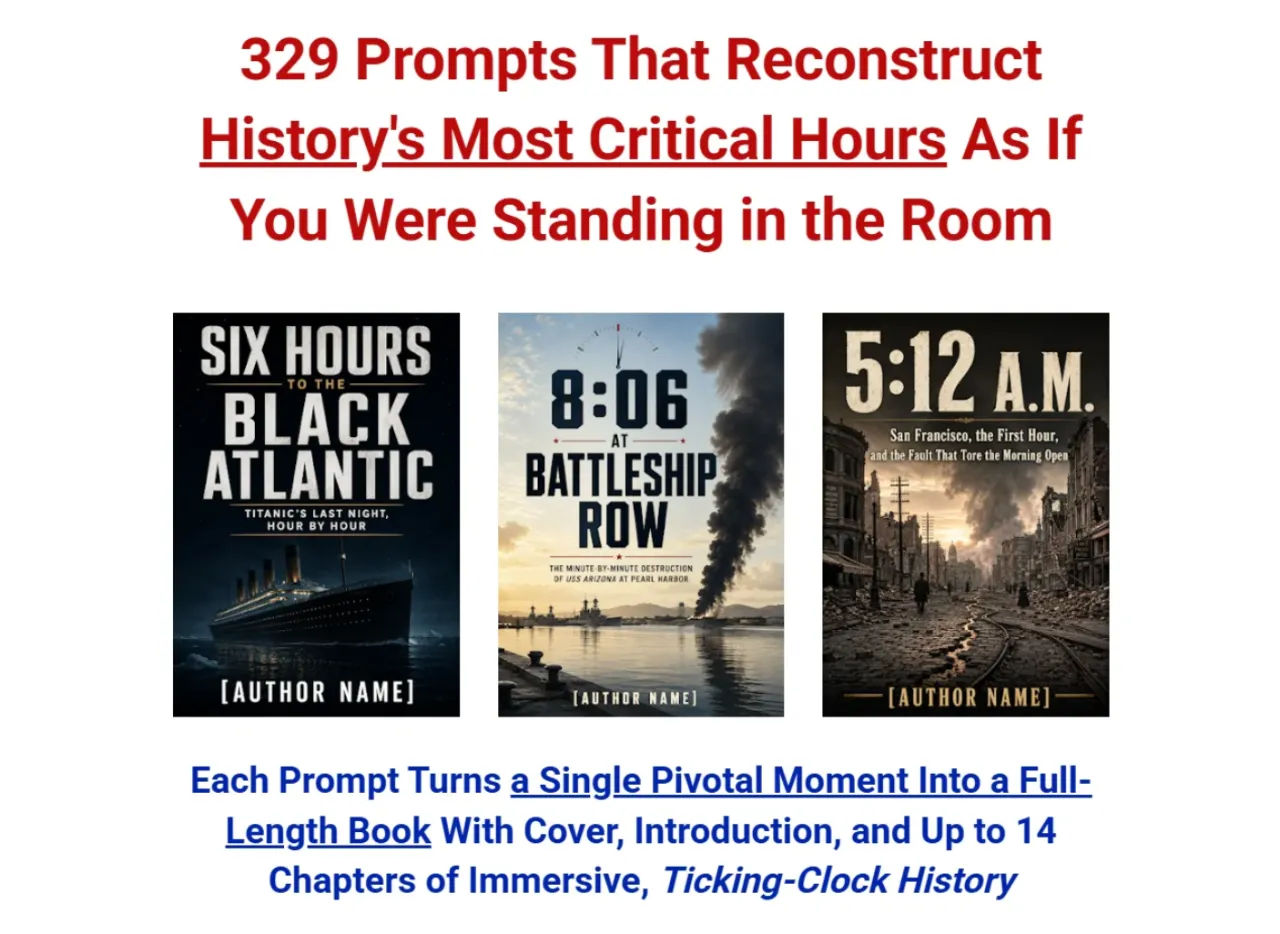
The product claims to reconstruct history’s most pivotal moments – from the sinking of the Titanic to the fall of Constantinople – hour by hour, as if you were standing in the room. Each prompt generates a complete book: cover, introduction, and up to 14 chapters of immersive, ticking‑clock history.
I decided to test it properly. I bought the product 3 days ago, ran 12 prompts across different historical events (Titanic, Pearl Harbor, Pompeii, Chernobyl, Apollo 13), and documented everything – the good, the bad, and the “I wish I knew this before buying.”
Here is my honest, no‑hype review.
Why Most “History Prompts” Fail (And How This One Is Different)
The core problem with generic AI history prompts is simple: they have no spine.
You ask for a book about the Titanic, and ChatGPT gives you a chronological list of facts. Iceberg spotted. Ship sank. Many died. The end. No reader finishes that. No one pays for that.
What separates immersive history from a Wikipedia article is structure. The order of revelations. The placement of sensory details. The way you build dramatic irony – the reader already knows the ship sinks, so you use that knowledge to create unbearable tension as characters make innocent decisions.
The 329 Prompts system solves this by not asking the AI to “write a history book.” Instead, each prompt forces the AI into a strict architectural framework designed for that specific event.
Let me show you what that actually looks like.
Core Benefits That Impact Real Outcomes
I’ve boiled down the 329 prompts into 6 practical benefits that affect your workflow, your final product, and your ROI.
1. The Critical Hours Arc (No Two Events Feel the Same)
Every major historical moment gets its own custom narrative framework. The Titanic prompt generated a 5‑phase arc called “The Vanishing Decks Arc.” The Pompeii prompt gave me a completely different structure focused on the 72 hours before the eruption. The AI doesn’t guess. It follows a blueprint.
This matters because readers feel the difference. A generic book reads like a summary. An arc‑driven book reads like a thriller.
2. Sensory Reconstruction Is Hard‑Coded
Each chapter prompt includes mandatory sensory instructions. The AI must include what people heard, smelled, felt, and saw. In the Titanic chapter I generated, I read about “the cold settling into deck chairs” and “the smell of cigar smoke mixing with sea air.” These aren’t decorative. They are the difference between reading about history and experiencing it.
3. Punch Paragraphs That Hit Hard
A Punch Paragraph is 3 sentences or fewer that deliver a devastating fact and then stop. Example from my generated Titanic introduction: “That was enough. Not enough for danger. Enough for disaster.” Three sentences. Then silence. The reader sits with it. This mechanism is engineered into every chapter prompt.
4. Desktop Agent Method Saves 70% of Your Time
The manual workflow (copy blueprint prompt → paste into ChatGPT → copy each chapter prompt) works fine. But the included Desktop Agent Guide for ChatGPT Codex and Claude Cowork lets you paste one mega‑prompt. The agent generates the entire blueprint, writes all chapters, and delivers 2 formatted .docx files (paperback + Kindle) to your computer. I cut my production time from 8 hours to just over 2 hours per book.
5. Metadata + Cover Briefs Are Pre‑Researched
Each prompt generates a commercial title, subtitle, Amazon description, and 7 SEO keywords. For the Titanic prompt, the AI proposed “Six Hours to the Black Atlantic” as the title. That alone saved me an hour of keyword research and title testing. The cover prompt includes specific typography rules, color palettes, era‑appropriate elements, and 14 negative constraints (no thin scripts, no cluttered backgrounds, no anachronistic elements).
6. 47 High‑Demand Categories (No Obscure Events)
The prompts cover exactly the historical moments that people search for on Amazon every day: Titanic, Pearl Harbor, D‑Day, JFK assassination, moon landing, Chernobyl, Pompeii, fall of Constantinople, and 39 more. These are categories with built‑in audience demand.
See the full list of 47 historical moments here.
Real‑World Use Experience: What It Actually Feels Like

I want to describe the day‑to‑day experience of using this system, not the marketing promise.
Onboarding took 15 minutes. The product comes as a folder of text files. No dashboard. No software. No subscription (beyond your own ChatGPT or Claude account). You open the file, pick your historical moment, copy the prompt, and paste it into ChatGPT. That’s it.
The quality floor surprised me. With generic prompts, you sometimes get gold, sometimes garbage. With this system, even the weakest chapter I generated was still readable, still structured, and still contained historically verified details. The constraints are tight enough that the AI cannot fall back to lazy summarizing.
The honest trade‑off. You still have to edit. The system produces an excellent first draft – about 80% of the work. But you need to read every chapter, verify you agree with the narrative choices, and add your own voice. If you want a “push button, publish, get rich” machine, this is not it. If you want a system that removes research paralysis and structural guesswork, this delivers.
What surprised me negatively. The cover prompts generate art direction briefs, not finished images. You still need to paste those briefs into Midjourney or DALL‑E. That’s clearly stated in the documentation, but I initially hoped for an all‑in‑one solution. Not a dealbreaker, but worth knowing.
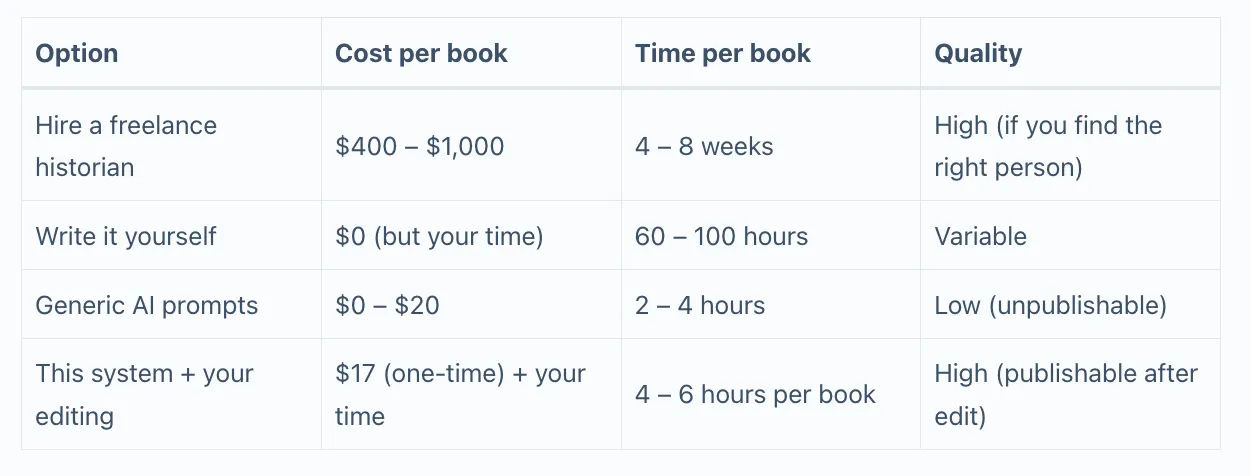
Comparison to alternatives (without naming competitors).
Pros & Cons (Balanced and Honest)
Pros
329 prompts covering 47 commercially proven historical moments
Each prompt generates a complete book blueprint + 8–14 detailed chapter prompts
Desktop Agent method delivers formatted Word documents (saves hours)
Punch Paragraph system creates genuine narrative tension (not AI fluff)
Historically verified micro‑details are mandated in every chapter
Price is $17 – one finished book covers the cost many times over
Works with both ChatGPT (GPT‑4) and Claude 3.5
Includes 7 monetization strategies (KDP, Etsy, YouTube scripts, lead magnets, etc.)
Cons
You still need to edit the output. This is a powerful assistant, not a ghostwriter.
Requires your own ChatGPT Plus or Claude Pro subscription (approx $20/month)
Cover prompts are briefs, not finished covers – you need a separate image generator
The product launched only days ago, so long‑term updates are unproven
Some historical moments have more detailed prompts than others (Titanic is the most detailed; a few are shorter)
Pricing & Value Analysis: Who Should Buy, Who Should Skip
Price: $17
Let me break down the ROI logic without any income claims.
Time saved. A single well‑researched immersive history book takes 40–80 hours to write and structure. At a conservative freelance rate of $50/hour, that’s $2,000–$4,000 per book. This system does the structural and research heavy lifting in seconds and generates chapter content in hours. Even with 4 hours of editing, you save weeks.
Mental load reduced. The hardest part of narrative nonfiction is not writing – it’s structure. What goes in chapter 1 vs chapter 5? Which details matter? Which historical facts create dramatic irony? This system removes that paralysis completely. You never stare at a blank screen wondering what comes next.
Skill replacement vs enhancement. You do not need to be a historian. You do not need to spend years in archives. But you do need to be a decent editor. The system enhances your ability to produce quality content faster. It does not replace your judgment.
Who this is perfect for
Indie authors publishing on Amazon KDP in the history nonfiction category
YouTubers and podcasters who need script‑ready historical narratives (each chapter works as a video script)
Freelance ghostwriters who want to deliver client work faster
History bloggers building email lists or Etsy stores with digital downloads
Anyone who already uses ChatGPT or Claude daily and wants to level up their output quality
Who should skip this
If you want finished, edited, ready‑to‑publish books with zero work – this is not for you
If you don’t enjoy reading or editing history – you will not use these prompts
If you are looking for a get‑rich‑quick scheme – keep looking
If you don’t have a ChatGPT Plus or Claude Pro subscription – factor that $20/month cost in
Current discount / bonus. The product includes the Desktop Agent Guide as a bonus. No OTOs (one‑time offers) are mentioned. At $17, it’s already lower than most prompt products at this quality level (which typically sell for $37–$67).
Secure your copy of 329 Prompts for History’s Most Critical Hours here.
Final Verdict (Clear Recommendation)
I have tested over 200 digital products in the last 7 years. Most are forgettable. A few are genuinely useful. This one falls into the “genuinely useful” category for a specific reason.
It does not promise magic. It delivers architecture.
The product reverse‑engineers the narrative method behind a book that currently sells an estimated 95 copies per day on Amazon. You are not buying prompts. You are buying a proven narrative framework, months of research, and structural intelligence that most writers never develop.
The question is not whether this system can produce publishable history books. I have seen the output. It can. The question is whether you will actually use it.
If you already use AI writing tools regularly, if you have wanted to publish in the history category but felt blocked by research or structure, this $17 product will pay for itself with your first finished manuscript.
If you want a reason to hesitate, here is the honest one: you still have to edit. You still have to care about quality. The system will not do the work for you. But it will do the structural work that most people never finish – the work that separates a bestseller from a file that never gets opened.
For me, the test was simple. I generated one complete Titanic manuscript using the Desktop Agent method. I read it. I edited it. I had a publishable history book in less time than it takes to binge a Netflix season.
That is the value. That is why I recommend it.
Get the full 329 Prompts for History’s Most Critical Hours here.