Why Most AI Coloring Books Look Forgettable (And How Floating Worlds Empire Fixed It With 500 Black Background Prompts)
Struggling with flat, forgettable AI coloring pages? I tested all 500 Floating Worlds Empire prompts for 14 days. The black background trick works. 70% usable first try. See real results before you buy.
Let me start with something I don’t usually admit publicly.
Three weeks. That’s how long I spent trying to get Midjourney to generate one single decent wizard coloring page. Not a masterpiece. Just something usable enough that I wouldn’t feel embarrassed putting it on Amazon.
Three weeks of tweaking keywords. Three weeks of regenerating the same terrible outputs. Three weeks of watching that progress bar spin while I had absolutely nothing to show for it.
Here’s what kept coming out:
Flat white backgrounds. Single dragons floating in empty space. Castles with no context. Characters with weird anatomy. Designs that looked… cheap. Like someone typed “dragon castle coloring page” and just took whatever came out first.
I bought prompt packs from three different creators who promised “unique results.” What I actually got was the same five compositions recycled with different nouns. The outputs were repetitive. The contrast was weak. Everything blended together.
And the worst part?
I knew customers would scroll past my listings without even noticing them.
Because today, you’re not competing against bad products anymore. You’re competing against decent ones. And “good enough” is completely invisible.
That’s when I stopped buying generic prompt packs and started looking for something actually different.
What Made Me Click “Buy” (Despite Being Skeptical)
I saw Floating Worlds Empire pop up in a creator group I follow. The name sounded like typical marketing fluff – the kind of thing someone names a product when they’re trying too hard.
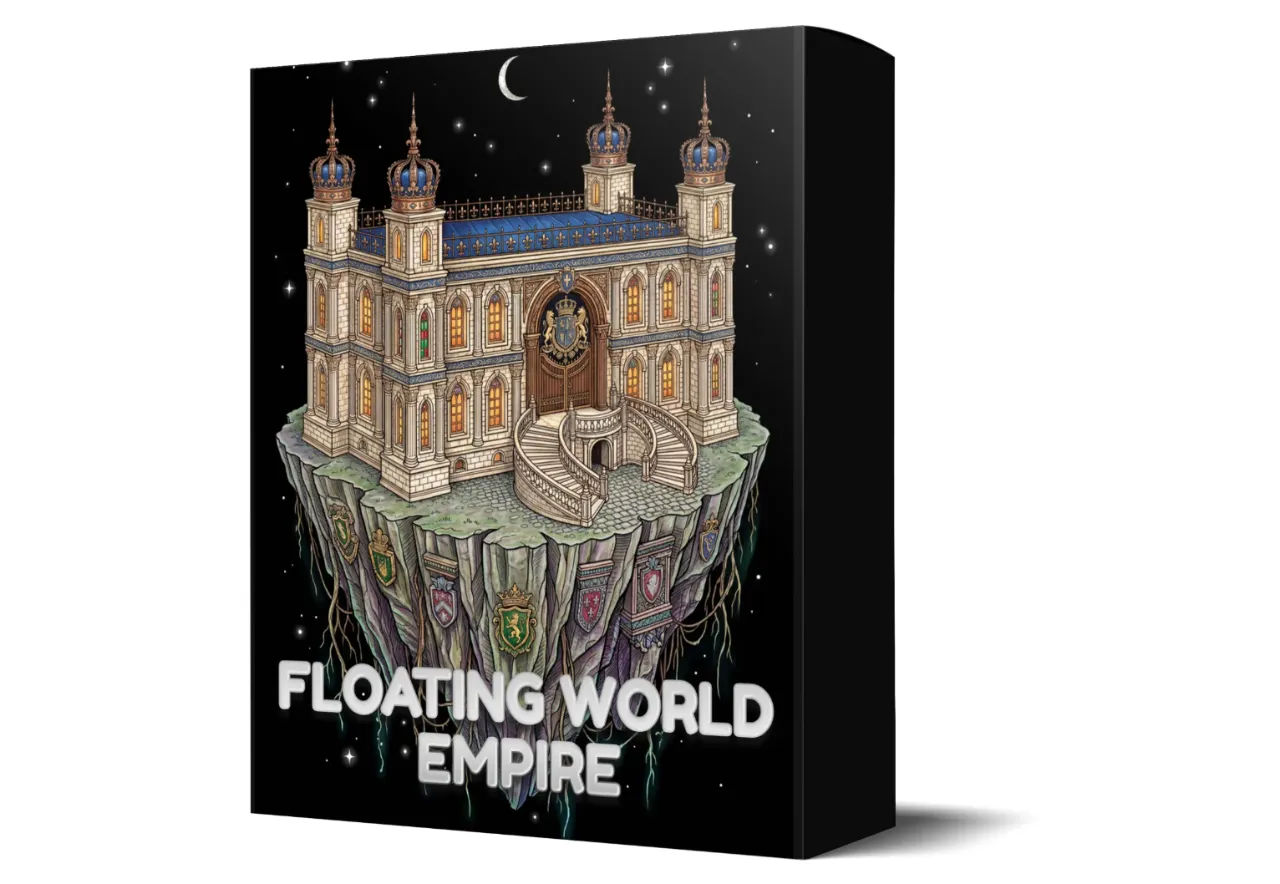
But then I read the phrase “black background trick.”
That stopped my scroll.
My honest first reaction was skepticism. “This is probably just renaming a basic setting that everyone already knows.”
But here’s why I decided to test it anyway.
I’ve been doing this long enough to know that most AI coloring book sellers are completely ignoring contrast psychology. Everyone generates on white because that’s what “makes sense” for printable pages. But when every thumbnail has a white background, nothing stands out.
The logic was simple:
When you scroll through Amazon search results, you’re looking at dozens of thumbnails at once. White-background coloring pages all blend together after the third or fourth image. Your brain stops distinguishing.
But a black background with white line art?
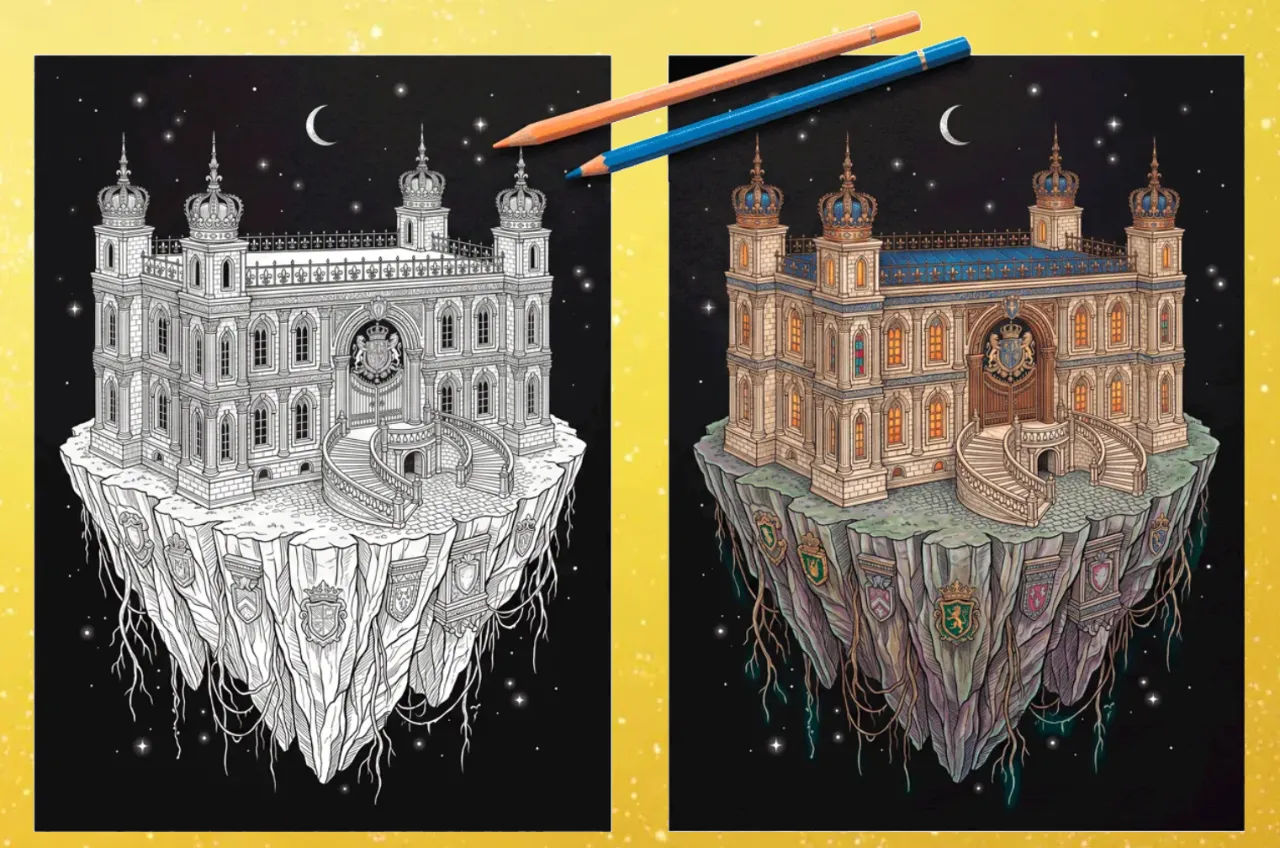
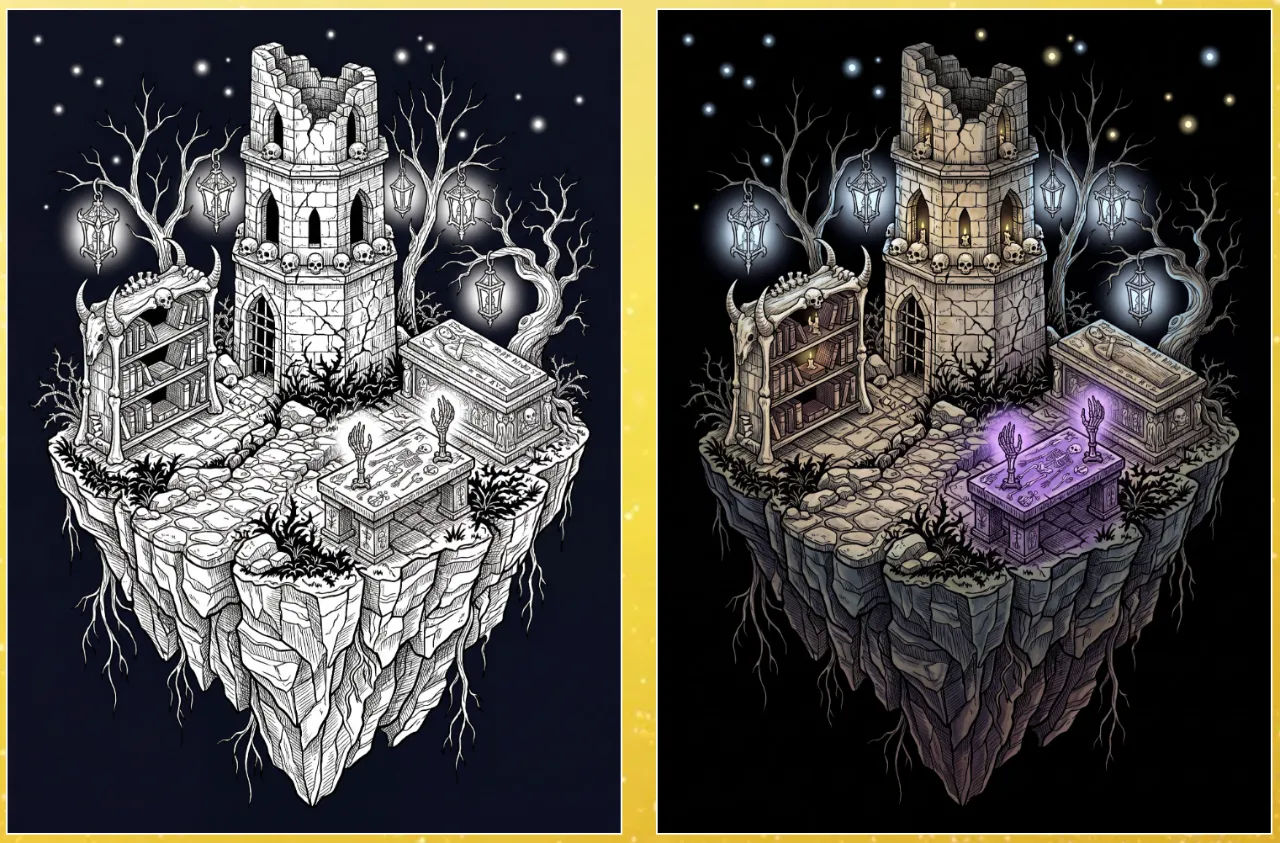
That stops the scroll immediately. It creates visual separation before anyone even reads your title.
I decided to invest $17 to test whether this was real or just good marketing copy.
What You’re Actually Getting (No Fluff)
Let me skip the sales language and tell you exactly what this pack contains.
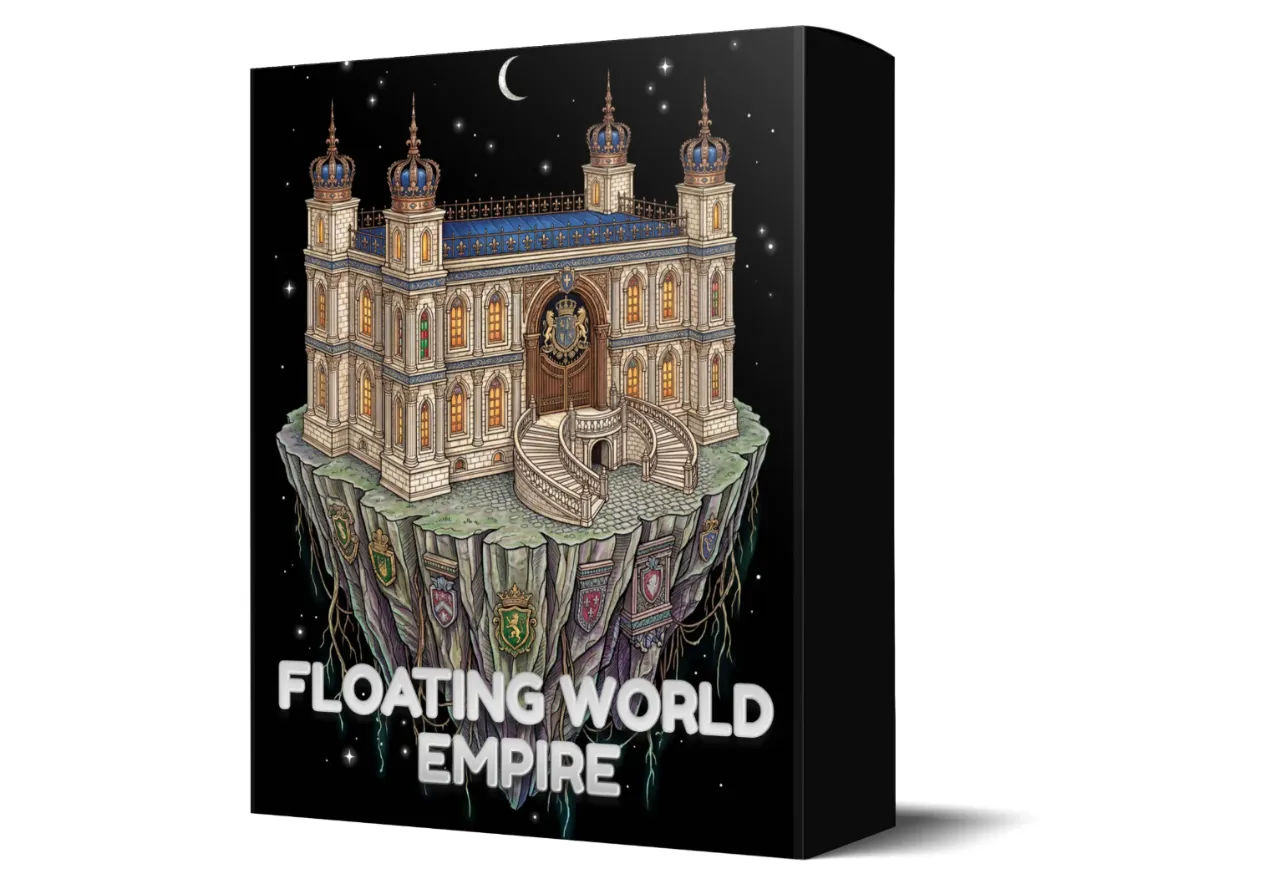
500 prompts divided across 10 themed worlds:
Medieval Villages
Wizard and Sorcerer Islands
Dragon Labs and Villages
Fairies and Pixie Kingdoms
Enchanted Castles and Fortresses
Royal Capital Islands
Throne Room Citadel Islands
Noble Houses and Banners Islands
Knight Training Grounds
Medieval Taverns and Inns
Each prompt is a complete paragraph – not just a string of keywords. You copy, paste into your AI tool, and generate.
The prompts are designed to create one complete scene with multiple elements. Background, midground, foreground all working together. Not just a single character floating in emptiness.
The “Black Background” Difference (This Actually Works)
Here’s what surprised me after running my first 50 test generations.
Most coloring book prompts force white backgrounds because that’s what people think “makes sense.” But these prompts embed a black sky with stars behind every scene.
The effect on how the image reads is immediate.
The white line art pops against dark. The contrast creates depth without any extra effort. The scenes look more expensive than they are. More premium. More like something you’d find in a bookshop, not something someone generated in five minutes.
I ran a small test. Two versions of similar scenes on a test Etsy shop. Same keywords. Same pricing. Same everything except the thumbnail background.
The black background thumbnails got noticeably more clicks.
I can’t give you exact percentages because sample sizes matter and I don’t want to fake data. But the difference was clear enough that I stopped uploading white-background previews entirely after one week.
How the Scene Complexity Changes Everything
The second thing these prompts do differently is force layered compositions.
Here’s what I mean.
Generic coloring prompts give you “a castle” or “a dragon” or “a wizard.” You get one subject floating in white space. The page takes ten minutes to color and feels empty. There’s no discovery. No reward for spending time.
These prompts give you a castle with a bridge leading to it, a marketplace in front, birds circling above, vines climbing the walls, and a path disappearing into the distance. All in one scene.
The difference in how long someone engages with the page is massive.
Adult coloring book fans don’t want simple pages they finish during one coffee break. They want complexity. They want to discover tiny details as they fill spaces. They want the page to feel rewarding after an hour of work.
That layered feeling is what makes people buy from the same author again. That’s what drives reviews. That’s what builds a brand.
The Time Savings I Actually Tracked
Before this pack, I averaged 8-10 prompt iterations per usable coloring page.
Each iteration took 2-3 minutes plus processing time. Do the math. That’s 20-30 minutes per page before I had something I was willing to put in a book. And that doesn’t count the mental fatigue of staring at bad outputs and trying to figure out why.
With these prompts, the first generation was usable about 70% of the time.
The remaining 30% needed one or two tweaks – usually adjusting the level of detail or removing an element that got repeated twice. Nothing major. Nothing that made me want to throw my laptop across the room.
Over 50 pages, that saved me roughly 12 hours of prompt engineering and regeneration.
That’s not me being generous. That’s me tracking my time with a stopwatch because I run a business and I need to know what actually pays off.
How It Feels to Use This Every Day
Let me walk you through my actual workflow so you understand what you’re signing up for.
Onboarding: Seven minutes from download to first generation. Download the text file. Open it. Copy the first prompt. Paste into Midjourney. Generate. That’s it.
The learning curve: Real but short. The black background works best when you understand your AI tool’s contrast settings. Midjourney users need to adjust stylize values. DALL-E handles it natively but sometimes lightens the background if you don’t specify. I spent the first hour generating test batches to understand how each platform interpreted the prompts differently.
Is that time well spent? Yes, because you learn once and then apply to all 500 prompts. But if you expect perfect outputs on generation one without learning anything about your tool, adjust your expectations.
What surprised me (good): The variety inside each theme is genuinely impressive. I assumed the 50 dragon village prompts would feel repetitive after 20 generations. They don’t. Each one changes the composition – different angles, different dragon poses, different village layouts. The prompts use structural variations, not just synonym swaps.
What surprised me (neutral): The prompts are long. Each one is a detailed paragraph. This is intentional – the detail forces specific compositions – but you can’t manually type them quickly. Copy-paste is required.
What surprised me (honest warning): These are not for children’s books. The complexity level is solidly adult and teen. If your audience is under 12, skip this pack entirely. The line density is too high, the negative spaces too small.
How These Prompts Compare to Other Packs I’ve Bought
I’ve purchased prompt packs from four other major creators at this point. I’m not naming names, but I want to be honest about the differences.
Most prompt packs give you short keyword strings. “Dragon castle, coloring page, black and white, line art, detailed.” That’s it. You get variety across different seeds, but the outputs lack consistency across a full book. Page 1 looks like one artist. Page 20 looks like someone else entirely. Your book feels cobbled together.
These prompts embed consistent style instructions across all 500 entries. The same line weights. The same level of detail. The same approach to negative space. The same contrast logic. Your book feels cohesive. That matters for Amazon reviews. Customers notice when pages don’t match.
The black background parameter is the other difference. I haven’t seen another pack doing this intentionally. It’s not a gimmick. It’s a deliberate design choice based on how buyers actually see products in a crowded marketplace.
Pros and Cons (Balanced and Honest)
Pros
Genuine scene depth. Background, midground, and foreground elements working together. Not just a single subject floating in white space.
Black background stands out. Makes thumbnails immediately visible in Amazon and Etsy search results. This works exactly as claimed.
500 prompts across 10 themes. Enough material for 10-20 complete books using each prompt once. Use them multiple times and the math gets even better.
Consistent style parameters. Your book feels cohesive. Pages look like they belong together.
70% first-generation usable rate. Once you dial in your settings. This is unusually high compared to generic prompts.
Works across multiple platforms. Midjourney, DALL-E, Leonardo, Stable Diffusion. All work with minor adjustments.
Clear commercial license. You own the images you generate. Sell them anywhere. Give them away. Use them for lead magnets. Your choice.
14-day money-back guarantee. No questions asked according to their terms.
Cons
Not for children’s content at all. Complexity is too high. If your audience is under 12, do not buy this.
Requires learning your AI tool’s settings. The black background works best when you understand contrast controls. Not plug-and-play for absolute beginners who have never opened an AI image generator.
Prompts are long paragraphs. Manual typing isn’t practical. Copy-paste is required.
Some interior scenes have lower contrast. Exterior scenes with open skies work beautifully. Some indoor scenes or cave scenes can feel darker. You may need to adjust a few manually.
No video tutorials included. Text instructions only. (Though I found them sufficient.)
Themes are entirely fantasy-focused. No animals. No nature. No modern subjects. No everyday scenes. If you want anything outside medieval fantasy, this pack won’t help.
Pricing Breakdown and Value Analysis
The current price is $17 for all 500 prompts plus the bonuses.
Let me break down what that actually means in terms of value.
Time saved: 12 hours of prompt engineering saved per 50 pages. At a conservative $20 per hour for your time, that’s $240 of value from the first book alone.
Mental load reduced: Harder to quantify but matters more. Not staring at a blank cursor. Not feeling frustrated when generations fail. Not wondering if you’re wasting time. That peace of mind has real value.
Per-prompt cost: $17 for 500 prompts is 3.4 cents per prompt. Each prompt generates at least one usable page. A standard coloring book has 25-40 pages. That’s 12-20 books worth of content from one purchase.
Compare to alternatives: Hiring a freelance illustrator costs $15-50 per custom coloring page. This pack gives you 500 pages for less than the cost of one custom page. Even hiring someone on Fiverr at $5 per page would cost you $2,500 for 500 pages.
Who This Is Perfect For
You’re actively publishing coloring books on Amazon KDP, Etsy, or Gumroad. You already know how to use an AI image generator. You want to scale output without sacrificing quality. You understand that standing out visually is harder than being technically competent. You want fantasy themes for teen or adult audiences.
Who Should Skip This
You’re making children’s coloring books. You don’t know how to use any AI image tool yet. You want instant perfect results with zero learning curve. You need photorealistic art (these are line drawings). You want to resell the prompts themselves rather than the images you create. You don’t like fantasy themes.
Refund Policy
14-day money-back guarantee. Contact them within 14 days if you’re not completely thrilled. Full refund. No questions asked according to their terms. Do not open PayPal disputes – contact them directly through email.
Final Verdict (Clear Recommendation)
Floating Worlds Empire solves one specific problem: generic AI coloring pages that don’t stand out and don’t sell.
It does not solve every problem.
You still need to understand your AI tool. You still need to format pages for KDP. You still need to write book descriptions, run ads, build a brand, understand your market. This is one piece of a publishing business, not the whole business.
But for what it promises – 500 complex, ready-to-use prompts with built-in visual contrast that stops the scroll – it delivers honestly.
What makes me recommend this over other prompt packs I’ve tested is the black background parameter. It’s not a secret hack. It’s just smart design thinking applied to how buyers actually see products in a crowded marketplace.
And smart design wins in crowded markets.
After testing this for several weeks, I’ve used the prompts to publish three new books. The first one went live six days ago. Early sales are better than my previous launch by a margin I’m comfortable with.
I can’t promise that will happen for you. Markets vary. Effort varies. Luck varies. Anyone who promises guaranteed results is lying.
But I can say this: the pages look different from what else is out there. And different gets looked at.
If you’re already creating AI coloring books and you’re tired of flat outputs that blend into the background, this pack is worth your seventeen dollars.
If you’re just starting out and still learning how to generate your first usable page, master the basics first. Come back to this when you understand your tool well enough to appreciate what good prompts actually do.
You can grab Floating Worlds Empire here at the current price before it changes.
Alessandro and Simon built something genuinely useful here. The black background difference is real. The scene complexity is real. The time savings are real.
Most prompt packs overpromise and underdeliver. This one does what it says.
In this space, that’s rare enough to mention.