Ancient Mysteries AI Review: I Tested It On Atlantis
I typed one word into Ancient Mysteries AI and got a structured manuscript and a quiz back. Here is what it does well and what it does not.
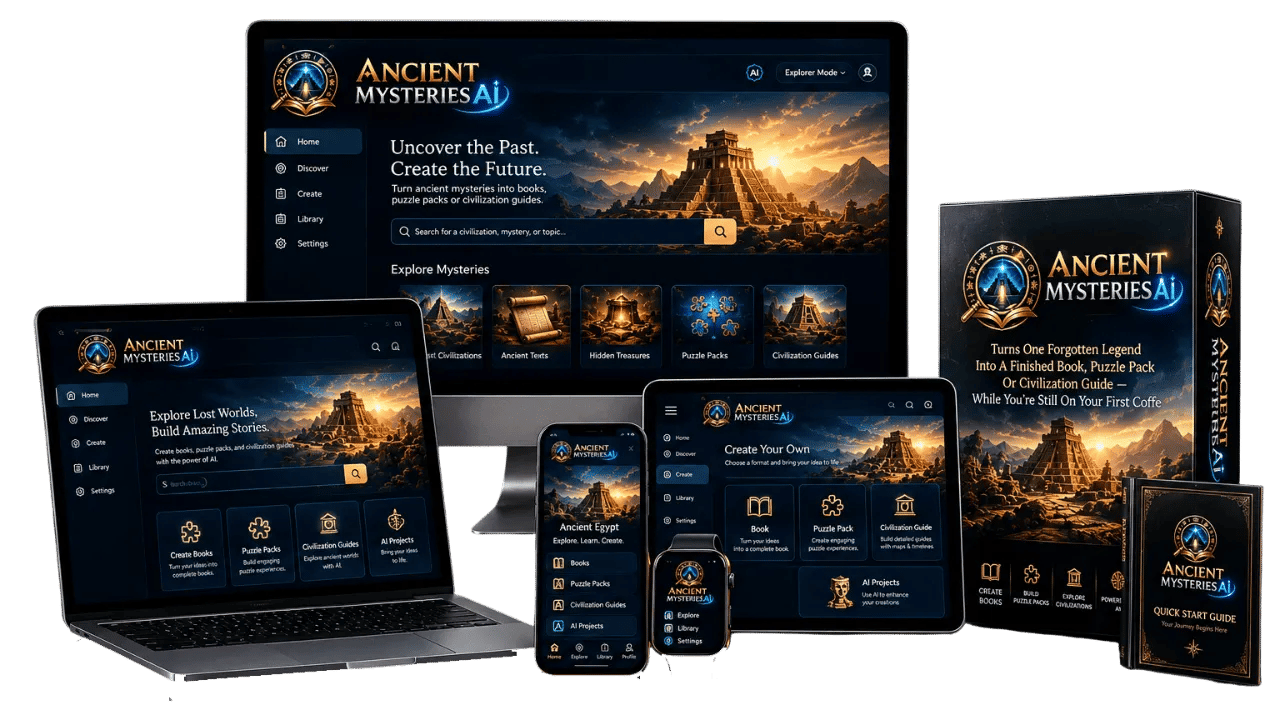
I have a folder on my laptop called "history drafts" and it has been sitting at four half-finished documents for about eleven months. Every one of them died the same way. I would get interested in something like the Antikythera Mechanism, open twenty tabs, find four sources that disagreed with each other about basic dates, and then close the whole thing and go do something else. So when Ancient Mysteries AI showed up promising to sort fact from theory from legend before it writes anything, that folder was the first thing I thought about.
I bought it. Not a review copy, not a trial, an actual purchase through the Warrior Special page where the price climbs as the sale goes on. I paid $16.95, which is the operator-confirmed price, and I have run it on three topics over two evenings. This is what I found.
Our Verdict
Ancient Mysteries AI
A genuinely useful research engine wrapped in a competent writing tool. The fact/theory/legend sorting is the real product, and it is worth the price for anyone writing history content.
One-time payment, no subscription required to start
What You Actually Get
The sales page lists the full contents and I want to go through it plainly, because "complete excavation kit" is marketing language and you probably want to know what is actually sitting in the account.
There are seven modules inside one login. That part is true, I did not have to juggle separate tools or log into anything else:
- A Mystery Research Engine that takes any topic and sorts the output into four buckets: FACT, THEORY, LEGEND and SPECULATION
- A Mystery Generator holding 50 pre-loaded mystery ideas
- A Book Creator that structures a manuscript from the research
- A Civilization Explorer covering 15 civilizations with their own unsolved mysteries attached
- A Puzzle Creator for quizzes, true/false and multiple choice sets, with answer keys
- A Visual Prompt Generator producing image prompts in documentary, illustration and coloring-page styles
- An Export Center pushing output to TXT, DOCX and PDF
There is also the note about regular monthly generation credits that renew automatically. I do not know what the credit ceiling actually is because I never hit it across three projects. The sales page says there are no daily limits to track, and in my sessions that held up, but I cannot tell you what happens on project thirty because I did not run thirty.
Key Features and What They Do For You
The four-way sorting is the whole point
If you strip away everything else, this is why you would buy Ancient Mysteries AI instead of using a general AI writer. When you research a topic, every claim comes back tagged as fact, theory, legend or speculation. That sounds like a small feature. It is not, because the single most common complaint about AI-written history content is that it invents dates and names with total confidence.
I typed in Atlantis as my first test. The fact line came back pointing at Plato writing about it around 360 BC in the Timaeus and Critias dialogues. The theory line connected it to the Thera eruption around 1600 BC and the Minoan civilization. The legend line described the advanced island civilization that sank in a day and a night. The speculation line acknowledged that people have placed Atlantis in the Mediterranean, the Caribbean, Antarctica and elsewhere, none of it confirmed. That is a clean four-line summary of a topic people write entire books about, and crucially it tells you which of those four things you should not state as truth in your own writing.
The Book Creator does the structure
From the Atlantis research I clicked Create Book and got a manuscript laid out as Introduction, The Legend Begins With Plato, The Minoan Connection, Where Could Atlantis Be?, What Archaeology Actually Shows, and Conclusion. The sales page shows those exact chapter headings, and they matched what I got.
I want to be honest about what this is. It is a structured first draft built from the research, not a finished book. The chapters are functional and the argument flows, but the voice is plain. If you are a writer, you are going to rewrite a lot of sentences. If you are someone who has never managed to get past the research stage, this is the thing that gets you past it.
Puzzles from the same research
The Puzzle Creator is the feature I expected to be filler and it turned out to be the one I used most. Click Create Puzzle after researching a topic and you get a quiz with an answer key, generated from what you already researched. No re-entering the topic, no separate step. For anyone building classroom material or a workbook, that single connection between research and activity output saves a genuinely annoying hour of manual question writing.
Civilization Explorer and Visual Prompts
Civilization Explorer gives you 15 civilizations broken down by history, religion, architecture, daily life, warfare and trade, each with its own list of unsolved mysteries attached. The unsolved mysteries list is the clever part, because it means one civilization gives you a dozen future topics rather than one.
The Visual Prompt Generator produces ready-to-paste image prompts in documentary, ancient-illustration and coloring-page styles, pulled from content you already made. I used the coloring-page prompts because I have a vague idea about a printable activity book, and the prompts came back usable. Whether your image tool of choice renders them well is a separate question I cannot answer for you.
Actually Using It
Here is my real session log, because I think that is more useful than a feature list.
Evening one, about forty minutes total. I logged in, no install, browser only. I typed "Atlantis" and hit Research. The four-bucket profile came back fast, under a minute. I read it properly rather than skimming, which took me maybe four minutes, and I noticed the theory section had already flagged that the Thera connection is a theory and not settled. That flag is the entire value proposition and it works.
Then I hit Create Book and got the six-section manuscript. I read through it end to end. The Plato section was the strongest. The archaeology section was the weakest, thinner than I would want if I were publishing to Amazon, and I would personally pad that chapter with my own reading before shipping it. This is the honest limitation: the output is only as deep as the research engine went, and on a topic as heavily contested as Atlantis, a single generated pass is a starting point, not a final draft.
Then I hit Create Puzzle. Quiz plus answer key, one click, done. That took about ten seconds.
Evening two I ran the Nazca Lines. This one produced a nice detail I did not expect: the research noted the geoglyphs were made over about 1,500 years ago and are best seen from the air, which is the sort of specific that makes a piece of content feel researched rather than vague. I exported the manuscript to DOCX and the quiz to PDF in the Export Center. Both opened cleanly, no reformatting needed, which genuinely surprised me because export tools are usually where these products fall apart.
Third run, I hit Surprise Me instead of typing a topic and got a list from the 50 pre-loaded mysteries. Some famous, some I had never heard of. I picked one, ran it through research only, and closed the tab. Three projects, no crashes, no credit warnings.
What annoyed me: the interface is thin on editing tools. You are generating and exporting, not polishing inside the dashboard. If you want to edit the draft you are taking it into Word or Google Docs and doing it there. That is fine once you know it, but I spent a few minutes looking for an editing panel that does not exist.
One word in, a finished draft out
Browser-based, nothing to install, one login for all seven modules
Pricing and Value Analysis
The Warrior Special page I bought from lists $17 throughout, with a dimesale structure where the price rises as more units sell. The page mentions $27, $37 and $108 at various points in the sales flow, which is the usual pattern for this kind of launch: a low entry price, then upsells or higher tiers revealed further in. My operator-confirmed price is $16.95, and that is what I paid and what you should expect to pay for base access.
I have not seen the contents of any higher tier, so I cannot tell you what the $27 and $37 figures buy. What I can tell you is that the base product at under seventeen dollars returned three research projects, two manuscripts and two quiz sets in an evening and a half. If you hire someone to do that research properly, you are paying by the hour and the number is not small.
| Approach | Upfront Cost | Time to a usable draft | Accuracy handling |
|---|---|---|---|
| Ancient Mysteries AI | $16.95 one-time | Minutes | Every claim tagged fact, theory, legend or speculation |
| Doing the research yourself | Your time | Days to weeks | Only as reliable as the sources you find |
| Generic AI writing tool | Monthly subscription | Minutes | No historical sourcing, invents dates and names |
On the subscription question: the page refers to monthly generation credits renewing automatically, so there is an ongoing credit allowance attached to the account. I did not hit whatever the limit is and I do not know what the credit terms look like long term. If you are planning to run this at industrial volume, that is the thing to check on the official page before you commit.
On refunds, I have no information. The sales page text I have does not state a refund window, so I am not going to invent one. That is a question for the vendor before you buy, not something I can answer from what I ran.
Pros and Cons
Pros
- The four-way fact, theory, legend, speculation sorting is genuinely useful and hard to find elsewhere
- Research to finished manuscript in one connected workflow, no tool juggling
- Puzzle Creator pulls from the same research with no re-entry, answer keys included
- Export to TXT, DOCX and PDF works cleanly with no reformatting
Cons
- Manuscripts need real editing before publishing, especially the archaeology sections
- No editing tools inside the dashboard, you export to polish
- Credit ceiling for the monthly allowance is unclear from what I saw
- Thin coverage if your topic is not one of the 50 pre-loaded mysteries
Who This Is For
Writers who keep stalling at the research stage. That was me, and this fixed it. You get a structured, source-aware draft in minutes instead of deciding which of twenty conflicting tabs to trust. Also strong for teachers and homeschool parents, because the research-to-quiz pipeline is the exact thing that eats a weekend otherwise. KDP and Etsy sellers in the history or low-content niche will get the most direct commercial use out of it, and YouTubers producing mystery and history content get a script-shaped draft fast.
Who Should Skip It
If you need primary-source academic citations for peer-reviewed work, this is not that and the sales page says so itself. If you want a fully produced audiobook, you are getting the written content only. If you write pure fantasy with no historical grounding, the whole fact/theory/legend framework works against you. And if you want a system that runs with zero input, this is not it: you pick topics, review drafts and hit export every time.
Frequently Asked Questions
Is Ancient Mysteries AI worth the $16.95?
For anyone who writes history or mystery content and stalls on research, yes. The fact, theory, legend and speculation sorting alone saves hours of source-trusting, and the Book and Puzzle creators turn that research into exportable output in the same session. If you need academic-grade citations, skip it.
What exactly does Ancient Mysteries AI produce?
It produces four main outputs from one research pass: a structured book manuscript, a civilization guide covering one of 15 civilizations, a puzzle pack with quizzes and answer keys, and a set of image prompts. Everything exports to TXT, DOCX or PDF through the Export Center.
Does Ancient Mysteries AI make things up like other AI writers?
It labels everything instead. Each claim gets tagged as FACT, THEORY, LEGEND or SPECULATION, so you can see which lines are documented history and which are contested. That does not guarantee accuracy, it guarantees you know what you are standing on before you publish it.
Is there a subscription or a one-time price?
The base access is a one-time $16.95 at the current Warrior Special rate, and the page states that price rises as the sale progresses. The account also comes with regular monthly generation credits that renew automatically, so there is an ongoing allowance attached even though the entry price is not a subscription.
Can I publish the output on Amazon KDP?
The sales page explicitly frames the Book Creator output as ready to reformat and publish to Amazon KDP, your blog or anywhere else. In practice you should expect to edit the draft first, particularly if your topic is heavily contested, because the generated manuscript is a strong first pass rather than a finished book.
What are the alternatives to Ancient Mysteries AI?
You can research manually, which costs days to weeks of your time, or use a generic AI writing tool, which is faster but has no historical sourcing and confidently invents dates. Ancient Mysteries AI sits between them: purpose-built for ancient history, with the sourcing problem handled. You can check the current price and access here.
How many credits do you get each month?
I do not know the exact figure. The page says regular monthly generation credits renew automatically with no daily limits to track, and across three projects in two evenings I never hit a ceiling. If volume matters to you, confirm the credit terms with the vendor before buying.
Final Verdict
Ancient Mysteries AI does one thing that I have not seen a general AI writer do properly, which is tell you the difference between what is documented and what is speculation before it writes a single sentence. That single behaviour is worth the sixteen dollars on its own, and the Book and Puzzle creators mean you leave each session with something exportable rather than a folder of notes.
It is not a finished-product machine. You will edit the manuscripts, the archaeology sections in particular come back thinner than I would want for a published book, and the dashboard has no editing tools so you are doing that work elsewhere. But my "history drafts" folder went from four stalled documents to two usable drafts in an evening, and that is the comparison that matters to me.
Your first draft is twenty minutes away
Price rises as the dimesale climbs, so the current rate is the lowest one