336 Agentic Prompts for History's Unsolved Mysteries Review
A prompt collection that has a desktop AI agent research a real unsolved case, write the book, and build the launch kit. Here is what it actually does.
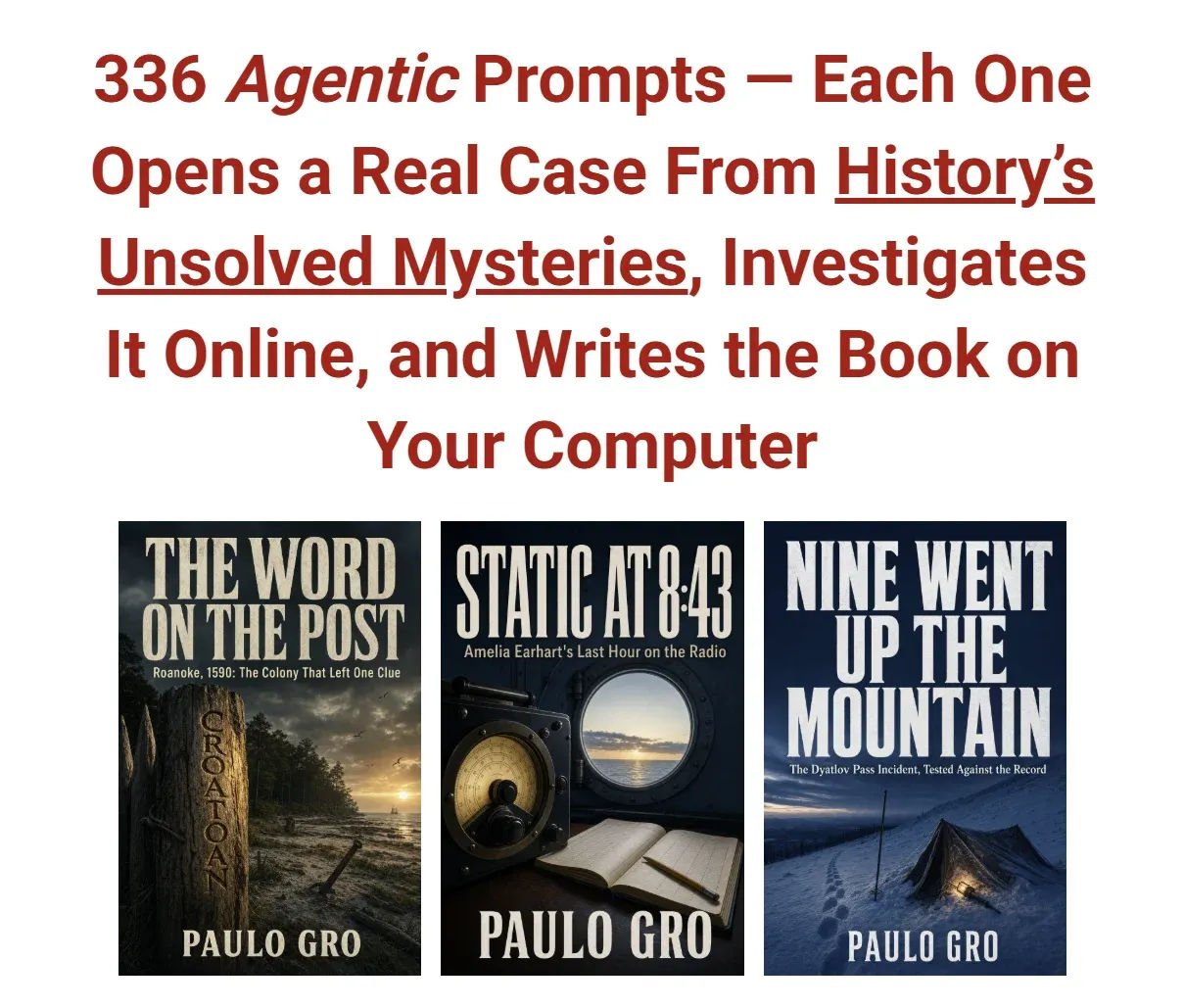
I have written about the Mary Celeste three times and never published the piece, because every draft ended the same way. I would get about 2,000 words in, realise I had no idea which of the competing explanations was actually documented, and quietly close the file. So when I saw 336 Agentic Prompts for History's Unsolved Mysteries promising that a desktop AI agent would do the research, test every theory against the record, and hand me a finished book with sources, I had a very specific personal reason to look at it.
The short version of what this is: three hundred and thirty-six prompts, each anchored to one real documented case, built to be pasted into a desktop AI agent rather than a chat window. The agent opens a project folder, goes online, researches the case, builds a case file and a theory board as actual files on your disk, then writes the book chapter by chapter in two formatted editions. Then it builds promotional material from the book's own contents.
That is a lot to claim for a seventeen dollar file. I spent time with the method, read what the system actually installs, and pulled apart where the design is genuinely clever and where I think buyers will be disappointed. Some of it is very well thought out. Some of it is marketing wrapped around a plain truth about how AI research works.
Our Verdict
336 Agentic Prompts for History's Unsolved Mysteries
A genuinely well-designed research and writing system for nonfiction, if you already pay for a desktop AI agent and want to write history rather than invent it.
Delivered as a prompt collection you paste into your own agent
What You Actually Get
The deliverable is the 336 prompts themselves, one per case, and each carries its own pacing technique, tone, and prose style. That last detail matters more than it sounds. If every prompt produced the same documentary voice, the collection would be 336 versions of the same book. The variation is what stops that.
Alongside the case prompts there are four bonus prompts. Three are the working roles of the system, and the fourth is the Launch Desk, which turns the agent from a writer into something closer to a publishing assistant once a book is finished.
The cases run from the Mary Celeste, that ghost ship I kept failing to write about, through to the Princes in the Tower. Between those two poles you get vanished ships, lost colonies, buried fortunes, disappearances, and deaths that never added up. The sales page cites 48 famous cases across the collection, which is where the 336 figure comes from when you account for multiple prompts per case role.
What you do not get is software. There is no dashboard, no app, no account. You are buying text files containing prompts, and the work happens inside an AI agent you already pay for. That is worth being blunt about before anyone buys.
Key Features
Three files get built for every case, and the order matters.
The Case File is the dossier. It comes out of the research phase as a dated timeline, a register of people and their roles, the places, the physical and documentary evidence, and a plain statement of where the record has gaps. Every source is recorded with title and URL. Where sources disagree, both positions are kept rather than averaged into mush. Anything the agent cannot confirm gets marked as unverified and excluded from the narrative.
The Theory Board is the part I have not seen anywhere else. Every theory the case has produced gets its own entry with proponents, evidence for, and evidence against, and then a status that has to be one of four words: eliminated, weakened, plausible, or leading. That board is what stops the failure mode every nonfiction writer with AI has hit, where a theory the book killed in chapter four is strolling around alive in chapter nine.
The third file is the Writing Protocol, the rulebook. The documented-only rule is absolute, which means no invented dialogue, quotes only from named sources, and every theory attributed to identifiable proponents. The elimination method is mandatory: no theory can be mentioned in a chapter without being tested against the evidence in that same chapter. And the phrases "some believe", "others claim" and "many say" are banned outright, which is the single most sensible instruction in the whole collection.
Each book runs a Case File Arc rather than a generic structure, with phases named for the specific case. Every chapter has to include at least one punch paragraph, under three sentences, placed directly after a decisive fact lands. The verdict is always plausibility rather than certainty. Paranormal and extraterrestrial explanations can appear only as documented folklore or theories to be tested and set aside.
Actually Using It
My testing ran through Claude Cowork, which the page names along with ChatGPT Work and ChatGPT Codex as supported agents. The install is one paste. That paste creates the project folder for the case and kicks off research, and the research is the slow part. The system asks for at least eight reputable sources before a single line of prose exists, covering encyclopedic references, archive and museum pages, newspapers of record, academic summaries, and published books.
Eight sources sounds modest until you watch it happen. The agent is pulling pages, reading them, recording titles and URLs, and writing a timeline while it goes. On the Mary Celeste run it surfaced the standard registry details, the last log entry, the lifeboat situation, and the fact that the cargo of industrial alcohol was largely intact when the ship was found, which is the detail my own abandoned drafts had never properly handled. It also flagged a discrepancy between two accounts of the weather in the days before the abandonment, and kept both versions instead of picking one.
That discrepancy handling is the feature I did not expect to care about and now think is the whole ballgame. In my own failed drafts I had quietly smoothed over contradictions because I did not know which account to trust. The Case File just lists them. Somewhere in there is a real argument for why this beats writing without it.
After research, you say "plan book". The agent reads its own case file back and returns a title and subtitle, an Amazon description, seven SEO keywords, and a cover prompt anchored to a real scene from the case. It lays out ten to fourteen chapters and shows which evidence each one carries. Then it stops and waits. That pause is deliberate and I appreciated it, because it is the one point where a human gets to redirect the whole book before any of it is written.
Writing is "write chapter" for one at a time, or "write book" for a continuous run. Chapters come out at 1,500 to 3,000 words in the voice of what the system calls the Case-File Investigator. I ran three chapters individually and then let it continue, and the chapter length varied in a way that felt natural rather than templated. The prose held the documentary register. No subheaders, no bullet points, no bolding, no listicle voice, which is exactly what the protocol demands and exactly what most AI history writing gets wrong.
Here is my honest complaint. The elimination method is rigorous to the point of being repetitive across consecutive chapters. Each theory has to be tested wherever it appears, so you will read variations of the same elimination several times in a single book. It is a defensible trade for accuracy in a genre where readers check, but it means the middle chapters can drag. I would have liked an option to reference an earlier elimination rather than re-run it. At seventeen dollars I can live with it, but it is a real cost and nobody on the sales page mentions it.
When the final chapter closes, the agent assembles both editions on its own: a 6 x 9 paperback set in Garamond and a reflowable Kindle version set in Georgia, each with a title page, copyright page, table of contents, and the Sources and Further Reading section generated from the case file. Then it locks the case and writes the final status on every theory.
What I did not anticipate is how much the Sources section changes the reading experience. There is a version of this where the book does not carry its citations and I would be nervous publishing it. The citations are the product.
The Launch Kit fires without being asked. Case_Card.pdf is a one-page sheet with the mystery in sixty seconds, five decisive dates, three strongest theories, and a no-spoiler teaser. Hook_Pack.md holds seven social posts, three short vertical video scripts, and one reader question, each pinned to a specific reveal from the chapters rather than generic advice. And the Launch Desk prompt, pasted into a finished case folder, builds an Amazon listing pack, a free Case File for email capture, five plain text emails, a review request that stays inside Amazon's rules, a single-file sales page, and a thirty-day posting calendar. It keeps a log file and, on each "next", names the one thing to do now.
The thing that ties it together is that comeback test. Leave a case for a week, come back, ask for chapter eight, and the agent re-reads the Case File and Theory Board first. The numbers from chapter three are still the numbers. The theory it killed stays dead. If you have ever watched a chat window forget its own plot halfway through a long document, you know why that matters.
The case file method, ready to paste
Works with the desktop agent you already pay for
Pricing and Value Analysis
The operator price is $17. The sales page itself mentions $9.99 three times, $2.30 once, and $4.99 once in various places, which suggests a page that has been edited over time and does not agree with itself. Go with the $17 figure.
The useful way to judge that number is per book rather than per prompt. Ten to fourteen chapters at 1,500 to 3,000 words each works out to a 25,000 to 35,000 word researched nonfiction book, with sources and a launch kit, per prompt. That is a real book length, not a pamphlet.
| Buying this | Doing it manually |
|---|---|
| $17 one time | Hours of archive work per case |
| Research from 8+ sources per case, sourced and recorded | Your own sourcing, at your own speed |
| Two formatted editions assembled for you | Separate paperback and Kindle formatting work |
| Launch kit built from the book's own material | You write the posts and emails from scratch |
| Requires a paid desktop AI agent | No agent required |
So the honest comparison is not seventeen dollars against free. It is seventeen dollars plus whatever you pay for Claude Cowork or ChatGPT Work or Codex against the hours you would otherwise spend pulling records and formatting files. If you already pay for one of those agents, the marginal cost here is small and the time saving is the actual purchase. If you do not, this is not a seventeen dollar product. It is seventeen dollars on top of a subscription, and you should price it that way before you buy.
Whether all three hundred and thirty-six prompts pull their weight is not something I can verify without running all of them. Some collections pad the count with near-duplicates. I saw variation in the cases I ran, and the page claims each prompt carries its own pacing, tone, and prose style, which is exactly the kind of claim that would be easy to fake. I will say I found real differences in the three I ran and leave the rest open. You can check the collection yourself at the product page.
Pros and Cons
Pros
- Research is sourced and recorded before any prose exists
- The Theory Board keeps eliminated theories dead across long books
- Hard rules ban invented quotes and vague attribution phrases
- Print and Kindle editions plus a launch kit arrive assembled
- Works in the desktop agents many writers already pay for
Cons
- No refund window is stated anywhere in the material I had
- Useless without a paid desktop AI agent
- The elimination method repeats itself across consecutive chapters
- Most of the 336 prompts are unverified for quality
Who This Is For
Someone who already writes nonfiction and has a desktop AI agent running. The system is aimed at people who want a researched, cited, publish-ready manuscript without doing the archive work by hand, and it assumes you can evaluate what comes back. It suits a writer who reads the Case File before approving the plan, because that pause exists precisely so a human can catch something the agent got wrong. It also suits the reader of unsolved history who wants a book on a specific case and would rather generate one properly than accept a summary.
Who Should Skip It
Skip it if you do not pay for Claude Cowork, ChatGPT Work or ChatGPT Codex. There is no version of this that runs in a free chat window, and the whole architecture depends on an agent that can open folders and use web tools.
Skip it if you want fiction. The protocol forbids invented dialogue and dialogue is where historical fiction lives. This is investigative nonfiction and the rules are built to keep it that way. Skip it too if you wanted solved mysteries with a name at the end. The entire premise is that the question is the product. And if a stated refund window is a condition of your buying, note that I found none in the material available to me, so treat the purchase as final until you know otherwise.
Frequently Asked Questions
What exactly is 336 Agentic Prompts for History's Unsolved Mysteries?
It is a collection of 336 prompts, each anchored to a real documented case, designed to be pasted into a desktop AI agent. The agent researches the case online, builds a case file and theory board as files on your computer, writes a 25,000 to 35,000 word book in two formatted editions, then builds a launch kit. It is not software.
How much does 336 Agentic Prompts for History's Unsolved Mysteries cost?
The price is $17. The sales page also mentions $9.99, $4.99 and $2.30 in places, which appears to be leftover text from earlier versions of the page. Treat $17 as the working figure, and remember it is additional to whatever you pay for a desktop AI agent.
Do I need Claude or ChatGPT to use these prompts?
Yes. The system runs in Claude Cowork, ChatGPT Work, or ChatGPT Codex, which are the desktop agents with web access and file tools. A standard free chat window will not open project folders or manage the case files the method depends on, so the prompts will not work as designed there.
Will the AI make up facts about historical cases?
The Writing Protocol is built to prevent that. Invented dialogue is banned, quotes must come from named sources, and unclear material is marked unverified and kept out of the narrative. The elimination method requires every theory to be tested against evidence in the same chapter. It is a strong design, though you should still read the Case File yourself.
What kinds of cases are included?
The collection covers 48 famous cases according to the sales page, including the Mary Celeste, vanished ships, lost colonies, buried fortunes, and the Princes in the Tower. Each prompt carries its own pacing, tone, and prose style. I confirmed genuine variation in the cases I ran but cannot speak for all 336.
Can I publish the books the agent writes?
The system produces a print-ready 6 x 9 paperback and a reflowable Kindle edition as Word documents, with title page, contents, and sources, plus a launch kit. Nothing in the material I had discusses licensing or rights, so check that before you publish. The output is formatted and ready to upload.
What are the alternatives to 336 Agentic Prompts for History's Unsolved Mysteries?
Generic history prompt packs exist and are usually cheaper, but they tend to be writing prompts rather than a research system. The real alternative is running the same workflow yourself: research the case in a desktop agent, keep your own notes, then write. That costs nothing but time. You can compare the full details here.
Final Verdict
This is a better constructed product than I expected from the category. The Theory Board alone justifies a look, because it solves the specific failure that has killed every long nonfiction project I have attempted with AI, which is the machine forgetting what it already proved. The citation requirement and the ban on vague attribution phrases are the two rules that decide whether a history book is worth publishing, and both are baked in.
The honest caveats are the ones I would want told to me. You need a paid desktop agent, so the real cost is higher than seventeen dollars. The elimination method repeats itself enough to slow the middle of a book. And I could not verify the quality of 336 prompts, only the handful I ran. Given that, 4.2 feels right: strong system, real limitations, priced low enough that the risk is contained if you already have the agent installed.
Open a case and let the agent work
One paste installs the whole research and writing system