Kids Activity Factory Review: 490 Book Prompts for $17
I pasted one Kids Activity Factory prompt into ChatGPT and waited to see if a full 30-page book came out. Here is what actually happened, and where the $17 falls short.
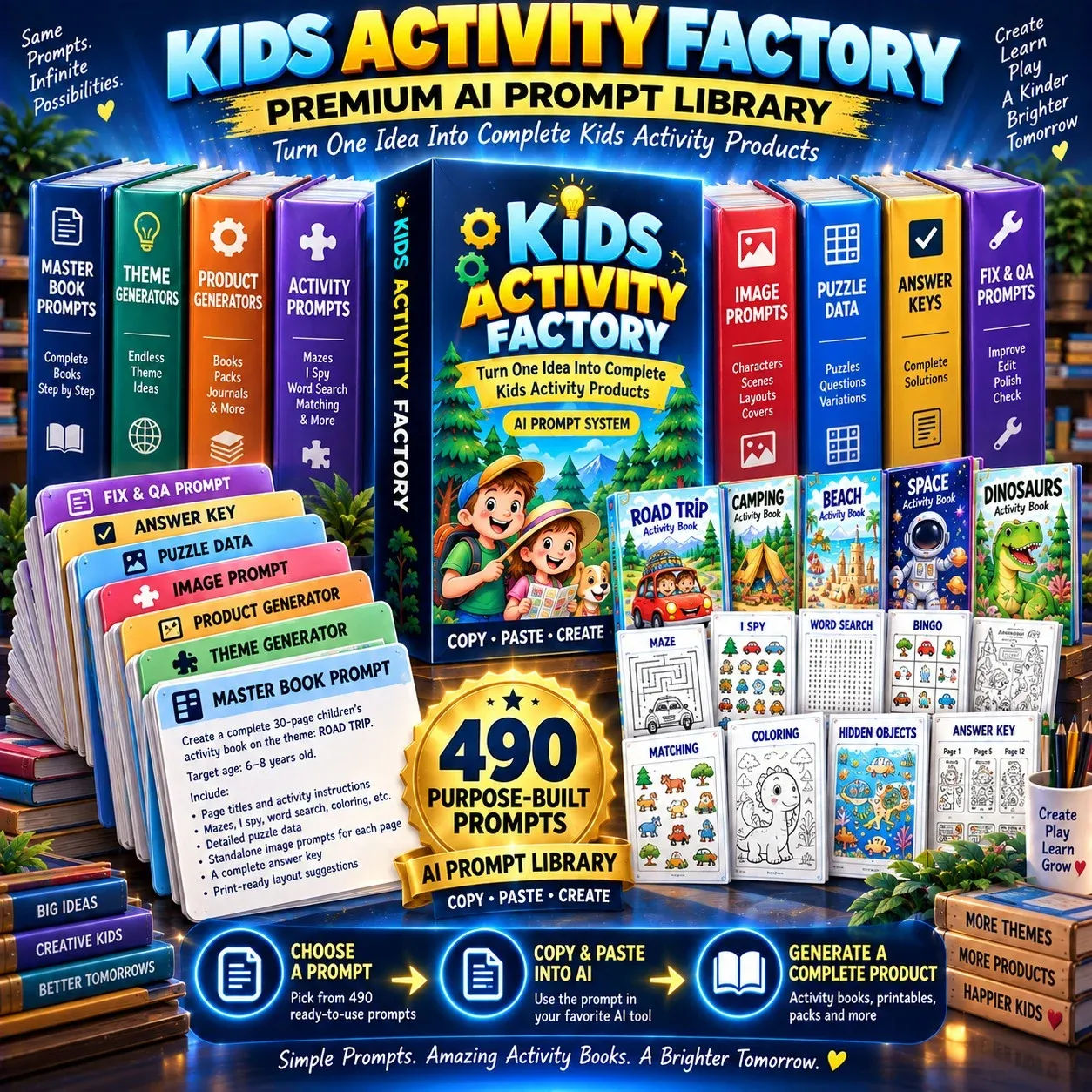
I have made three kids activity books the slow way, and the third one nearly finished me. Six hours on a Sunday, thirty-odd chatbot messages, and a maze where the solution was printed right there on the same page as the puzzle. I closed the laptop, told my wife I was done with KDP, and meant it for about a week. Then I bought Kids Activity Factory, mostly because it costs $17 and I had already wasted more than that on a Fiverr cover that came back with the wrong animal on it.
Kids Activity Factory is a vault of 490 prompts built by Kylie, a mom who turned a road trip sketchbook into an Amazon KDP bestseller. Each prompt is meant to generate one complete 30-page children's activity book: cover, 25 activity pages, answer key, plus a closing page. You copy a prompt, paste it into ChatGPT, and end up with book text and page instructions you then lay out yourself.
My expectations were low. I have bought prompt packs before. Most of them are one-line wishes like "write me a fun activity book for kids" and you get six pages and a cheerful sign-off. The claim here is bigger: a three-page instruction blueprint that holds the structure together across a whole book.
So I tested it instead of reading it. That is what most of this review is about.
Our Verdict
Kids Activity Factory
A genuinely complete prompt system for KDP activity books, held back by the fact you still lay out and fix the pages yourself.
One-time payment, 30-day money-back guarantee
What You Actually Get in Kids Activity Factory
The core deliverable is 490 Master Book Prompts. Each one is a long instruction block, not a sentence. Kylie describes it as roughly three pages of setup: the role ChatGPT should take, the book identity (title, theme, type, age range), the object library for that world, the recurring mascot description, the 30-page architecture, the activity mix rules, the puzzle integrity rules, the per-page output format, and a final QA pass the model runs on itself before it stops.
That structure is the same in every prompt. The theme changes. The object library changes. The mascot changes. Camping, dinosaurs, beach, space, ocean, farm and a stack of others.
Alongside the prompts, the sales page lists a set of supporting techniques. The ones I could actually find and use:
- A short opening instruction that stops ChatGPT quitting after page 6
- A mascot description block you paste into every image prompt so the character stays visually consistent
- Rules for keeping I Spy counts hidden on the puzzle page until the answer key
- A word search image prompt fix for the blank grid problem
- The "Print-Safe" spec so generated artwork survives KDP bleed cropping
- A repair prompt for when the model gives you six dinosaurs instead of four
- Answer key formatting rules that stop coloring pages being labelled as having a correct answer
What you do not get: any layout software, any done-for-you book files, any artwork, any cover design. This is instructions for an AI tool plus a method. That distinction matters and I will come back to it.
Key Features and What They Do For You
The 30-page architecture is the spine, and it is what separates this from a prompt dump. Every book comes out in the same order: cover, a "Getting Ready" page, 25 activity pages, an answer key, and a closing certificate page. Kylie makes a specific argument for that page 2 "Getting Ready" section, saying most creators skip it and that it affects how buyers rate the book. I do not have review data to verify that, but I can see the logic: a parent flicking through a preview needs to know instantly what age the book suits and what is inside.
Character Lock is the feature I expected to fail and it mostly held. Each image prompt carries a fixed description of the mascot, covering clothing, colours and proportions. In my test book the mascot kept the same hat and the same body colour across all thirty pages. Not perfect, one page had slightly different shading, but nothing like the drifting styles I have had before.
The puzzle integrity rules handle the thing that actually kills these books. In an I Spy page, if the model prints "4 dinosaurs" next to a scene containing seven, a buyer spots it in the preview and you get a two-star review. The prompts push the count out of the puzzle page and into the answer key. Cover and interior consistency gets handled by the same architecture.
Then there is the three-difficulty trick. The same prompt can produce an easy, medium and harder version of a book by adjusting the age range, which turns one prompt into three listings if you want them. I have not published all three, but I generated two and the puzzles were measurably different, not just relabelled.
Actually Using It
I ran a camping theme first because that is what the sales page uses as its worked example and I wanted a fair comparison.
Step one is picking a prompt from the vault. The files are organised by theme and by book type, so you are not scrolling through 490 unlabelled documents. I found the camping maze entry in under a minute.
Step two is pasting the prompt into ChatGPT. This is where I expected the whole thing to fall apart, because I have done this before. The prompt is long, and pasting it feels slightly ridiculous, like writing a letter to a very literal intern.
It did not fall apart. The first run produced a complete 30-page book in one session. I did not have to sit there typing "continue" every time it stopped. It produced the cover spec, the Getting Ready page, 25 activities, the answer key and the certificate in one pass.
Time from paste to finished text: 22 minutes. I timed it because that is the claim I cared most about.
Then the honest part. The book was not finished. What came out was the text and the page-by-page instructions. I still had to generate the images, still had to fix two of them, and still had to lay the whole thing out in Canva. That took me just over two hours, not 25 minutes.
Two things needed repair. The first was a coloring page where the model produced a shaded grey illustration instead of clean black outlines. The prompt notes cover the two words that fix this, and they worked on the retry. The second was a word search grid that came back as an empty box on the first image attempt, again covered by a specific instruction in the material.
I also hit one problem nobody warned me about. My first I Spy scene came back with the right count but the wrong animal, six bears where the theme was camping wildlife, so I needed three attempts to get something usable. The repair prompt in the vault fixed a count mismatch efficiently, but the fix for a completely wrong subject was just regenerate and accept it.
Total time for a publishable camping book: about three hours including layout and fixing. That is a real number, not a sales page number. It is also roughly a tenth of what my first book took me. I will take it.
If you want to see the current price and the guarantee terms yourself before buying, the Kids Activity Factory page lays out both.
Want to try the same prompt I tested?
30-day money-back guarantee, so you can test it on one book
Kids Activity Factory Pricing and Value
The price is $17 as a one-time payment. No subscription, and Kylie calls it founder's launch pricing, with a note that the page will not stay at $17. I have no way to verify how long that holds, and launch pricing claims are common enough that I would not buy on urgency alone. Buy because $17 is a low-stakes amount to test a workflow, not because a countdown told you to.
What is the comparison actually worth? Here is how I see the options, using the figures from the sales page and my own experience.
| Option | Typical cost | What you get | Time to a finished book |
|---|---|---|---|
| Kids Activity Factory | $17 one time | 490 structured book prompts plus technique notes | About 3 hours including layout |
| Free one-line prompt packs | $0 | Short prompts that produce partial books | Ends up in the 30 to 40 hour grind |
| Fiverr cover design | Around $15 per cover | One cover image, no interior | Days, plus revision rounds |
| KDP courses | $97 and up | Keyword, cover and listing teaching | Weeks of study before a first book |
The $15 Fiverr comparison is the one that convinced me, because a single cover plus a single mismatch revision costs about the same as this entire prompt vault. The $97 course comparison is less flattering to the course than the page implies, since a course teaches a business and this teaches a production step. They are not the same purchase. If you need to learn KDP, this is not that.
And the income figures floating around KDP content, the $500 to $5,000 a month range mentioned on the page, are not a promise about your results. They are a description of the category. Publishing income depends entirely on your listings, your keywords, your covers and your patience.
Pros and Cons
Pros
- 490 prompts, far more variety than I will ever get through
- The 30-page structure keeps every book consistent
- Mascot consistency actually works across all 30 pages
- The I Spy and maze answer leak fixes solve the real review killer
- The repair prompt saves a whole generation when something breaks
Cons
- You still generate images and lay out every page yourself, roughly 2 hours
- Long prompts eat a fair amount of your session before anything comes out
- Nothing for cover design or KDP listing and keyword work
- Output still needs a human eye, especially on coloring pages
Who This Is For
Anyone who has already made at least one kids activity book and knows how grim the manual process is. You will feel the value immediately, because you already know what 30 hours of prompt wrestling feels like. Same for printables sellers on Etsy who want a faster pipeline without hiring a designer.
It also suits people who own ChatGPT and use it competently. If you have never pasted a long structured prompt into an AI tool and iterated on the output, you will spend your first session learning that skill rather than making a book.
Who Should Skip It
Skip it if you want finished books. This is not a PLR pack, there are no done-for-you PDFs, and no artwork. If you were hoping to download thirty books and upload them tonight, this is the wrong product and you will feel cheated.
Skip it if you are not willing to learn Canva or similar. The last two hours of every book are yours to do. If layout work is the part that puts you off, the prompts do not remove it.
And skip it if you are buying because you need money this month. Prompt packs speed up production. They do not create demand.
Frequently Asked Questions
Is Kids Activity Factory worth it?
For $17, yes, if you already make or plan to make KDP kids activity books. The 490 prompts plus the answer-leak and mascot consistency fixes cut my production time from roughly 30 hours to about 3 hours per book, including the image and layout work you still do yourself.
How much does Kids Activity Factory cost?
It is $17 as a one-time payment, no subscription. The sales page calls this founder's launch pricing and says it will not stay at that level, though I cannot verify how long that holds. For comparison, a single Fiverr cover is around $15.
Do I need ChatGPT to use these prompts?
Yes. Every Master Book Prompt is written to be pasted into ChatGPT and run as a single session. You need a working account and the patience to paste a long instruction block. No other AI tool is required for the text and page structure.
What exactly do the prompts produce?
Each one produces a complete 30-page book structure: cover, a Getting Ready page, 25 activity pages, an answer key, and a closing certificate page, all sharing one theme and mascot. You still generate the images and lay the pages out yourself in Canva or Publisher.
Is there a refund policy on Kids Activity Factory?
The sales page states a 30-day money-back guarantee, and it is listed as a one-time payment. If you are unsure, the safest approach is to buy, run one prompt end to end, and decide before the window closes. You can check the current terms on the official page.
What are the alternatives to Kids Activity Factory?
Free one-line prompt packs, which produce partial books. Paid KDP courses at $97 and up, which teach keywords and listings rather than production. Or a Fiverr designer at around $15 per cover plus your own time on the interior. None of them include a structured 30-page book prompt system.
What is the main downside of Kids Activity Factory?
It is only the prompt and method layer. You still spend around two hours per book generating images and laying out pages, and none of the cover design, keyword or listing work is covered. Budget for that before you buy.
Final Verdict
Kids Activity Factory does the one thing I needed it to do: it stops ChatGPT quitting at page six and holds a whole book together. The mascot stayed consistent, the answer key matched the puzzles, and the maze solutions were not printed on the puzzle pages. That set of fixes is the difference between a listing that gets reviewed badly and one that does not.
It is not a shortcut to finished books. Three hours per book, not twenty-five minutes, and two of those hours are yours. I also think the 490 number is more inventory than most people need. You will find your seven or eight themes and stop browsing.
At $17 with a stated 30-day guarantee, the downside is small and the upside is a working production line. If you already sell printables, this is a straightforward yes. If you have never touched KDP, buy it after you have read one guide on listings, not before.
Ready to run your first prompt tonight?
One-time payment, 30-day money-back guarantee