Little Discovery Review: One Prompt, One Kids Picture Book
Little Discovery hands you 480 prompts across 48 nature themes, each one planning a full 30-page picture book. I used it to build one. Here is what actually happened.
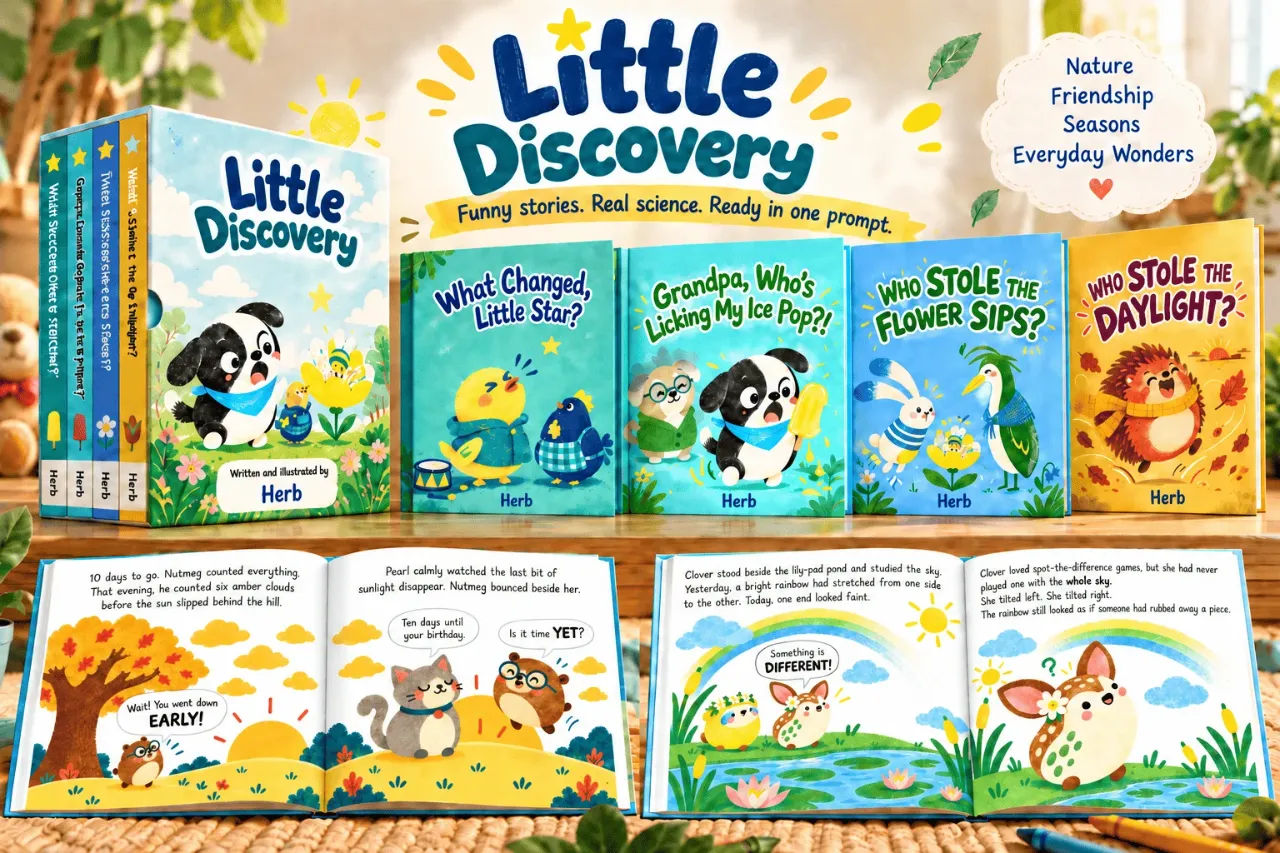
Little Discovery is a pack of 480 prompts across 48 nature themes, each one built to plan a complete 30-page children's picture book. I bought it because I had spent an entire Saturday trying to make a hedgehog look like the same hedgehog on page four as he did on page one, and I had failed.
That is the honest origin story. My daughter had asked me to make her a book about why the sun goes down earlier in winter. I had ChatGPT open, a cup of tea going cold, and a character who kept changing species between generations. By attempt six he had a scarf on page one and no scarf by page three, and the illustration of him looking at a sunset had a tree growing out of his head.
So I paid the $17 and downloaded Little Discovery. This is what happened over the next three evenings.
Our Verdict
Little Discovery
A genuinely useful prompt library for anyone who wants to build children's picture books without rebuilding the process from scratch every time.
One-time payment, PLR rights included
What You Actually Get
The numbers are the selling point and they check out: 48 nature themes, 10 prompts per theme, 480 prompts total. The themes map onto the four seasons, so you get autumn, winter, spring and summer blocks, and the individual topics are the small things kids notice. Shorter days. Leaves changing colour. Snowy footprints. Tadpoles. Worms after rain. Fireflies.
But the count is not really what you're buying. What you're buying is that each prompt is a full book plan rather than a story seed. One prompt gives you:
- A title, subtitle and series name
- A book description of roughly 150 to 200 words
- Seven keyword phrases for listing the book
- Locked character details, repeated where they need to be so the hero stays recognisable
- A complete 30-page script, written page by page
- A simple science explanation in child-friendly language
- Front and back cover prompts
- 30 page-by-page visual prompts, one per page
- A closing activity page, such as a craft, a nature journal starter or a spot-the-difference
Also included are PLR rights, which matters more than it sounds. If you want to sell the finished book as a paperback or a printable, or hand it to a classroom as a resource, the licence side is already dealt with rather than being something you have to go and read about later.
The structure of every story is the same underneath: a small animal hero notices something odd in nature, invents a wonderfully wrong explanation, follows clues, and eventually gets the real science answer. Then the last page gives the child something to do with their hands. That consistency is the product. It is also the thing you'll either love or find limiting, and I'll get to that.
Key Features and What They Do For You
Locked character details
This is the feature that solved my hedgehog problem. Each prompt specifies the hero's traits and repeats them where they're needed, so when you're generating the illustrations the character description is already sitting in the prompt rather than living in your head. The characters are built to be memorable: expressive animal heroes with big round eyes, their natural colours, and one signature detail that never changes. A mustard knitted scarf, in the case of one hedgehog in the collection.
Does it guarantee a perfect character across 30 images? No. I still got two pages where my hero's eyes drifted apart. But I went from roughly six regenerations per illustration down to one or two, and that is the difference between a hobby and a miserable afternoon.
Page-by-page visual prompts
Most prompt packs give you a scene note and wish you luck. This gives you a full direction for every one of the 30 pages. That matters more than I expected, because the problem I kept hitting wasn't the character. It was composition. My illustrations were beautiful and completely full, so there was nowhere to put the sentence. Little Discovery builds pages that leave open space for the story, with playful lettering and soft speech bubbles planned in from the start rather than squeezed in afterwards.
The story formats
Every prompt comes with its own story shape. The collection names a few: a countdown, a diary, a detective case, a rhyme, a news report, a journey. So one theme's ten prompts are not ten variations of the same book. There's a midnight stakeout format where two friends stay up to catch the culprit, a letters-to-nature format where the hero writes and gets an answer back, a trap inventor format with three clever ideas and three spectacular failures, and a breaking news format where a tiny reporter treats an ordinary nature event as the story of the year.
This is the part that stops the output feeling like a template. If you've ever made three books in a row and realised they have the same rhythm, you'll understand why it matters.
The science page
Every book ends with the real answer, written simply, and then an activity. That's the bit that makes these books something a parent or a teacher would actually keep, instead of another cute story about a bunny learning about sharing. The mystery drives the story rather than being bolted on at the end.
Actually Using It
I picked the autumn block and the prompt about shorter days. The example on the page uses a hedgehog called Pip in a mustard knitted scarf who panics whenever his world changes, and his friend Tilly, a slow old tortoise who knows that most of Pip's emergencies need curiosity rather than panic. Pip becomes convinced someone is stealing the daylight.
What I got in the file was the whole thing. A title and subtitle. A description I could paste straight into a listing. Seven keyword phrases. The character notes for Pip and Tilly. Thirty pages of actual story text, written out. The explanation of why days get shorter in autumn, in words my seven-year-old could follow. Front cover and back cover prompts. Thirty illustration prompts, one per page. And a closing activity.
I did not have to write any of that. That is roughly a weekend of work removed from the front of the project.
The first illustration took three attempts. The prompt told me what Pip looks like, what he's doing, and where the empty space should be, and my image tool still gave me a page where he was facing the wrong way. Attempt two had the scarf in a colour I didn't ask for. Attempt three was right. Compare that to the six or seven attempts per page I was doing before, and the maths is obvious.
Pages four through twelve went faster. Somewhere around page eight I stopped reading the visual prompt word for word and started skimming it, because I'd learned the pattern. That's a good sign in a product like this. It means the prompts are teaching you a method, not just handing you output.
The story text itself I did change. The 30-page script is complete and usable, but I rewrote about a third of the sentences to sound more like something I'd say out loud at bedtime. That's not a criticism, exactly. The script is a script. It's built to be readable and correct, and it is, but it isn't trying to be you.
The thing that genuinely surprised me was the ending. Pip discovers why the days are getting shorter, and then the story lands on the idea that earlier sunsets mean stars and cosy blankets and more cocoa time with Tilly. That is a real emotional beat rather than a moral stapled to the last page.
Total time: about four hours across three evenings, including my daughter's editorial feedback, which mostly consisted of asking why the fox didn't have a hat.
Pricing and Value Analysis
Little Discovery is $17 as a one-time payment. No subscription, no monthly anything. The sales page mentions the $17 price once and that's the number I'd work from.
I'll be blunt about how I'd judge that. $17 is roughly the price of two coffees and a pastry, and what you're getting for it is a structured framework that removes the planning phase of about 480 books. If you make even one book with it, you're at less than twenty dollars for a finished product. If you make two, it's under nine dollars each.
Compare it against the alternatives a buyer would realistically consider:
| Option | Cost | What you get |
|---|---|---|
| Little Discovery | $17 one time | 480 prompts, 48 themes, full 30-page plans with PLR rights |
| Blank ChatGPT session | Free | Every decision yours, including character consistency and page layout |
| Hiring a children's book illustrator | Typically hundreds per book | Professional art, but you still write and plan the story |
| Other prompt packs | Varies | Usually story ideas only, no per-page visual prompts |
The honest caveat is that $17 gets you prompts, not pictures. You still need an image tool to generate the illustrations, and depending on what you use, that may cost you separately. Twenty years ago that would have been a real problem. Now the whole reason this product makes sense is that image generation got cheap. Just don't buy this expecting a finished PDF to fall out of it. You are the assembly line.
You can see the full breakdown on the Little Discovery page before you decide.
Pros and Cons
Pros
- 480 prompts across 48 nature themes, plus a 30-page book plan for every single one
- Every book ends with real science and a hands-on activity page, not a moral
- Blank space is planned into the illustration prompts, so story text has somewhere to sit
- PLR rights included, so you can publish or sell what you make
Cons
- You still need your own image tool and have to generate every page yourself
- The completed 30-page scripts are functional rather than artful and I rewrote about a third of mine
- Character consistency still isn't guaranteed, I got two wonky pages
- The prompts follow a consistent formula, which some people will find repetitive by book ten
Who This Is For
Parents who want to make a personal book for their own child and don't want to spend a weekend fighting an AI. Teachers and homeschoolers who want a shelf of nature stories with a real science page attached. And anyone who wants to publish children's picture books as a low-content product and is prepared to do the illustration work or outsource it.
It suits people who like a framework and are happy to fill the gaps. If you already have a strong idea of how you write a children's book, Little Discovery will mostly speed up the part you find boring.
Who Should Skip It
Skip it if you want finished illustrations. This is not a generator with a button on it. Every page still has to be rendered, checked, and sometimes re-rendered, and if that sounds like work you don't want, no prompt pack will fix that.
Skip it if you're expecting the assembled books to be publish-ready as they come. They aren't. The scripts are solid foundations. What sits on top of the foundation is your job.
And skip it if you genuinely enjoy planning books from a blank page. That's a real thing and some people do. If that's you, this is solving a problem you don't have.
Frequently Asked Questions
Is Little Discovery worth it?
For $17, yes, if you're going to make at least one children's picture book. The 480 prompts save you the story planning, title, description, keywords and page layout work. If you're only curious and won't finish a book, save your money. The value comes from actually using it.
What exactly is included in Little Discovery?
480 prompts across 48 nature themes, grouped by the four seasons. Each prompt plans a complete 30-page picture book: title, subtitle, series name, a 150 to 200 word description, seven keyword phrases, locked character details, a full 30-page script, a science explanation, cover prompts, 30 per-page visual prompts and a closing activity. PLR rights are included.
Do I need to pay for anything else?
Probably. Little Discovery gives you the prompts, but you still need image generation software to turn the 30 per-page visual prompts into actual illustrations. That may be a separate cost depending on what you already use. There's no subscription attached to Little Discovery itself.
Can I sell the books I make with Little Discovery?
PLR rights are included, which means you can publish the finished books as paperbacks, printables or classroom resources. That covers the licence question. Do check the terms yourself before you list anything on a store you care about, because platform rules vary.
Does Little Discovery work for any age of child?
The stories are written in simple, child-friendly language with a light science explanation and a hands-on activity. They fit the picture book stage, roughly ages three to eight. The nature topics are the small everyday things a young child notices and asks about, which is what makes them land.
How long does it take to make one book?
My first one took about four hours across three evenings, including redoing several illustrations. The planning phase was already done by the prompts, so nearly all of that time was image generation, checking and rewriting sentences to sound more like me. Expect the second one to go faster.
Are there alternatives to Little Discovery?
You can start from a blank ChatGPT session for free, but you'll spend hours on character consistency and page composition, which is the exact problem this solves. Hiring an illustrator costs far more and doesn't help with the story. The Little Discovery prompt library sits in between.
Final Verdict
I came into this annoyed at a hedgehog who couldn't keep his scarf on, and I left with a finished 30-page book about why the winter evenings get dark so early. It took me four hours. It would have taken me a weekend without this, and most of that weekend would have been spent re-writing the same character description over and over.
It isn't magic. You still generate every page yourself, the 30-page scripts are competent rather than lovely, and by the time you've made your tenth book the formula will start to show. But the formula is the point, and $17 for 480 of them is a fair trade.
If you've been circling the idea of making a picture book and keep stalling at the blank page, this is the thing that gets you off the blank page.
Ready to make your first one this week?
One-time $17, 480 prompts and PLR rights