Ghost Mystery Writer GPT Review: 456 KDP Novels?
I ran Ghost Mystery Writer GPT on a real ghost mystery idea and read every phase of what came back. It is $17, it is a single HTML file, and it fixes the chapter 38 problem. Mostly.
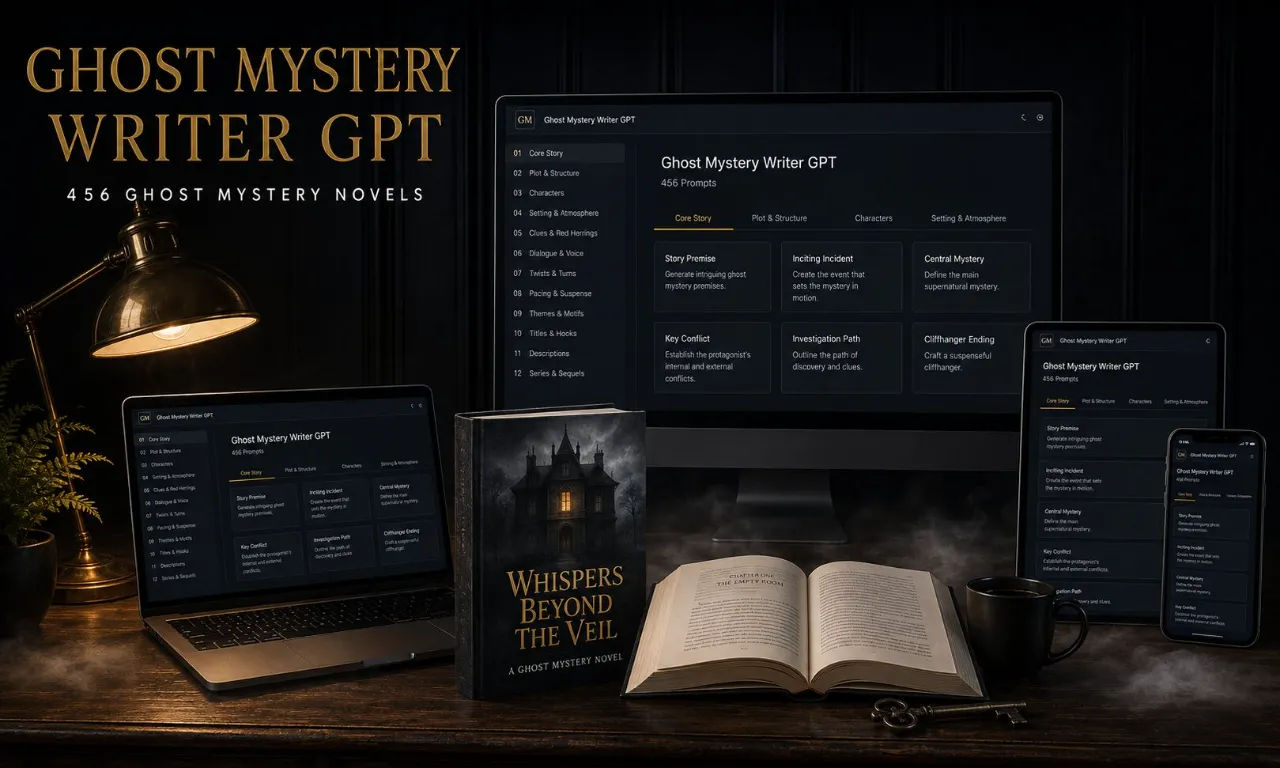
I bought Ghost Mystery Writer GPT on a Tuesday night because of a housekeeper named Margaret.
Not a real housekeeper. A character in a draft I had abandoned three months earlier, back when she was still called Maureen in chapter one and had somehow become Margaret by chapter nineteen. The ghost in that book could walk through a locked door in the opening scene and then spent four chapters knocking on doors like a polite delivery driver. I had a folder of notes explaining what the haunting was supposed to do, and the model ignored all of it, because models do not read folders. They read the last two thousand words you typed and then happily invent a new universe.
So when I saw 456 prompts promising a finished 40-chapter novel from a single paste, my first reaction was the usual one. Sure. Another spreadsheet of one-liners with the nouns swapped out. I have bought those before. I opened Ghost Mystery Writer GPT anyway, paid the $17, and spent the next week finding out whether the claim holds up when an actual half-finished manuscript is sitting on your desk.
Here is what I found, including the parts that annoyed me.
Our Verdict
Ghost Mystery Writer GPT
A 456-prompt library with a locked five-phase build order that keeps a 40-chapter ghost mystery internally consistent. Worth $17 if you actually finish books.
One-time payment. Works on the free ChatGPT plan.
What You Actually Get
The download is smaller than you expect and that is a compliment. There is no software, no login, no dashboard with a free tier that quietly expires. The whole tool is one HTML file. You double-click it, it opens in your browser, and it runs offline. I tested that by turning off wifi, and the search, filtering and one-click copy all kept working.
Inside the file:
- 456 complete ghost mystery novel prompts, sorted across 38 categories and 6 groups
- A search and filter panel so you can hunt by place, job, decade or mood
- One-click copy that grabs the entire prompt, engine included, not just the opening line
- Prompt 000, a Custom Concept Mode that asks five short questions and builds a full commission around your own idea
- Three built-in guides: How To Use, Publish On Amazon, and Cover and Formatting, with a pre-publish checklist that remembers your ticks
- The same 456 prompts as a spreadsheet for Excel or Google Sheets
- A two page Start Here PDF written for someone who has never unzipped a file
- Three bonuses the page values at $47 combined
The three bonuses are The First Book, Day by Day (seven sittings, about eleven hours, with a fourteen-evening version if your evenings are an hour rather than two), Is This Chapter Any Good?, and What Ghost Mystery Readers Punish. I will come back to the middle one because it is the one I got the most out of.
Full commercial rights are included. Publish under your own name or a pen name, keep the royalties. No attribution required.
The Features That Actually Matter
The headline feature is not the 456. It is the five-phase order, and the fact that ChatGPT is not allowed to write prose until it has committed to the rules in writing.
Phase one is the Format and Concept Sheet. Title, sub-genre, shelf position, point of view, tense, hook, premise, emotional promise, content rating. Boring on its own. It matters because everything downstream is pinned to it.
Phase two is the Story Bible, and this is where the abandoned drafts usually die. You get a setting dossier with named rooms and five recurring sensory motifs. You get a Haunting Logic Engine: what the entity is, what it wants, what it can do, what it cannot do, what triggers it, what weakens it, and the one hard rule it can never break. That last part ships as six numbered laws the model is forbidden to violate later in the book. Then a cast register of eight to twelve named characters, each with an age, a speech habit and a secret. The Buried Truth, written plainly so you know the answer. And a clue schedule mapping at least nine planted clues and three fair red herrings to the exact chapters that carry them.
Phase three is the pen name and author persona: three genre-appropriate names, one chosen and justified, plus the bio, dedication and epigraph.
Phase four is the drafting engine. Forty chapters at 1,000 to 1,125 words each, written against the bible instead of against the last thing the chat happened to say. That is the whole trick, and it is a real one. Type SHORT and you get a 20-chapter novella from the same concept instead.
Phase five is the KDP assets. Blurb, seven backend keywords, two category recommendations, an A-plus content outline, a cover art brief, trim size, page count estimate and font recommendation. The listing, not just the manuscript.
Then there are the live controls you can type mid-build. OUTLINE prints the clue schedule so you can see where the plants are thin. EXPAND rewrites the last chapter longer without padding it. TITLES gives you ten alternative commercial titles. KDP jumps straight to the listing assets. CONTINUE moves to the next chapter in the same voice with no recap, which sounds minor until you have watched a model spend four hundred words summarising itself.
Actually Using It
I picked a prompt from the Investigators and Detectives group, the one about a cold case that reopens itself every anniversary. Detective Ruth Kolwicz, three months from a pension she does not want, rust-belt city in western Pennsylvania. I copied it with one click and pasted it into a fresh ChatGPT chat on the free plan, which the page claims is enough. For the record, it was. I never hit a wall or got told to upgrade.
Phases one and two came back in one response and took a few minutes. The output was longer than I expected and I read all of it, which I do not usually do with AI output. The Haunting Logic Engine is the part I keep coming back to. Six numbered laws, and the sixth one was something I would never have thought to specify. The clue schedule came back as a table mapping nine clues and three red herrings to chapters 4, 9, 11, 17, 19, 22, 26, 31, 34 and so on. I checked three of the later chapters at the end of the build to see whether the plants were actually there.
Two of the three were. The third was present but badly buried, sitting in the middle of a paragraph of weather description where no reader would clock it. That is a real flaw and I want to be honest about it. The engine maps the clue to a chapter. It does not guarantee the clue gets a good position inside that chapter. I fixed it in about four minutes by moving two sentences, but I had to notice it first, and I only noticed because I went looking.
The drafting phase is where the hours go. I did not sit through all forty chapters in one go. I ran it in blocks over three evenings, roughly four hours total, asking for CONTINUE and reading as I went. Chapter lengths landed between 1,010 and 1,120 words, inside the range the page states. POV stayed locked to Ruth the whole way through. Tense held. Nobody changed their name. The housekeeper problem did not happen, which was the entire point of buying this.
There was one wobble around chapter 26, where a secondary character's speech habit drifted from clipped to chatty. I typed a two line correction into the chat and it fixed itself for the remaining chapters. Not a disaster, but it is not a hands-off process if you want the book to be good rather than merely finished.
Chapter 38 agreeing with chapter 2 is the thing I wanted to test most, so I went back and re-read the opening after finishing. The hard rule from the sixth law was still intact. The five sensory motifs from the setting dossier were still showing up, and one of them, a smell I had not noticed on the first pass, had been seeded in chapter 3 and paid off in 37. I did not plan that. The bible did it.
The one-click copy is genuinely one click, by the way. No highlighting, no select-all, no losing the first line of a prompt to an over-eager text box.
What I did not love: the free plan will stall on you in a long session, and you have to keep the tab open or the thread gets unwieldy to scroll. There is a spreadsheet version of all 456 prompts if you would rather plan a catalogue in Excel, and I ended up using that more than the tool for browsing, then going back to the HTML file whenever I wanted to actually copy something. Slightly annoying to have two places for the same text. The page is upfront that they hold identical content, so it is not a hidden gotcha, just a mild annoyance.
Then there is Is This Chapter Any Good?, the second bonus. It takes the opening of a real chapter the system produced, prints it exactly as it came out with nothing tidied up, and marks up thirteen decisions the prose is making on purpose. Then it rewrites the same scene three ways to show how it fails, and leaves you four questions you can ask of any chapter in about ninety seconds. I used those four questions on my older, abandoned draft. It failed two of them on the first page. That bonus was worth the price on its own for me, which is not a sentence I write often about a bonus file.
Stop abandoning drafts at chapter nine
Use code GHOST5 for $5 off, first 50 buyers.
Pricing and Value Analysis
The price is $17, one-time. There is a $5 off coupon, GHOST5, and the operator says it is limited to the first 50 buyers, so it may or may not still be live by the time you read this. Check the page rather than taking my word for it.
The sales page itself throws a lot of numbers around: $47 appears six times, $5.99 three times, $17 three times, and there are mentions of $0.00, $2.99, $4.99, $14.99, $13, $147 and $195. Most of those are not the product price. Here is how they actually break down.
| Figure | What it is | Source |
|---|---|---|
| $17 | Ghost Mystery Writer GPT, one-time | Operator notes / sales page |
| $47 | Stated value of the three free bonuses, not a price | Sales page bonus section |
| $2.99 to $5.99 | Kindle price bands for ghost mysteries seen on Amazon | Sales page Amazon screenshots |
| $14.99 | Traditionally published outlier in the same search | Sales page Amazon screenshots |
| $0.00 | Kindle Unlimited reads | Sales page Amazon screenshots |
The comparison the page makes is decent. Ask anyone to write you 456 finished ghost mystery commissions, each with a concept sheet, a story bible, a clue schedule and a KDP listing, and you are not paying $17. You are paying for the one you buy, which is what the full library costs, one time, with a spreadsheet included. Fifteen minutes of my time at what I charge for freelance work is worth more than this thing costs, and I got a full manuscript out of it.
Where the value argument weakens is if you never publish any of it. The library is not going to write the book for you in the sense of removing the work. Four hours of reading and correcting went into my test novel, and I could easily have spent more. If you buy this and let it sit, you spent $17 to feel like you were going to start a book, which is a fine thing to spend $17 on if you are honest about it. It is not a lot of money either way.
There is a refund discussion worth having here, and I cannot give you a window because none of my sources state one. I do not know whether a refund policy exists for this product. Check before you buy if that matters to you. I did not request one, because I kept mine.
Pros and Cons
No list here. This is what I actually came away with after a week.
Pros
- Five-phase build order stops the chapter 38 continuity mess
- Haunting Logic Engine with six unbreakable laws is the real product
- Nine clues and three red herrings mapped to specific chapters
- One HTML file, offline, no account, no subscription
- Free ChatGPT plan is genuinely enough
- Full commercial rights, keep 100% of royalties
- Bonus on judging a chapter is worth more than it sounds
Cons
- A clue can land in a bad spot inside a good chapter
- Voice drift on minor characters still needs a manual nudge
- Tool and spreadsheet duplicate the same text, mildly annoying
- Free plan gets sluggish in long build sessions
- No refund window stated in any source I could find
Who This Is For
You have started at least one ghost mystery and abandoned it. You have a ChatGPT account and you have used it for fiction and gotten frustrated. You want to build a catalogue rather than a single book, because the sales page makes a genuinely good point about how this genre works: the bestseller sort shows books eleven, twelve and twenty-one of long series sitting at the top, and the one standalone in that group has nine reviews. Ghost mystery readers find an author and read the shelf.
You also probably already understand that Amazon requires AI-assisted content to be declared at upload. The engine reminds you of that at the end of every book, which tells you they are not pretending otherwise.
You like the idea of a 40,000 to 45,000 word novel but you do not want to commit to that size on your first attempt, so you will appreciate the SHORT switch to a 20-chapter novella.
Who Should Skip It
Skip it if you want software that writes and publishes with no reading involved. That is not what this is. You read the bible, you read the draft, you move a clue that landed in the wrong paragraph.
Skip it if you do not want to publish under the KDP AI disclosure rules. They are written into the engine and they are not optional.
Skip it if you are looking for a general fiction tool. This is ghost mystery only, 38 categories of it, and a horror prompt pack it is not.
And skip it if $17 is going to bother you when the manuscript sits in a folder untouched in March. That is a you problem, not a product problem, but it is the honest reason most people should not buy this.
Frequently Asked Questions
Is Ghost Mystery Writer GPT worth it?
For $17, yes, if you intend to finish and upload a book. The five-phase build order and the Haunting Logic Engine solve the continuity collapse that kills most AI-assisted drafts. If you only want to browse prompts and never publish, you already have enough free material and should save the money.
How much does Ghost Mystery Writer GPT cost?
It is $17 as a one-time payment, with no subscription. There is a coupon, GHOST5, that takes $5 off for the first 50 buyers. Several larger figures on the sales page, including $47, refer to the stated value of the bundled bonuses rather than the price of the product itself.
Do I need ChatGPT Plus to use it?
No. The page states the free plan is enough and I ran my test novel on the free plan without hitting a paywall. Long sessions can get slow on the free tier, so running it in blocks over several sittings works better than trying to generate forty chapters in one go.
Does it work for genres other than ghost mystery?
No, and it does not pretend to. All 456 prompts are ghost mysteries across 38 categories and 6 groups. There is no romance, thriller or fantasy library inside this download. If you write in another genre, this is the wrong product entirely, however good the engine underneath it is.
Can I sell the books I generate?
Yes. Full commercial rights are included, so you can publish under your own name or a pen name and keep 100% of the royalties. The engine does remind you that Amazon requires AI-assisted content to be declared when you upload, and it will not invent reviews, ratings or endorsements for your listing.
What is the difference between the tool and the spreadsheet?
Nothing, in terms of the prompts. The HTML file and the spreadsheet hold identical text, and the page says so. The tool gives you search, filtering and one-click copy. The spreadsheet is easier if you want to sort and plan a whole catalogue of books before you start writing any of them.
Is there a refund if I do not like it?
I do not know, and I am not going to guess. None of my sources state a refund window or a money-back guarantee for this product. If a refund policy matters to you, check the page directly at cachua.fun before you buy rather than relying on this review.
Final Verdict
I came into this expecting a spreadsheet of recycled one-liners and I came out with a finished 42,000 word manuscript, two scenes I had to fix by hand, and a much better idea of why my earlier drafts kept falling apart. The clue schedule and the six haunting laws do the work that no amount of prompt tinkering ever did for me. The flaws are real: a clue can land in a boring paragraph, a side character can drift, and you still have to read the book. But the thing it promised, a 40-chapter ghost mystery where chapter 38 still agrees with chapter 2, held up when I tested it.
At $17 one time, with a $5 coupon possibly still live for the first 50 buyers, the maths is not difficult. Buy it if you are going to finish a book. Skip it if you are not, and no hard feelings either way.
456 novels, one prompt each
One-time payment. No subscription, no account, works offline.