Halloween Cozy Horror Book Writer (PLR) Review
An 11-stage Claude Skill that turns one-line cozy horror ideas into structured manuscripts, with True PLR rights. Here is what it does well and where it falls short.
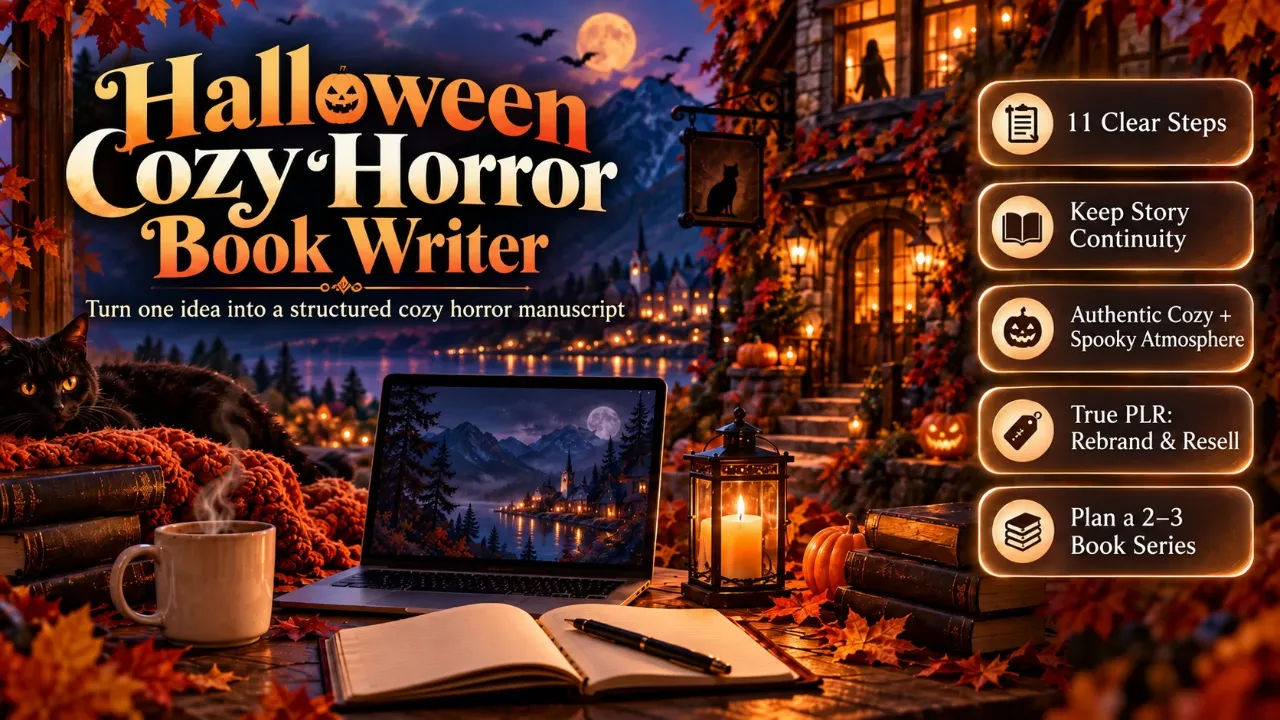
I have a folder on my desktop called "plr-graveyard." It has 41 items in it. Prompt packs, ebooks with someone else's name still on the cover, a Google Doc that just says "story prompts (100+)" with eight prompts inside. I bought Halloween Cozy Horror Book Writer expecting to add it to that folder within twenty minutes. It is a Claude Skill with True PLR rights, and it claims to run an 11-stage gated workflow that turns a one-line idea into a revision-ready cozy horror manuscript.
I had a specific problem in mind. I run a small KDP side project, mostly cozy mystery, and every October I think about doing something with a seasonal angle and then don't, because cozy horror is a different animal. Half the time in cozy, no one dies, but under cozy horror someone usually has to be at stake, and if you don't have rules for your supernatural element, the horror just sort of flaps around. I have started three drafts with an AI and abandoned all three by chapter four because the "curse" meant something different in every chapter.
So I paid $11.95 and installed it. The install is not a one-click thing, and I'll get into that, but it worked.
Our Verdict
Halloween Cozy Horror Book Writer (PLR)
A genuinely structured 11-stage Claude Skill for cozy horror with usable True PLR rights, as long as you understand you're buying a workflow plus a license, not a finished product or a marketing kit.
Instant download. True PLR. 14-day conditional refund.
What You Actually Get
The core asset is a Claude Skill package. Not prompts. A skill with workflow files, reference documents, templates, examples, scripts, and installers.
Concretely, from the package listing:
- One Claude Skill, with two install paths: Claude.ai via a ZIP, and Claude Code
- An 11-stage gated workflow, plus Modes A through F, including Series Blueprint
- Eight enforced planning templates: story brief, character bible, cast map, horror engine, master plot, chapter card, canon ledger, series blueprint
- Seven craft references, covering cozy craft, the horror engine, voice, canon, KDP guardrails, a quality rubric, and series architecture
- Three worked demo stories: pumpkin farm, haunted inn, winter ghost
- A skill validator script and an evaluation suite
- Start-here doc, quickstart, installation guide, and starter requests
Then there's the commercial layer, which is the actual reason to buy a PLR product rather than just using a Claude skill you wrote yourself. You get the True PLR license file, a usage-rights summary written in plain language, rebrand instructions, and PLR marketing assets. You can also issue your own end-user license from an included template.
What you don't get: anything to do with publishing. No ad copy, no A+ content, no listing factory, no cover generator. The sales page says this outright, which I appreciated more than I expected to. It describes itself as a front-end system with one job. That is accurate.
Key Features
The thing I keep coming back to is that every stage has a gate. You cannot move to stage 8 until stage 7 clears. When I've used plain chat prompts before, the model will happily write me 12 chapters of a book where the protagonist's sister is named Dana in chapter 2 and Diane in chapter 9. The gate structure exists to stop exactly that, and it mostly does.
The Horror Engine is the part I'd point a buyer toward first, because it is the actual differentiator. Most AI horror writing gives you a spooky image: a scarecrow that moves, a mirror that shows someone else. Spooky images are cheap. What the Horror Engine forces you to define is the threat's rule, its limit, its cost, its consequence, and the evidence path. A threat with a cost is a threat the reader can be afraid of, because the characters can't just ignore it.
The Canon Update stage runs after each drafting batch and records what is now true, who knows what, which hooks are open, and which clues have paid off. If you have ever lost an afternoon scrolling through your own draft looking for the name of a dead character's dog, this is the feature you're buying.
Adversarial Review attacks the draft on purpose. Not a score, not "great job, here are three suggestions." The product description is explicit that it hunts fatal flaws, clichés, thin zones, and hands back specific fixes. So far that matches what I've seen.
Series Blueprint mode is optional and lets you plan two to three books with escalation threads while still resolving book one's central promise. I haven't used it. I don't think I'd use it for a while, and the sales page is upfront that this isn't a catalog-production dashboard.
Actually Using It
Install took me eleven minutes, and four of those were me being confused about which path to take. The Claude.ai route uses a ZIP. The Claude Code route is a separate set of steps. The installation guide walks you through both, and if you read it before you start clicking, you'll be done in five minutes. I did not read it before I started clicking.
The skill runs on the command /writing-cozy-horror-books. I gave it the same style of premise the sales page demos, and then I gave it one of my own. Mine was about a town where the annual scarecrow contest keeps producing a winning entry nobody remembers entering. Cozy, small town, festival, one supernatural rule that needs pinning down. My natural instinct with an AI is to type the premise and then immediately type "now write chapter one."
You can't do that here, and this was the first thing that annoyed me and then the first thing I was glad about.
Stage 1 made me lock the hook, the stakes, and how the cozy half and the horror half actually connect. Not "write a cozy horror" but a specific statement of which element supplies the comfort and which supplies the threat, and why they share a clock. My scarecrow idea had the festival as the cozy anchor and the contest deadline as the horror clock. Once that was on paper, the book had a shape. I have written 20,000 words of fiction that never had a shape, so I noticed.
Stage 2 is Character Architecture. The gate requires a lead, an opposing force, key relationships, and at least three supporting characters, each with a distinct plot function and a voice marker. This is the stage that kills books. Character bloat is the number one reason my drafts die. The skill asks what job each person does in the story before you're allowed to keep them. I cut two characters that existed purely because I liked them.
Stage 3 is where I got the most out of it. My rule: at midnight after the contest opens, each scarecrow's face changes to resemble someone who has broken a promise to the town and never made it right. Limit: it shows who, never what they did or when the debt comes due. Cost: if you take a scarecrow down before its debt is settled, the mark transfers to someone in your household. Consequence: if nobody acts, more than one face changes per night.
Writing that out took me maybe fifteen minutes and fixed the flapping. My curse had a system. Readers can learn a system. Characters can make decisions inside a system. Decisions are plot.
The chapter cards come next, and this is where the workflow starts doing labor I would otherwise skip. Every chapter gets a goal, an obstacle, a turn, a sensory anchor, a voice line, a memorable image, and a continuity dependency. I'll be honest, filling out all seven fields for every chapter is tedious. I skipped the voice line on two cards and the draft came back flatter in those chapters. The tool is right and I was lazy.
Guided Drafting produces chapters from the plan. What surprised me is the texture. The demo story on the sales page has an excerpt where the protagonist touches a pumpkin's rind and it's warm, and the dialogue that follows is short and functional. Mine came back similar. Not purple, not overwritten, and the characters move instead of explaining themselves. I went back and read the sales page excerpt after I'd done my own, and it wasn't a cherry-picked showpiece. It reads like what the skill actually produces.
Canon Update runs after each drafting batch. In my case, after four chapters it flagged that I had established the scarecrow faces appear at midnight but had written a scene where one changed at dusk. I had not noticed. That's a four-chapter-later catch on something I would have found at 2am on a formatting pass, if at all.
Adversarial Review was uncomfortable in a productive way. It told me my midpoint was thin because my lead had no cost to pay yet, and that my town's authority figure was doing exposition work instead of opposing anything. Both true. Targeted Revision then fixed those two things without regenerating the whole book.
The limits. The output does not read like a human wrote it, in the sense that a careful reader who reads 80 cozy mysteries a year might sense a current underneath. It reads competent and consistent. Some of my best sentences in the draft were ones I edited in by hand after the fact. And the cozy is easier to get right than the horror. My threats are still a little too explainable. That's a me problem as much as a tool problem.
Time: I got from premise to a revision-ready draft of a novella-length project in a weekend that I would previously have spent producing 6,000 words and a headache.
Want the same 11-stage workflow on your own premise?
Price rises $0.50 every hour and caps at $16.95.
Pricing and Value Analysis
At the time I bought, the front-end price was $11.95. The sales page says it rises by $0.50 every hour and caps at $16.95, which is the standard WarriorPlus launch ladder. If you're seeing $16.95, you're past the bottom of the ramp.
The number that matters more than $11.95 is the resale math. True PLR means you can rebrand the package, put your name and support email on it, and keep 100% of what you sell. If you sell three copies at $17, you've covered the purchase. If you sell none, you've spent $11.95 on a writing tool you can still use yourself. That's the floor and it's a reasonable floor, because the writing tool is genuinely useful on its own.
| Option | Typical cost | What you get |
|---|---|---|
| Halloween Cozy Horror Book Writer (PLR) | $11.95 rising to $16.95 | 11-stage Claude Skill, 8 templates, 7 references, 3 demos, installers, True PLR license and marketing assets |
| Generic AI prompt pack | $7 to $27 | A folder of prompts, no sequence, no canon tracking, no resale rights usually |
| Hire a ghostwriter for one cozy horror novella | Hundreds to low four figures | A finished manuscript, no license, no resale rights, no reusable system |
| Write it yourself with a free chat prompt | Your time | No gate structure, no continuity ledger, and you hit the chapter-four wall |
The comparison that matters most isn't the price. It's whether the thing you're selling has a reason to exist. Cheap PLR gives you files and nothing to say on a sales page. This gives you an 11-stage named mechanism and a worked walkthrough you can point at. That's the difference between a $11.95 product and a $47 product, and it's the reason I bothered writing this up rather than adding another entry to the graveyard folder.
Pros and Cons
Pros
- Eleven named stages with real gates between them, so the draft can't drift
- Horror Engine forces rule, cost, limit, and consequence, which is what makes the threat frightening
- Canon Update caught a continuity error four chapters after I made it
- True PLR rights let you rebrand, sell, and keep 100% of your sales
- Works on your own premise, not just the three demo stories
- Install guides cover both Claude.ai and Claude Code
Cons
- Two install paths and neither is one-click; read the guide first
- Filling in all seven chapter card fields is tedious and skipping them shows in the draft
- Focused on one subgenre only, so no use if you write anything outside cozy horror
- No publishing assets, no listing builder, no ad copy
- Output reads competent and consistent but not distinctly human
- Refund is described as 14-day conditional, so check the terms before buying
Who This Is For
You write or want to write cozy fiction with a supernatural element and you keep stalling around chapter three or four. You want a structure that makes you decide things before you type, and you'd rather be told your midpoint is thin than told you're doing great. Bonus points if you already sell something, because the True PLR rights turn this into a Halloween-seasonal product you can put in front of buyers who want a spooky writing tool in October and never think about it in April.
It also suits the beginner KDP fiction writer the sales page describes. Someone with a spooky idea and a blank document and no scaffolding. The 11 stages are the scaffolding.
Who Should Skip It
Skip it if you write anything other than cozy horror. The package is explicit that it isn't a library of every fiction subgenre, and it isn't. If you want a general-purpose novel-writing skill, this isn't it and you'll be annoyed within an hour.
Also skip it if you want a finished product to upload. You're buying a workflow plus a license. There is real work left: you install it, you fill in the templates, you rebrand if you're selling, you build your own page. The included marketing assets are a starting point, and the license is firm about not advertising fake scarcity, fake proof, or income claims, so you can't just paste the vendor's page and call it yours.
And if you came looking for cover design, ad copy, or a KDP listing factory, look elsewhere. That's outside the scope by design.
Frequently Asked Questions
What is Halloween Cozy Horror Book Writer (PLR)?
It's an 11-stage Claude Skill that turns a simple cozy horror idea into a structured, revision-ready manuscript. It includes Horror Engine, Canon Update, Adversarial Review, and an optional Series Blueprint mode, plus True PLR rights so you can rebrand it, sell it, and keep 100% of those sales. It runs on Claude via the command /writing-cozy-horror-books.
How much does Halloween Cozy Horror Book Writer cost?
The front-end price starts at $11.95 and rises by $0.50 every hour until it caps at $16.95. There are no numbers beyond that in the product listing I read. At $11.95, three resales at $17 covers the purchase, and you can use the writing tool yourself regardless.
Is there a refund?
The product listing describes a 14-day conditional refund. It's conditional, not unconditional, so read the terms on the sales page before you buy rather than after. I can't tell you what the conditions are beyond the word itself.
Do I need to know how to code or use Claude Code?
No. There are two install paths, one for Claude.ai using a ZIP and one for Claude Code. The Claude.ai route is the one most buyers will use. The installation guide covers both, and the start-here document walks you through your first run. Budget ten minutes and read it before you start.
Can I sell it as my own product?
Yes, with limits. You can rebrand it, close-label it, rename titles, folders, and marketing assets, and sell your version keeping 100% of those sales. You cannot sell or transfer the PLR rights themselves, let customers rebrand or resell the package, drop the unmodified files into free memberships or public repos, or remove the end-user personal-use restriction. Your buyers get personal and own-business use only, and there's a template for issuing that license.
Does it work for genres other than cozy horror?
No. The listing is explicit that this is cozy horror focused. It isn't a full developmental-editing suite, a catalog production dashboard, or a library covering every fiction subgenre. If you write romance, thriller, or epic fantasy, the 11 stages will still be interesting but the Horror Engine and cozy craft references won't apply to you.
What are the alternatives?
A generic AI prompt pack costs less in some cases and gives you far less: no gate sequence, no continuity ledger, and usually no resale rights. Hiring a ghostwriter produces a finished manuscript but no reusable system and no license. Writing it yourself with a free chat prompt is the cheapest option until you hit the chapter-four wall, which is the exact wall this product exists to get you past.
Final Verdict
I did not add this to the graveyard folder. The 11-stage structure is real, the gates do what they claim, and the Canon Update stage caught a mistake I would have shipped. The Horror Engine alone was worth the $11.95, because it turned my vague curse into a system with rules and costs, and a system is something a reader can be afraid of.
The honest caveats: the install isn't one-click, the chapter card templates are tedious if you do them properly, and the output is competent rather than remarkable. As a PLR product, though, it's the rare one that hands you a sales argument instead of a ZIP file. If you write cozy horror or sell to people who do, buy it before the ladder hits $16.95. If you write anything else, keep your money.
Ready to put your own name on an AI writing product?
Instant download. True PLR. 14-day conditional refund.