Meridian Review: Books Your Competitors Can't Copy
Meridian is a web app that computes local data books (night sky, planting, tides, prayer times) for one exact town and locks that town to your account. Here is what $17 actually gets you.
I was three weeks into a tide log journal when I found the same interior on six other listings. Not similar. Identical. Same opener layout, same curve placement, same everything, and five of the six were selling for less than mine because the sellers had clearly batch-generated the covers and moved on. I had spent about forty hours on a book that anyone with a blank template and a weekend could clone, and the whole time I thought I was building an asset.
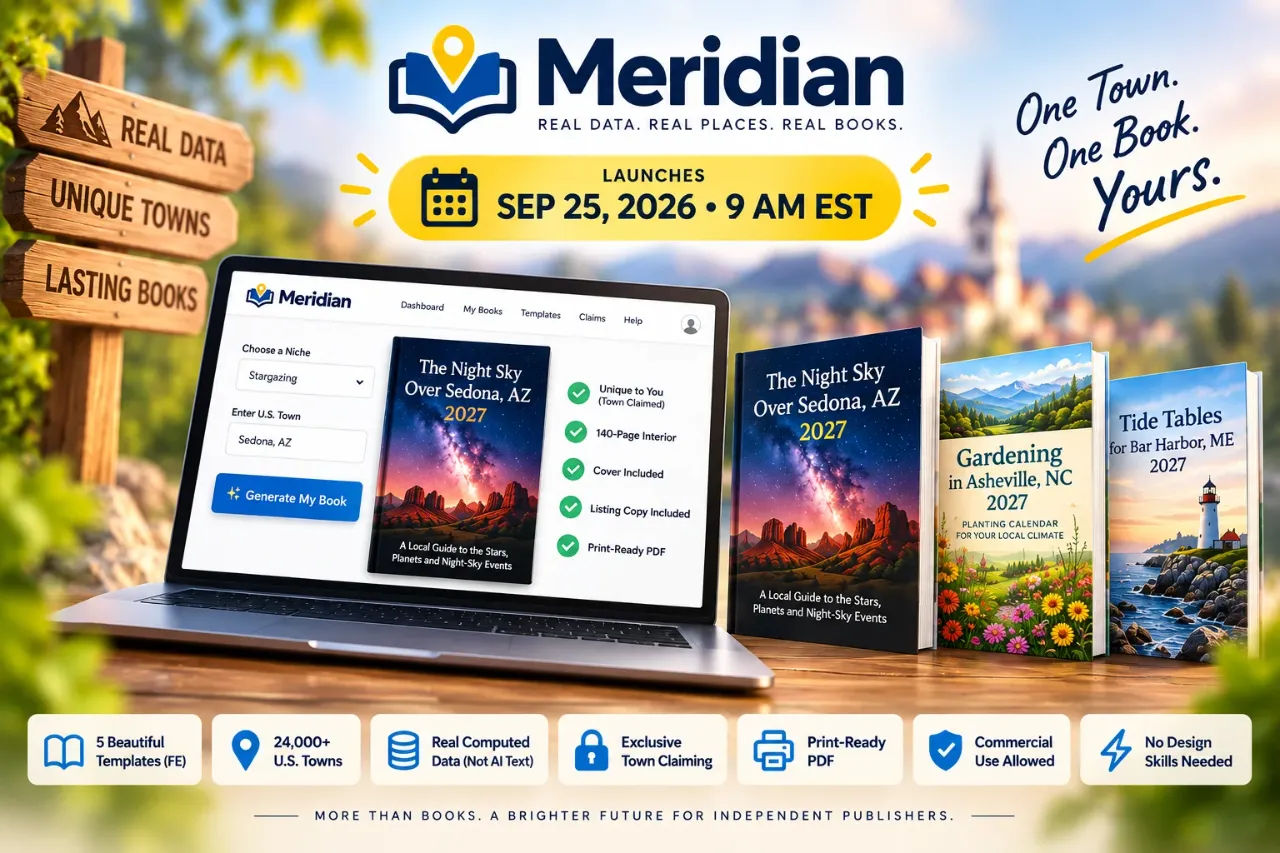
That is what pushed me to look at Meridian, which its builder describes as a data-book engine for KDP and printables publishers. The pitch is blunt: pick a niche, type any of 107,000+ towns across 14 countries, and roughly two minutes later you download a print-ready book computed for that exact place, with its cover and listing copy. The town gets claimed on their server, so no other Meridian user can publish it. First come, first served, enforced on their end rather than on the honour system.
I paid $17 during launch week and spent four evenings putting it through its paces. I made a night sky book for a town in Texas I have never visited, a planting calendar for a UK postcode area, and a prayer times timetable for a French city in both French and English, because that language-multiplier claim was the part I wanted to test hardest.
Our Verdict
Meridian
A genuinely different KDP tool: computed local data books with server-side town claiming, held back by a template library that partly sits behind an upgrade.
One-time payment. Check the live claims table before you buy, it needs no signup.
What You Actually Get For $17
The front end ships five templates. Night Sky, When To Plant, The Weather Year, Prayer Times, and Solunar Fishing. Everything on that list is computed from real data rather than written text, which matters more than it sounds like it should.
Coverage is 107,000+ towns in the United States, Canada, the United Kingdom, Ireland, Australia, New Zealand, Germany, Austria, Switzerland, France, Belgium, Spain, Italy and Mexico. Night Sky, Prayer Times and Solunar Fishing run in English, German, French, Spanish and Italian. The planting and weather books are US towns in English only.
Your purchase includes 25 town claims. Each claim is per template, per year, per language, so Edna, Texas as a night sky book is one claim, and the same town as a planting calendar is a second. A German Munich and an English Munich are two separate claims as well, which the sales page is upfront about.
Every download is a ZIP containing a print-ready 6x9 interior at 140 pages, a matching full-wrap cover personalised with your town and theme, listing copy with a title, subtitle, description and 7 backend keywords, and a printable certificate naming the town, the edition and you.
Key Features, And What They Do For You
Server-side claiming is the actual product
Everything else here is convenience. The claim is the moat. The engine tracks who generated which town for which template and year, and once it is yours, the next Meridian user sees it marked as taken. That is enforced on their server, not on a promise. If the business disappeared tomorrow your book would still exist and still be yours to sell, but the exclusivity window is only as durable as the platform.
Computed tables, not AI prose
Moon phases, moonrise and set times, frost dates pulled from NOAA freeze normals, climate figures from the NOAA 1991-2020 normals, tide highs and lows, and the five daily prayer times worked out from the sun's position. The builder frames this as the same class of content as a tide table, and from what I generated that holds up. There is no hallucinated sentence in the interior because there is no generated sentence in the interior at all.
Five languages with local conventions
The German edition renders München and Bayern, uses 24-hour times, comma decimals and Monday-first calendars, and letters the spine bottom-to-top the European way. The English edition says Munich and Bavaria. Southern hemisphere books draw the moon lit on the other side, which is a detail I would not have thought to check and would have shipped wrong.
Keepsake years back to 1940
You can generate any past year back to 1940. A 1994 book carries 1994's daylight-saving rules rather than today's, which is the kind of accuracy that survives an Amazon review from someone who actually remembers the date. I made a birth-year sky book for a friend's fortieth and it took under three minutes end to end.
Three interior themes and a dedication page
Same underlying numbers, visibly different book. The dedication page is a small thing that makes the gift angle work properly rather than looking like a print-on-demand afterthought.
Actually Using It
It is a web app. No install, no API keys, no terminal window. I logged in, picked Night Sky, typed a town name, and waited. The wait was under two minutes for the first one, and I did not time the rest precisely because I was tabbing away and coming back.
The output surprised me in one specific way. I expected a wall of numbers. What I got was a 140-page interior with chart pages drawn from the same figures: a daylight band across the year, a month of moon phases, a tide curve on the openers for the Tide Log template. Those pages are the ones worth photographing for a listing, and they are the reason a computed book does not read as a spreadsheet dump.
The listing copy came out honest in a way that I found slightly annoying at first and then appreciated. It promised only what the pages contain. No "discover the secrets of the cosmos," no padded subtitle. If you are used to writing your own copy you will want to edit it, and you should. Seven keywords is a starting point, not a strategy.
The cover is the weak link in the chain, and I want to be straight about why. It arrives as a full-wrap KDP-ready file personalised with the town and theme. It is competent. It is not going to win a browse-page beauty contest against a designer's $200 cover, and in the night sky category you are competing with covers that have had real money spent on them. For the local angle, "The Night Sky Over [Your Town]" does a lot of work on its own, so I think it survives, but I would not count on the default cover to carry a crowded niche by itself.
Then there is the template split, which is the thing I would want to know before buying. Five templates ship on the front end. Four more, the Tide Log & Fishing Journal, Golden Hour Planner, Hunting Solunar Almanac and Moon Gardening Calendar, sit in what the page calls the Template Vault, an upgrade. The Tide Log is the one I actually wanted, because the tide shelf has a 150-year purchase habit behind it. It is behind the upgrade. Whether that is a fair split depends on what you plan to publish, but it is not obvious from the headline, and it is the main reason my rating is not higher.
One town is not one book, and that took me a minute to internalise. The same town as a night sky almanac, a planting calendar, a weather year, a prayer timetable and a fishing calendar is five separate claims and five separate listings. So 25 claims is not 25 towns. Depending on how you spread them, it is somewhere between five and twenty-five books. That reframing is the useful part of the pitch, and it is accurate.
What I could not verify from my own use is whether the claim database is as clean as advertised, because I have no way to see other users' accounts. What I can say is that the public claims checker reads the live table without a signup, so you can look before you spend anything. I would do that first, and I would do it for the specific towns you have in mind rather than the category in general.
Your town might already be taken
The claims checker is public, so you can confirm availability before paying.
Pricing And Value Analysis
Meridian is $17 as a one-time payment during launch week, and the page states the price goes up after launch week ends. There is no subscription mentioned anywhere in the material I have. All sales are described as final, so treat this as a non-refundable purchase rather than something you can test-drive and return. The launch opened September 25 at 9:00 AM CT. I saw $27 and $67 appear in the page's pricing context and I am not going to pretend I know exactly what they attach to, so I am not going to guess.
Here is the comparison that actually matters to me, and it is not Meridian versus another tool. It is Meridian versus the two ways of getting a local data book without it.
| Route | Upfront cost | Time per book | Can someone else copy it? |
|---|---|---|---|
| Meridian, front end | $17 one-time, 25 claims | About two minutes per book | No, the town is claimed per template, year and language |
| Hand-computed almanac | Your time, and it is the expensive part | Weeks per book, per town | Yes, eventually, if anyone bothers |
| Blank journal or AI text template | Cheap or free | An afternoon | Yes, immediately, by thousands of sellers |
Twenty-five claims at $17 works out at 68 cents a claim. If one book sells at all, the maths stops being interesting. That is the honest case for it. The honest case against is that a claim you never publish is worth nothing, and if you buy this, generate three books and lose interest, you have spent $17 on three PDFs.
I would also flag the arithmetic on the upgrade. If the Vault templates are what you actually want, add that to your real cost before deciding, because the $17 headline is for the front-end five.
Pros And Cons
Pros
- Computed real data rather than generated text, so nothing in the interior can be a hallucination
- Server-side town claiming gives genuine exclusivity instead of an honour system
- Five languages with local names and conventions, not machine-translated English
- Keepsake years back to 1940 with period-correct daylight-saving rules
- Download includes interior, wrap cover, listing copy and a claim certificate
Cons
- Four of the nine advertised templates, including the Tide Log, sit behind an upgrade
- The default cover is competent, not competitive in design-heavy niches
- All sales final, so there is no refund window if it is not for you
- No way to verify how clean the claims database is until you are inside
- Listing copy needs editing before you publish it
Who This Is For
KDP publishers who are tired of competing on covers and ad spend, and who are willing to publish books built on tables rather than prose. People with a specific local angle in mind, a town, a region, a language market where the shelf is thin. Anyone who has looked at the tide and almanac shelves and noticed that every single one of those long-running titles covers a whole continent rather than one town. And anyone who wants a keepsake product for gifting, because the birth-year angle is the fastest thing here to make and the easiest to explain.
Who Should Skip It
If you publish fiction, courses, planners or anything that lives or dies on voice, this does nothing for you. If you want a tool that writes the book for you, Meridian does not write, it computes, and the interior has no words for you to sell on. If you are not willing to spend an evening on cover work, the default cover will cap how well a crowded niche performs. And if you need a refund window before you commit, this is not the purchase for you, because all sales are final.
Frequently Asked Questions
Is Meridian worth it?
For $17 with 25 claims, yes, if you already publish print books on KDP and want data products that cannot be cloned. The maths works at under 70 cents a claim. It is not worth it if you publish fiction or voice-driven content, or if you will not follow through and actually publish the books you generate.
Does Meridian have a refund policy?
The sales page states all sales are final. There is no refund window advertised on the page I checked, so treat the $17 as non-refundable at the point of purchase. Check the public claims table for your towns before you buy, since that is free and needs no signup.
What does Meridian cost?
Meridian is a one-time $17 during launch week, and the page says the price goes up after launch week ends. That price includes five templates, 25 town claims, and downloads in five languages where the template supports them. The four Template Vault products, including the Tide Log, are a separate upgrade.
Can other Meridian users copy my book?
No. Claims are enforced server-side, not on an honour system. Once you generate a town for a specific template, year and language, the next user sees it marked as taken. The exclusivity is per template, per year, per language, so one town can support several separate books.
What if I want the same town in two languages?
Those are two separate books and two separate claims. A German edition for München and an English edition for Munich serve different readers on different Amazon stores, so the engine treats them independently. Each language edition also gets its own local names, clock conventions and calendar layout.
What are the alternatives to Meridian?
You can hand-compute an almanac per town, which takes weeks per book and was the reason nobody made local editions in the first place. Or you can publish blank journals and AI-written interiors, which is the clone shelf, and compete on covers and ad spend against accounts with bigger budgets.
Do I need to install anything to use Meridian?
No. It runs as a web app in your browser, with no software, no API keys and nothing to configure. You log in, pick a template and a town, wait roughly two minutes, and download a ZIP with the interior, cover, listing copy and claim certificate.
If you want to see the current state of the claims table before committing, you can check it through Meridian's launch page without creating an account.
Final Verdict
Meridian solves a real problem and I do not think the problem is marketing invention. The clone shelf is exactly as described, and the reason local almanacs do not exist is that computing a year of astronomy for one town used to be weeks of manual work. Putting that behind a town claim is a legitimate edge, and the output I generated held up to inspection: real tables, correct local conventions, chart pages worth photographing.
My reservations are about scope and durability. The $17 gets you five templates and 25 claims, with four more templates, including the strongest one for the tide shelf, behind an upgrade that changes the real cost. The default cover will not save a crowded niche. And the exclusivity only exists for as long as Meridian is running, which is a bet you are making on someone else's server. All sales final means you make that bet before you can test anything.
At 68 cents per claim, the downside is small and the upside is a shelf position nobody can take from you. Check the towns you want while they are still open, because once they are claimed, that is the end of it.
Open towns do not stay open
Public claims table, no signup needed. $17 one-time during launch week.